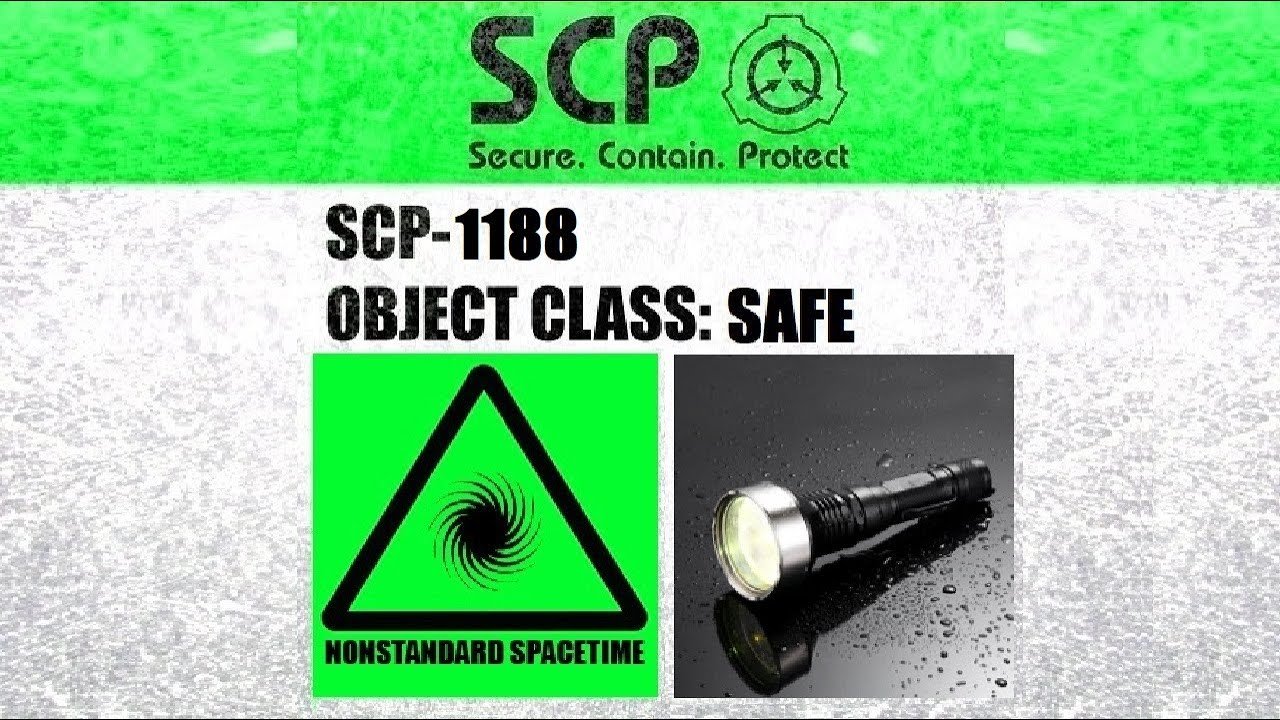
SCP-1188 is a Safe-class anomalous flashlight that temporarily displaces matter within a truncated cone of effect, creating instantaneous spatial relocation without traditional light emission. This object challenges fundamental physics by moving matter without energy transfer, while causing microscopic structural damage at displacement boundaries that raises critical containment and weaponization concerns.
The Physics of Instantaneous Displacement
SCP-1188 operates through a mechanism that fundamentally violates our understanding of mass-energy conservation and spatial continuity. When activated, the device projects an invisible cone of effect approximately 3 meters in length. Any matter within this cone doesn’t simply move—it ceases to exist in its original location and simultaneously reappears elsewhere, with zero transit time.
This isn’t teleportation in the science fiction sense. Traditional teleportation theories involve either quantum entanglement or wormhole-like connections that preserve causality. SCP-1188’s effect is more radical: matter simply occupies a different spatial coordinate without traversing the intervening space. The displaced volume appears to relocate to a parallel position offset from the original trajectory, though the exact destination mechanics remain under investigation.
The truncated cone geometry is particularly significant. Unlike a cylindrical beam, the cone expands as it extends from the bulb, meaning larger volumes of matter can be displaced at greater distances. This geometric property suggests the anomaly operates through field propagation rather than particle emission, similar to how gravitational effects diminish with distance but affect increasingly larger spherical shells.
What makes this truly anomalous is the absence of energy expenditure. Moving matter requires work in classical physics—force applied over distance. SCP-1188 accomplishes this with only the electrical energy needed to power a standard flashlight bulb, suggesting it’s tapping into an unknown energy source or exploiting a loophole in spacetime topology that allows “free” matter relocation.
Classification & Containment Engineering
SCP-1188 holds a Safe classification, not because it’s harmless, but because it’s predictable and easily contained. The Foundation’s classification system prioritizes containment difficulty over danger level. A nuclear warhead in a locked box is Safe; an unpredictable entity that phases through walls is Euclid or Keter.
Containment procedures are straightforward: the device is stored in a standard secure locker at Site-19, with access restricted to Level 2 personnel and above. The simplicity of these procedures reflects SCP-1188’s passive nature—it only activates when someone deliberately switches it on. There’s no risk of spontaneous activation, no memetic hazard from viewing it, and no indication it possesses sentience or autonomous behavior.
However, this Safe classification masks genuine danger. The Foundation maintains strict protocols around testing because the displacement effect can easily cause catastrophic structural damage to containment facilities. Shining SCP-1188 at a load-bearing wall, for instance, would temporarily remove that structural support, potentially triggering a collapse. The device is also kept away from other anomalous objects to prevent unpredictable interactions between spatial manipulation effects.
The Microscopic Damage Problem
The most insidious aspect of SCP-1188 isn’t what it does during activation—it’s what it leaves behind. Foundation materials scientists have discovered that every displacement event causes microscopic fracturing along the boundary between displaced and non-displaced matter. This “displacement scarring” occurs at the molecular level, creating stress concentrations that weaken material integrity.
Think of it like repeatedly folding a piece of paper. The first fold is clean, but each subsequent fold along the same line weakens the fibers until the paper tears. SCP-1188’s effect is similar but operates at atomic scales. When matter is instantaneously relocated, the bonds between molecules at the displacement boundary experience catastrophic shear stress. Some bonds break entirely; others stretch and deform.
This has profound implications for weaponization. A hostile entity could use SCP-1188 to weaken structural materials through repeated exposure without leaving visible damage. A concrete wall might appear intact but have compromised internal structure, ready to fail under stress. The Foundation has documented cases where materials exposed to 50+ displacement cycles showed 30-40% reduction in tensile strength despite no macroscopic changes.
The damage mechanism also explains why SCP-1188 cannot function as a “clean” excavation tool. Early testing proposed using it for archaeological work or precision material removal, but the edge scarring makes this impractical. Every “cut” made by SCP-1188 leaves a damaged zone several micrometers wide—acceptable for rough work but useless for applications requiring material integrity.
Research into displacement scarring has become a priority for Foundation materials science divisions. Understanding this phenomenon could provide insights into other spatial anomalies and potentially lead to countermeasures against teleportation-based threats.
Experimental Applications & Theoretical Limits
Foundation researchers have conducted extensive testing to map SCP-1188’s capabilities and limitations. The device can displace solid matter, liquids, and gases with equal effectiveness, though the visual effect varies dramatically. Displacing air creates a temporary vacuum that produces an audible “pop” as surrounding atmosphere rushes in. Displacing water creates a momentary cavity before hydrostatic pressure forces the liquid back.
The maximum displacement depth appears to be approximately 3 meters, after which the effect dissipates. This range limitation suggests the anomalous field weakens with distance, similar to how electromagnetic fields decay. Attempts to amplify the effect through modified power sources or lens systems have failed, indicating the 3-meter limit is intrinsic to the anomaly rather than an engineering constraint.
One of the most fascinating test results involves reflective surfaces. When SCP-1188 is aimed at a mirror, the displacement effect still occurs in the direction of the actual device, not the reflected image. This confirms the anomaly operates through a real physical field rather than following light-path geometry. The device “knows” where it’s actually pointing regardless of optical illusions.
Living tissue displacement raises ethical and practical concerns. Limited testing on D-class personnel (under Ethics Committee oversight) revealed that displacing flesh causes severe trauma. The microscopic damage effect is amplified in biological systems because living cells have complex internal structures that are catastrophically disrupted by displacement scarring. Subjects reported intense pain and showed tissue necrosis at displacement boundaries. This effectively rules out medical applications and confirms SCP-1188 would function as a devastating weapon against living targets.
The “shining it at itself” paradox has been tested. When SCP-1188’s beam intersects its own housing, the device displaces itself, creating a brief recursive loop before the beam angle changes and the effect terminates. This suggests the anomaly doesn’t discriminate between “self” and “other” matter—it simply displaces whatever falls within the cone of effect.
Cross-Reference: Related Spatial Anomalies
SCP-1188 occupies a unique position in the Foundation’s catalog of spatial manipulation anomalies. Unlike portal-based objects such as SCP-106’s pocket dimension or SCP-860’s forest door, SCP-1188 doesn’t create persistent connections between locations. The displacement is temporary and reversible—matter returns to its original position when the device deactivates.
This distinguishes it from true teleportation anomalies like SCP-507, whose dimensional shifts involve actual transit through alternate realities. SCP-1188’s effect is more akin to a “spatial loan”—matter is borrowed from one location and returned after use, with interest paid in the form of microscopic damage.
The closest analog might be SCP-184, which expands spatial dimensions within enclosed areas, though that object creates permanent changes rather than temporary displacement. Another comparison point is SCP-2935, which demonstrates that spatial manipulation can have catastrophic consequences when applied at large scales—a sobering reminder of why SCP-1188’s 3-meter range limit is fortunate.
Foundation theorists have proposed that SCP-1188 might be accessing the same underlying spatial framework that enables other teleportation anomalies, but through a different mechanism. If this hypothesis is correct, studying SCP-1188 could provide insights into the fundamental nature of space itself and how anomalous objects exploit its properties.
Frequently Asked Questions
What happens if you shine SCP-1188 at a person?
Shining SCP-1188 at living tissue causes severe trauma due to microscopic damage at cellular boundaries. The displacement effect disrupts cell membranes, organelles, and vascular structures, leading to immediate tissue necrosis and intense pain. The Foundation classifies this as a potential weapon effect and restricts testing on living subjects to extreme circumstances with Ethics Committee approval.
Can SCP-1188 displace other anomalous objects?
Yes, SCP-1188 can displace anomalous objects within its cone of effect, but interactions vary depending on the target anomaly’s properties. Objects with spatial anchoring effects may resist displacement, while reality-bending entities might produce unpredictable results. The Foundation maintains strict protocols preventing SCP-1188 from being used near high-risk anomalies to avoid containment breaches.
Does SCP-1188 actually produce light like a normal flashlight?
No. Despite its appearance as a flashlight, SCP-1188 does not emit visible light when activated. The displacement effect is invisible to the naked eye, though high-speed cameras can capture the momentary absence of matter within the cone of effect. This makes the device particularly dangerous because users cannot visually confirm where the beam is pointing.
What is the maximum weight or volume SCP-1188 can displace?
The limiting factor is geometric rather than mass-based. SCP-1188 can displace any matter within its truncated cone of effect, regardless of density or weight. At maximum range (3 meters), the cone’s cross-sectional area is approximately 0.8 square meters, meaning it could theoretically displace several tons of material if aimed at something sufficiently dense like lead or gold.
Why is SCP-1188 classified as Safe if it’s so dangerous?
The Safe classification reflects containment difficulty, not danger level. SCP-1188 is Safe because it’s completely inert when not activated, requires deliberate human action to function, and can be stored in a simple locked container. Many Safe-class objects are extremely dangerous when used—the classification simply means they won’t escape containment or activate spontaneously.