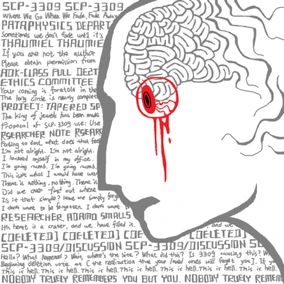
SCP-3309 is a Keter-class phenomenon that causes catalogued anomalies to spontaneously vanish from existence 24-36 hours after a mysterious deletion notice appears in their files. Unlike typical SCPs, this meta-narrative threat doesn’t just neutralize objects—it erases them from all databases, memories, and eventually removes Foundation personnel themselves, raising profound questions about the nature of existence within narrative layers.
The Phenomenon: What SCP-3309 Actually Does
At its core, SCP-3309 represents an existential threat unlike any conventional anomaly. When it targets a catalogued item, the process follows a chilling pattern: a note of unknown origin (designated SCP-3309-1) materializes at the end of the anomaly’s documentation. This note reads exactly like a Wiki deletion notice: “If you are not the author and you want to rewrite this article, you may reply to this post asking for the opportunity to do so.”
Within 24 to 36 hours of this notice appearing, the affected anomaly undergoes complete erasure. Documents vanish from all Foundation file systems—including the supposedly impregnable Protected Site-01 and RAISA Archives. But the deletion doesn’t stop at paperwork. The anomaly itself becomes neutralized or simply ceases to exist, as if reality itself has performed a backspace operation.
The scope of SCP-3309’s influence extends beyond individual items. Approximately 71% of disappearing documents connect to other unaffected anomalies, creating cascading failures in the Foundation’s containment network. This interconnected vulnerability threatens an ADK-Class “Complete Anomalous Destabilization” Scenario—a domino effect that could unravel the entire system of anomalous containment.
Foundation researchers initially struggled to identify any causal relationship between affected anomalies. They ranged from objects to entities, locations to conceptual structures. The randomness itself became a source of dread until patterns finally emerged from the chaos.
Project TAPERED SPEAR: When Containment Becomes Weaponization
The turning point came when SCP-3309’s research team identified three consistent criteria among deleted anomalies. This discovery led to one of the most controversial proposals in Foundation history: Project TAPERED SPEAR.
The criteria were disturbingly specific. Affected anomalies typically featured excessive containment procedures—titanium alloy chambers for objects that didn’t require them, suggesting either fundamental misunderstanding or careless documentation. Many were documented as K-Class threats, yet their files only outlined partial consequences with provisional procedures that seemed inadequate. Most damningly, the documentation itself was poorly written, improperly formatted, or riddled with logical and grammatical errors.
The containment team’s proposal was audacious: weaponize SCP-3309 against high-risk anomalies by deliberately introducing these criteria into their documentation. Essentially, they wanted to trick reality into deleting threats the Foundation couldn’t otherwise contain.
This directly contradicted the Foundation’s core mission. The organization exists to secure, contain, and protect—not to destroy. The Ethics Committee convened a special tribunal to debate whether the ends justified these means.
The vote was razor-thin: 21 for, 20 against, 2 abstentions. TAPERED SPEAR received authorization, and SCP-3309 was reclassified from Keter to Thaumiel—a designation reserved for anomalies the Foundation uses to contain other anomalies.
The first test case, SCP-4463, demonstrated the system’s terrifying effectiveness. This water-based spatial anomaly was transforming Arizona’s Chihuahuan Desert into wetlands, threatening to flood North America within 50 years. Researchers deliberately corrupted its documentation with grammatical errors, inconsistencies, and an unrelated image of an ocean wave. Within 28 hours, SCP-4463 vanished from all databases, and the affected area reverted to desert.
Nineteen anomalies followed in initial testing. Then 49 more in post-reclassification research. Each deletion was a calculated execution disguised as quality control.
The Researcher Smalls Incident: A Cautionary Tale
Researcher Adamo Smalls was a memeticist assigned to SCP-3309 from its initial discovery. His final notes, preserved in the file’s third addendum, chronicle a descent into existential horror that validates every fear about TAPERED SPEAR.
Smalls wrote about seeing his first white hair—or an entire patch—after just one round of testing. He described feeling numb, fading to dust, experiencing something that wasn’t illness but erasure. Locked in his office, he questioned whether the neutralized anomalies truly disappeared without consequence. “Did we ever find out where those neutralized anomalies went?” he wrote. “Surely it can’t be so straightforward, to do what we did—to see justice without repercussions.”
His final message contained a desperate realization: “Is it that simple? Have we simply forgotten? I don’t want to be forgotten.”
Then Researcher Smalls ceased to exist.
Dr. Robert Woods and Researcher John Calzaroli’s email exchange captures the horror in real-time. Calzaroli noticed Smalls missing from itineraries, his name expunged from project files. Woods insisted no “Researcher Smalls” had ever worked on the project. Calzaroli pushed back—Smalls was “the most exceptional memeticist we have.”
The exchange ends with deleted accounts and deleted messages. The implication is inescapable: SCP-3309 doesn’t just erase anomalies. It erases people. And when it does, it retroactively removes them from memory, from records, from existence itself. Only fragments remain—glitches in the deletion process that allow brief moments of recognition before the void closes completely.
Breaking the Fourth Wall: The Meta-Narrative Layer
SCP-3309 operates on multiple narrative levels simultaneously, making it one of the most sophisticated pataphysical anomalies in Foundation documentation. The genius of Lt Flops and PhamtomGuy’s creation lies in how it mirrors the actual SCP Wiki’s deletion process for low-quality articles.
On the real Wiki, poorly written SCPs receive deletion notices that look identical to SCP-3309-1. Authors are given opportunities to improve their work or allow rewrites. If the article fails to meet quality standards, it’s removed from the database. SCP-3309 transforms this administrative process into cosmic horror by asking: what if deletion notices had ontological weight? What if removing a story from a database actually erased it from reality?
This creates a recursive nightmare. Within the SCP universe, the Foundation believes it’s weaponizing a phenomenon to neutralize threats. From our perspective as readers, we understand that SCP-3309 represents the Wiki’s quality control mechanisms achieving sentience and autonomy. The “poorly written” anomalies aren’t just bad documentation—they’re narratively weak, vulnerable to erasure because they lack the coherence and reader engagement that sustains fictional existence.
The article’s opening poem—”Sometimes, we don’t fade until it’s too late”—takes on dual meaning. It describes both in-universe erasure and the creative death of abandoned or rejected stories. Authors pour memories, hopes, and dreams into their work. When that work is deleted, a piece of the creator fades with it.
SCP-3309 exists in conversation with other meta-narrative threats like SCP-2747 (a phenomenon that destroys narratives from within) and SCP-5309 (its numerical successor, exploring similar themes). Together, these anomalies form the Foundation’s pataphysics canon—stories about stories, examining the relationship between fiction and reality, creator and creation.
The Ethics Committee vote becomes even more disturbing through this lens. The Foundation isn’t just deciding whether to weaponize deletion—it’s deciding whether to actively participate in narrative destruction. The 21-20 vote suggests deep institutional ambivalence about playing god with existence itself, even fictional existence.
The Criteria of Deletion: What Makes an Anomaly Vulnerable?
Understanding SCP-3309’s targeting criteria reveals both in-universe logic and meta-commentary on creative writing quality.
Excessive Containment Procedures represent a common mistake in amateur SCP writing: confusing “bigger” with “better.” New authors often describe elaborate titanium chambers, complex security protocols, and military-grade containment for anomalies that don’t require them. This suggests the writer doesn’t fully understand their own creation. In-universe, it indicates Foundation personnel misunderstanding the anomaly’s nature—a conceptual weakness that makes the item vulnerable to narrative collapse.
Poorly Documented K-Class Threats highlight another writing pitfall: claiming world-ending stakes without properly developing consequences. An anomaly that can supposedly trigger an apocalypse but only has “provisional” containment procedures lacks internal consistency. The threat doesn’t feel real because the documentation doesn’t treat it seriously. This narrative weakness becomes literal weakness against SCP-3309.
Low-Quality Writing and Formatting Errors is the most direct criterion. Grammatical mistakes, logical inconsistencies, and improper formatting signal that an article hasn’t received adequate attention or revision. On the Wiki, these are grounds for deletion. In SCP-3309’s universe, they’re existential vulnerabilities—cracks in the narrative structure through which anomalies can be erased.
The brilliance of these criteria is how they function simultaneously as in-universe scientific observation and out-of-universe writing advice. SCP-3309 essentially says: “Bad writing makes your SCP vulnerable to deletion,” which is literally true on the Wiki and metaphorically true within the Foundation’s reality.
Thematic FAQ
Is SCP-3309 Thaumiel or Keter class?
SCP-3309 holds dual classification. Initially designated Keter due to its unpredictable threat to anomalous containment, it was reclassified as Thaumiel after the Ethics Committee authorized Project TAPERED SPEAR. This makes it one of the few anomalies to transition from threat to tool, though the article suggests this reclassification may have been premature given the Researcher Smalls incident.
What happened to Researcher Smalls?
Researcher Adamo Smalls was erased by SCP-3309 after working extensively with the phenomenon. His deletion followed the same pattern as affected anomalies: he vanished from records, and colleagues lost all memory of his existence except for brief moments of recognition before complete erasure. His case proves that SCP-3309 can target personnel, not just catalogued anomalies.
How does SCP-3309 relate to article deletion on the Wiki?
SCP-3309 is a meta-narrative that transforms the Wiki’s real deletion process into an in-universe anomaly. The deletion notice (SCP-3309-1) uses identical language to actual Wiki deletion notices. The criteria for vulnerability mirror reasons articles get removed: poor quality, inconsistent lore, and inadequate development. This creates a recursive horror where bad writing literally threatens existence.
Can SCP-3309 delete people?
Yes. While initially believed to only affect catalogued anomalies, the Researcher Smalls incident demonstrates that SCP-3309 can erase Foundation personnel. The mechanism appears similar: individuals connected to affected anomalies or the deletion process itself become vulnerable, especially if their documentation (personnel files, project records) exhibits the same weaknesses as deletable anomalies.
What is a narrativohazard?
A narrativohazard is a cascading hazard affecting elements of a narrative and its mode of transmission, often leading to mutual destruction. In the SCP universe, narrativohazards threaten the coherence of stories themselves. SCP-3309 functions as a narrativohazard because it doesn’t just affect objects within the story—it affects the story’s ability to exist, propagating through documentation and memory until nothing remains.
SCP-3309 stands as one of the Foundation’s most philosophically complex anomalies, forcing readers to confront uncomfortable questions about existence, memory, and the power of narrative. Its horror derives not from tentacles or reality-bending, but from the quiet terror of being forgotten—of fading away until there’s nothing left to prove you were ever there at all. In weaponizing deletion, the Foundation may have won battles against dangerous anomalies, but Researcher Smalls paid the price for humanity’s hubris in thinking we could control erasure itself.