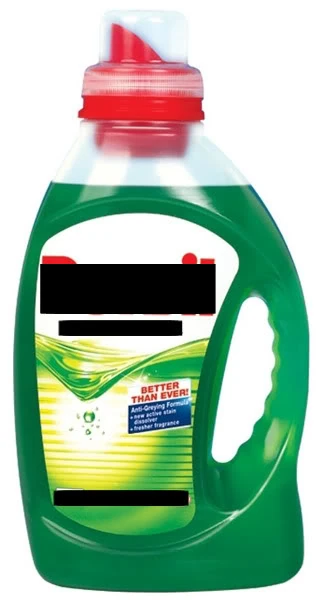
SCP-325 is a seemingly ordinary bottle of UK-brand washing detergent that induces progressive, fatal mysophobia in anyone who wears clothing washed with it. Classified as Safe due to containment simplicity, this anomaly transforms victims through five escalating stages—from heightened hygiene awareness to self-mutilation and a catastrophic Level 5 event that has killed dozens. The Foundation exploits Level 4 subjects’ blood as a perfect decontaminant, raising profound ethical questions about weaponizing human suffering.
The Mundane Disguise: What SCP-325 Appears to Be
At first glance, SCP-325 is indistinguishable from any household cleaning product you’d find under a British kitchen sink. It’s a “Value pack” bottle containing 1,775 milliliters of concentrated green liquid, chemically identical to the ████████ company’s “Naturals” range. The label features a product name—”█████ █████ █████!”—that doesn’t match any official ████████ catalog, yet the formulation is authentic enough to pass laboratory analysis.
This is precisely what makes SCP-325 so insidious. Unlike reality-bending artifacts or sentient entities, it requires no special containment beyond a waterproofed steel box and distance from laundry facilities. The Foundation classifies it as Safe not because it’s harmless—far from it—but because its danger is entirely contingent on use. A nuclear warhead sitting in a bunker is “safe” by the same logic: catastrophic potential, zero autonomous threat.
The detergent performs exactly as advertised, producing what test subjects describe as exceptionally clean laundry. Lab analysis reveals no physical difference between garments washed in SCP-325 versus commercial brands, yet victims consistently prefer SCP-325-treated clothing. This preference isn’t aesthetic—it’s the first symptom of memetic contamination, a cognitive trap disguised as consumer satisfaction. The anomaly doesn’t alter fabric; it alters perception, then psychology, then biology itself.
The Five Stages of Contamination: A Psychological Descent
SCP-325’s progression follows a predictable timeline measured in cumulative hours of exposure—time spent actually wearing contaminated garments. Understanding this escalation is critical to recognizing containment breaches before they become lethal.
Level 1 (1-24 hours) manifests as heightened hygiene consciousness. Victims wash their hands more frequently, comment on others’ cleanliness, and exhibit mild germaphobic tendencies. In isolation, these behaviors mimic ordinary anxiety responses or cultural norms around cleanliness. Foundation personnel near SCP-325 storage are monitored for these subtle shifts, as they often precede accidental exposure.
Level 2 (24-96 hours) marks the transition from quirk to pathology. Subjects develop clinical mysophobia—an irrational, pervasive fear of contamination. They begin hoarding cleaning supplies and canned goods, preparing for self-imposed quarantine. Interviews reveal a consistent delusion: the outside world has become “unclean” in a fundamental, almost metaphysical sense. This isn’t germaphobia as psychiatrists typically understand it; victims describe contamination as a moral or existential threat, not merely a health risk.
Level 3 (96-240 hours) sees complete social withdrawal. Subjects barricade themselves indoors, destroying any object they cannot sterilize to their satisfaction. Crucially, they reject all clothing except garments washed in SCP-325, creating a dependency loop that accelerates exposure. Many incinerate their possessions, suggesting the contamination delusion has expanded to include inanimate objects as vectors of corruption. The psychological mechanism here resembles severe OCD, but with an external memetic trigger rather than endogenous neurochemistry.
Level 4 (240-480 hours) introduces the anomaly’s most disturbing—and useful—property. Subjects begin self-harm, cutting themselves to harvest blood as a cleaning agent. Approximately 80% use blood alone; others mix it with bleach or other chemicals. Foundation testing confirms this blood achieves 100% decontamination efficacy against all known pathogens, chemical residues, and even certain anomalous substances. The bloodstream contains [DATA EXPUNGED] compounds that defy conventional analysis, suggesting SCP-325 doesn’t just alter behavior—it fundamentally rewrites human biochemistry.
Most victims (70%) die of exsanguination or exhaustion before reaching Level 5, making Level 4 the “stable” exploitation phase for Foundation purposes.
Level 5 (480+ hours) is heavily redacted, but the documented outcome speaks volumes: ██ civilian deaths and █ Foundation casualties in a single incident. The warning label on SCP-325 explicitly describes this event, implying the manufacturer knew exactly what would happen. Whatever occurs at 480 hours isn’t just individually lethal—it’s contagious, catastrophic, and rapid enough to overwhelm trained containment teams.
The Blood That Cleans Everything: Level 4’s Horrifying Utility
The Foundation’s relationship with SCP-325 embodies its core philosophical tension: containing the anomalous versus exploiting it. Level 4 subjects produce what is effectively a universal solvent for contamination—biological, chemical, and anomalous. Cross-testing with products from other SCPs has yielded “promising results for cleanup after containment breaches,” according to official documentation.
Consider the implications. A Keter-class entity breaches containment, leaving behind residues that standard hazmat protocols can’t neutralize. Instead of risking additional personnel or deploying expensive experimental countermeasures, the Foundation could theoretically use blood harvested from SCP-325 victims. The ethical calculus is brutal: sacrifice Class-D personnel (already slated for termination) to save researchers, or allow a contamination event to spread.
This raises uncomfortable questions about consent and utility. Class-D personnel are typically death row inmates or other “expendable” individuals, but SCP-325 doesn’t kill quickly—it drives victims into obsessive self-mutilation over weeks. The psychological torment preceding exsanguination arguably constitutes torture, even if the end result serves containment objectives. Some researchers have proposed synthesizing the anomalous blood compounds, but the [DATA EXPUNGED] analysis results suggest the transformation is too complex to replicate artificially.
The blood’s mechanism remains unexplained. Does SCP-325 introduce a pathogen that hijacks hematopoiesis? Is it a memetic effect that convinces reality itself the blood is a perfect cleanser? The fact that it works on anomalous contaminants—substances that violate known physics—suggests the latter. SCP-325 may be rewriting localized consensus reality, using human blood as a medium for imposing “cleanliness” as an absolute ontological state.
The Warning Label Nobody Reads: What Happens at Level 5
The redacted Level 5 event killed multiple Foundation staff and civilians, despite occurring in a controlled environment. The warning label on SCP-325—a consumer product warning—describes this exact scenario, which means whoever manufactured this detergent anticipated mass casualties and printed instructions anyway.
The 480-hour threshold appears to be a hard limit, not a gradual transition. Subjects don’t slowly worsen from Level 4 to Level 5; they undergo a sudden, catastrophic transformation. The pattern of casualties suggests the effect isn’t localized to the victim. Foundation personnel wearing NBC suits—designed to protect against nuclear, biological, and chemical hazards—were among the dead, implying Level 5 bypasses physical barriers.
Speculation within the research community centers on two theories. First, the “contagion model”: Level 5 subjects become vectors for SCP-325’s memetic effect, spreading contamination through proximity or perception. Anyone who sees, hears, or interacts with a Level 5 victim becomes exposed, creating a cascading failure. Second, the “reality collapse model”: the victim’s obsession with cleanliness reaches such intensity that it manifests physically, perhaps erasing “unclean” matter (including people) from existence within a radius.
The civilian casualties suggest at least one instance of SCP-325 escaped Foundation custody and reached Level 5 in a populated area. Current containment protocols authorize lethal force against confirmed Level 3+ exposures in the field, a rare departure from standard capture-and-contain doctrine. The Foundation would rather eliminate potential Level 5 events than risk another mass casualty incident.
The ████████ Company Connection: Corporate Conspiracy or Coincidence?
The most unsettling aspect of SCP-325 isn’t its effects—it’s the origin. The ████████ company, a legitimate UK detergent manufacturer, has no record of producing the “█████ █████ █████!” product line. Yet chemical analysis confirms the formula matches their proprietary “Naturals” range exactly. The documentation notes the company “has the facility to do so if the [REDACTED] is added into their manufacture process.”
This phrasing implies SCP-325 isn’t a naturally occurring anomaly or an artifact from another dimension—it’s an industrial product. Someone with access to ████████’s manufacturing infrastructure added an anomalous component to an otherwise normal detergent formula. The warning label’s accuracy suggests this wasn’t an accident; whoever created SCP-325 understood its effects well enough to document the Level 5 event before it happened.
Agent █████████, embedded as a ████████ employee, monitors for any signs of renewed production. The standing order—”stay silent unless production of SCP-325 is found to exist”—indicates the Foundation suspects an insider threat or rogue element within the company. This wouldn’t be unprecedented; several SCPs have corporate origins, from biological weapons programs to experimental consumer products with unintended side effects.
The alternative is somehow more disturbing: SCP-325 could be a proof-of-concept, a demonstration that anomalous effects can be mass-produced and distributed through normal commercial channels. If the [REDACTED] component can be synthesized at scale, any detergent factory becomes a potential SCP production facility. The Foundation’s containment strategy—incinerating all instances found outside custody—suggests they’re treating this as an existential threat to normalcy itself.
Frequently Asked Questions About SCP-325
Can you wash SCP-325 out of clothing?
No. Once fabric has been treated with SCP-325, the memetic contamination is permanent. The anomaly doesn’t leave a chemical residue that can be removed through additional washing—it alters the garment’s conceptual relationship to cleanliness. Contaminated clothing must be incinerated according to standard Foundation protocols. Attempting to “clean” SCP-325-treated items with normal detergent only wastes resources and risks spreading contamination if the clothing is worn again.
Why do people prefer clothes washed in SCP-325?
Victims report SCP-325-washed garments feel “cleaner” despite laboratory tests showing no physical difference from normally washed clothing. This is the anomaly’s initial memetic hook—a subtle cognitive bias that encourages continued exposure. The preference isn’t based on texture, scent, or appearance; it’s a low-level compulsion that bypasses rational evaluation. By the time subjects realize something is wrong, they’re already exhibiting Level 2 mysophobia.
How does the Foundation dispose of SCP-325 instances?
All recovered instances are incinerated after testing at the nearest Foundation Site. The incineration process follows standard protocols for biological hazards, with used desiccant (employed to contain spills) also destroyed by fire. The emphasis on incineration rather than chemical neutralization suggests SCP-325’s anomalous properties persist even after the liquid is diluted or degraded. Complete molecular breakdown through combustion is the only guaranteed method of neutralization.
What makes SCP-325 different from other memetic hazards?
Most memetic SCPs spread through information—seeing a symbol, hearing a phrase, or understanding a concept. SCP-325 requires physical contact with contaminated fabric, making it slower to spread but harder to detect. The progressive nature of exposure also distinguishes it from instant-effect memetics. Victims have days or weeks to seek help before reaching lethal stages, yet the compulsion to continue wearing treated clothing overrides self-preservation instincts. This combination of physical vector and psychological compulsion makes SCP-325 uniquely insidious among Safe-class anomalies.
Is there a cure for SCP-325 exposure?
The documentation doesn’t mention successful treatment, only containment and termination protocols. Level 1 exposure might be reversible through immediate cessation of contact and psychiatric intervention, but no formal decontamination procedure exists. The fact that Foundation personnel showing increased hygiene awareness are detained and given new overalls for 24 hours suggests early-stage exposure can be interrupted, though whether this constitutes a “cure” or merely delays progression is unclear. Once subjects reach Level 3, termination is considered more humane than attempting reversal.