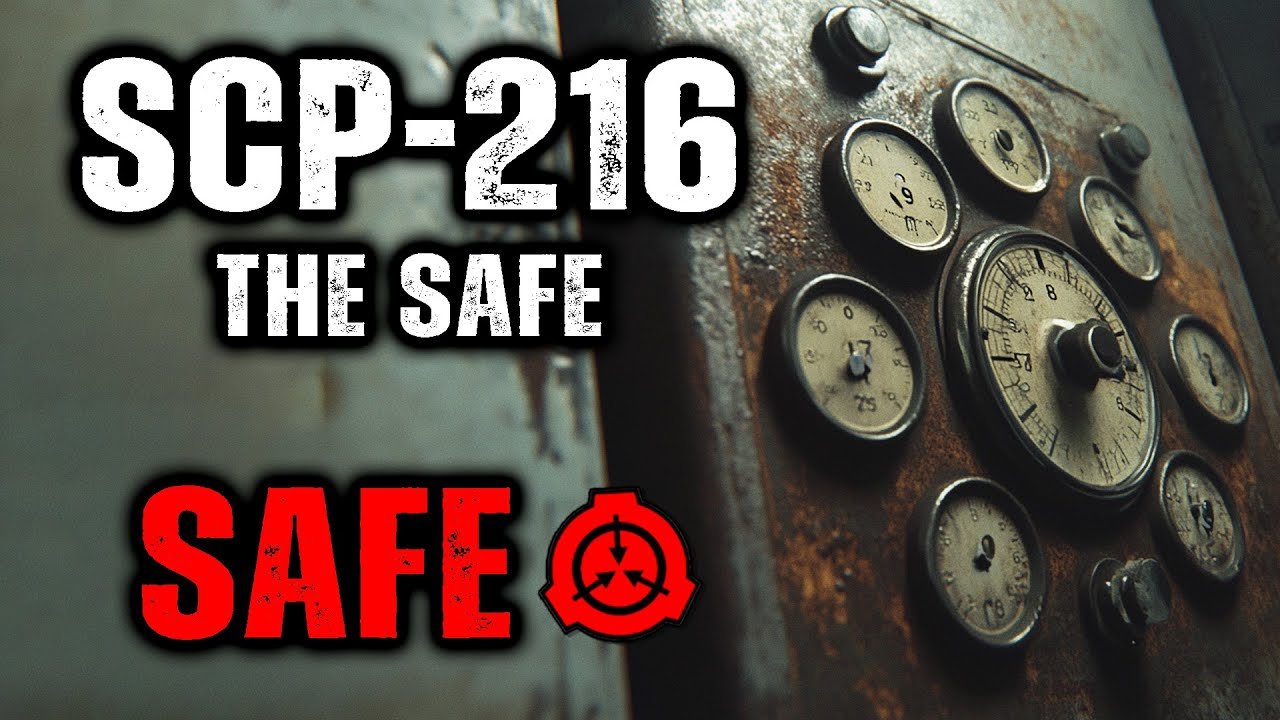
SCP-216 is a 35.6 cm (14-inch) iron safe equipped with a seven-dial combination lock, each dial numbered 0 through 9. This seemingly ordinary object is anything but—each of its 10 million possible combinations opens a doorway to a completely different interior space, defying conventional physics and transforming a small metal box into a gateway to countless pocket dimensions.
The Discovery and Acquisition History
The Foundation acquired SCP-216 under circumstances that remain partially redacted in official documentation, though field reports suggest it was recovered from an estate sale in ████████, Massachusetts in 19██. The safe’s anomalous properties were discovered when the original purchaser—a local antiques dealer—reported “impossible” interior dimensions to authorities, claiming the safe’s contents changed each time he opened it with different combinations.
Foundation agents embedded in local law enforcement intercepted the report and secured the object within 48 hours. The dealer was administered Class-B amnestics and given a non-anomalous replacement safe. Initial testing confirmed the dimensional anomaly within the first week of containment, leading to its classification as SCP-216 and assignment to Site-██’s Low-Risk Anomalous Objects wing.
What makes SCP-216’s discovery particularly significant is its mundane appearance. Unlike reality-bending artifacts that announce themselves through obvious supernatural characteristics, SCP-216 operated undetected for an unknown period—possibly decades or centuries—before its properties were formally documented. This raises unsettling questions about how many similar objects exist in circulation, their anomalous nature hidden by statistical improbability or simple lack of systematic testing.
The Mechanics of the Seven-Dial System
The mathematical reality of SCP-216 is staggering. Seven dials, each with ten positions (0-9), create exactly 10,000,000 unique combinations. In non-anomalous safes, these combinations serve as security permutations for a single lock mechanism. In SCP-216, each combination functions as a coordinate system for accessing discrete pocket dimensions.
Think of it this way: if traditional three-dimensional space uses X, Y, and Z coordinates to locate a point, SCP-216’s seven-dial system operates as a seven-dimensional addressing protocol. Each number sequence doesn’t unlock a door—it selects which door exists at that moment. The safe itself acts as a dimensional anchor point, a fixed location in baseline reality that serves as an access terminal to millions of separate spatial pockets.
The physics involved suggest non-Euclidean geometry at work. The interior spaces accessed through SCP-216 don’t exist “inside” the safe in any conventional sense. Instead, the safe’s door functions as a controlled Einstein-Rosen bridge, with the combination lock serving as the targeting mechanism. When you turn the dials to 0000001, you’re not opening a lock—you’re calibrating a wormhole.
What’s particularly fascinating is the consistency. The same combination always accesses the same interior space. Combination 0000001 will always reveal the same small chamber. Combination 5847392 will always open to the same environment. This reproducibility suggests the pocket dimensions aren’t being created on-demand but rather exist permanently, with SCP-216 serving merely as a stable access point.
Documented Interior Spaces: A Catalog of Realities
Foundation researchers have systematically tested thousands of combinations, documenting the bewildering variety of spaces contained within SCP-216. The interiors range from mundane to utterly alien, with no apparent pattern governing their distribution.
Combination 0000001 opens to a small, empty chamber approximately 1 cubic meter in volume. The walls appear to be smooth concrete, and the space contains nothing but stale air. This was the first interior space officially documented and serves as the baseline for comparison.
Combination 0000347 reveals a Victorian-era study, complete with period-appropriate furniture, oil lamps, and a collection of leather-bound books. The books are written in English but contain no coherent text—pages are filled with grammatically correct sentences that convey no actual meaning, as if generated by someone who understood syntax but not semantics. No exit other than the safe door exists. The room shows no signs of decay despite its apparent age.
Combination 0028451 accesses what researchers initially believed was an outdoor environment—a grassy field under an overcast sky. Extended observation revealed the “sky” is actually a curved ceiling approximately 50 meters overhead, painted or projected with remarkable realism. The grass is real, as are the insects inhabiting the space, but the entire environment exists within a finite (though large) enclosed area. The ecological system appears self-sustaining.
Combination 1847392 opens to a space that violates human perception. Personnel who entered reported severe spatial disorientation, describing the interior as “simultaneously too large and too small.” Video footage shows a room with impossible geometry—walls that appear to recede infinitely while remaining visibly close, corners that exist in more than three dimensions. Two researchers required psychological counseling after exposure. This combination is now restricted to remote observation only.
Combination 9999999 (the highest possible combination) reveals an interior identical to the exterior of SCP-216 itself—a small iron safe sitting in an empty room. Attempts to open this interior safe have been unsuccessful, as it lacks any visible lock mechanism. Whether this represents a recursive loop, a symbolic endpoint, or something else entirely remains under investigation.
Patterns have emerged from systematic testing. Lower-numbered combinations tend to produce smaller, simpler spaces. Mid-range combinations show greater variety and complexity. Higher combinations increasingly feature abstract or geometrically impossible environments. However, these are statistical trends, not absolute rules—exceptions exist throughout the numerical range.
The Recursive Camera Experiment
One of the most philosophically troubling experiments conducted with SCP-216 involved placing a video camera inside the safe (using combination 0000001, the simple empty chamber) and then immediately reopening the safe using the same combination.
The camera recorded its own placement, the closing of the safe door, and then—impossibly—the door opening again from the interior perspective. The footage shows a researcher’s hand reaching in to retrieve the camera, which is exactly what happened from the external perspective. But here’s the paradox: the camera was recording continuously. It documented the safe being closed and reopened without any temporal gap, yet from the external perspective, several minutes elapsed while researchers reset the combination and reopened the door.
This suggests that time within SCP-216’s pocket dimensions operates independently from baseline reality, or that the act of closing the safe door “freezes” the interior space in a temporal stasis until the correct combination reactivates it. The implications are profound: objects placed inside SCP-216 may experience no time passage whatsoever between closings and openings, regardless of external duration.
Further experiments revealed even stranger properties. When two cameras were placed in different interior spaces (combinations 0000001 and 0000002) and both safes were “closed” simultaneously (by resetting the dials), neither camera recorded anything during the closure period. The footage shows continuous recording up to the moment of door closure, then immediate resumption upon reopening—but the timestamps reveal hours of missing recording time that the cameras themselves didn’t experience.
This has led to the “Frozen State Hypothesis”: that SCP-216’s interior dimensions exist in a state of temporal suspension when not actively accessed through the correct combination. The spaces don’t cease to exist—they simply stop experiencing time. This makes SCP-216 not just a spatial anomaly but a temporal one as well.
Containment Philosophy: Why “Safe” Doesn’t Mean Harmless
SCP-216 carries the object class designation of Safe, which in Foundation taxonomy means the anomaly is well-understood, predictable, and easily contained. This classification is accurate but potentially misleading to those unfamiliar with Foundation protocols.
“Safe” doesn’t mean the object poses no danger. It means the object won’t spontaneously breach containment or activate without deliberate interaction. A nuclear warhead in a locked box would be classified as Safe by Foundation standards—not because it’s harmless, but because it’s predictable and securely contained.
Current containment procedures for SCP-216 are straightforward: the safe is kept in a standard secure locker at Site-██, with access restricted to Level 2 personnel and above. The combination lock is to remain set to 0000000 (all zeros) when not in active testing, as this combination produces no interior space—opening the safe with this setting reveals only the back interior wall of the safe itself, confirming it’s in its “neutral” state.
The risk assessment, however, identifies several potential hazards. First, the sheer number of unexplored combinations means unknown dangers could lurk behind untested number sequences. Combination 1847392’s geometry-defying interior demonstrates that some spaces pose psychological or physical threats. Systematic testing of all 10 million combinations would require decades and expose personnel to unpredictable risks.
Second, the temporal properties create potential for misuse. An object or person placed inside SCP-216 and left there (with the safe closed and combination scrambled) would experience no time passage. This could theoretically be used for indefinite preservation or imprisonment, raising ethical concerns about potential abuse.
Third, the recursive nature observed in the camera experiments suggests possible cascade scenarios. What happens if an SCP-216 interior space contains another dimensional anomaly? Could combinations exist that access spaces containing hostile entities or memetic hazards? The Foundation’s conservative approach to testing reflects these unknowns.
Frequently Asked Questions
What happens if you enter SCP-216 and someone changes the combination from outside?
This scenario has been tested under controlled conditions. When a D-class personnel entered an interior space and the external combination was changed, the subject remained trapped inside with no visible door or exit. The space became a sealed environment. When the original combination was restored, the door reappeared and the subject could exit. This confirms that the combination must match to maintain the connection between baseline reality and the pocket dimension. Changing the combination doesn’t destroy the interior space—it simply severs access to it.
Can you access the same interior space from multiple SCP-216 instances?
Only one instance of SCP-216 is known to exist in Foundation custody. However, theoretical analysis suggests that if multiple identical safes with the same anomalous properties existed, they would likely access the same set of pocket dimensions—functioning as different “doors” to the same rooms. This remains untested speculation, as no duplicate of SCP-216 has been discovered.
Has anyone tried to live inside one of the larger interior spaces?
Extended habitation experiments have been conducted in several of the larger, more hospitable interior spaces. The longest continuous stay was 72 hours in combination 0028451 (the artificial outdoor environment). The subject reported no adverse effects beyond mild claustrophobia from knowing the “sky” was artificial. However, all habitation experiments require the safe door to remain open with the combination maintained, as closing the door would trap the occupant. This makes SCP-216 unsuitable for long-term habitation or use as additional containment space.
Does the audio file mentioned in search results actually affect listeners?
This appears to be confusion with a different SCP object. SCP-216 itself produces no audio phenomena and has no memetic or cognitohazardous properties associated with sound. The safe is entirely silent in operation. Any audio files claiming to be “recordings from SCP-216” are either misattributed, fictional dramatizations, or refer to different anomalies entirely.
What’s the largest interior space discovered so far?
Combination 7834521 accesses what appears to be an abandoned warehouse measuring approximately 10,000 square meters—roughly the size of two American football fields. The space is architecturally mundane but impossibly large given the safe’s external dimensions. Exploration revealed the warehouse contains empty shipping containers, all unlabeled, and a loading dock door that opens to a solid concrete wall. The space appears to be a fragment of a larger structure, severed at its boundaries by whatever mechanism creates these pocket dimensions.