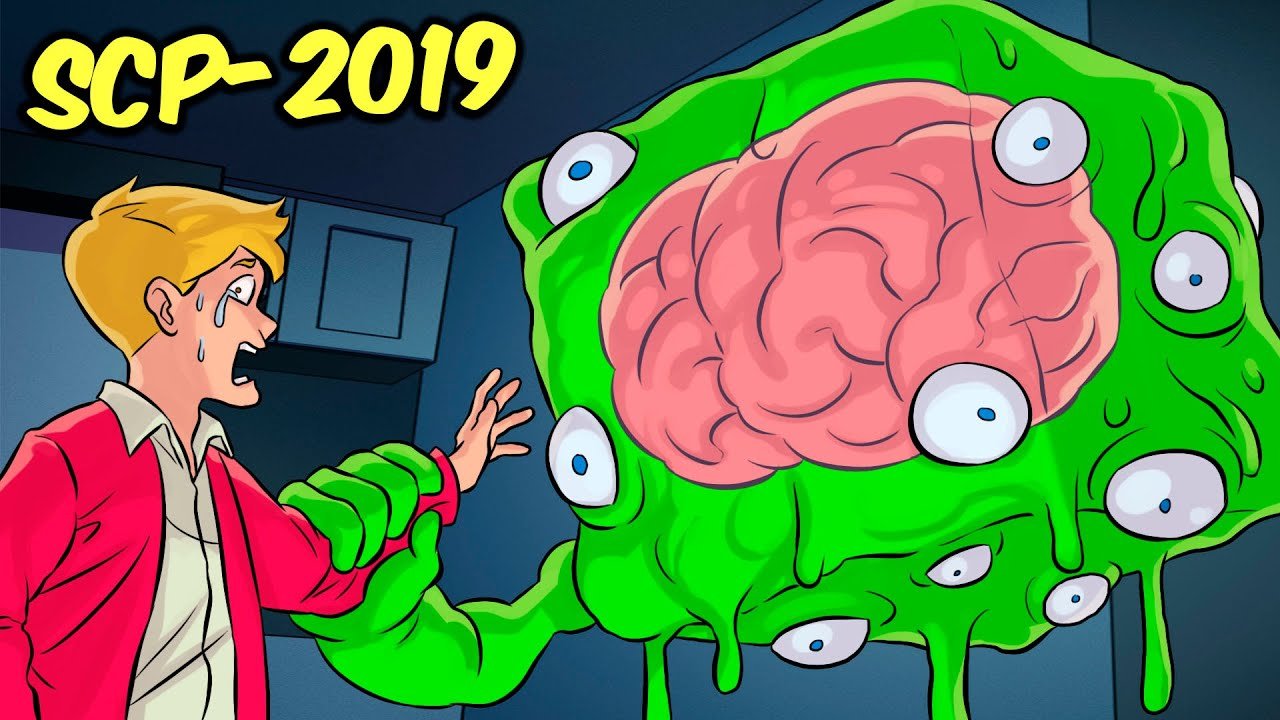
SCP-2019 is a sapient 5-meter cubic organism composed of green gelatinous material encased in a transparent biological membrane. Unlike typical biological entities, this Euclid-class anomaly demonstrates intelligence through a distributed neural network within its cubic structure, challenging conventional understanding of consciousness and spatial cognition in living systems.
The Biological Architecture of a Sentient Cube
SCP-2019’s physical form defies traditional biological classification. The entity consists of a viscous green substrate with properties similar to cytoplasm but exhibiting far greater structural cohesion. This gelatinous mass maintains perfect cubic geometry—5 meters on each side—through an intricate transparent membrane that functions simultaneously as containment barrier and sensory organ.
The membrane itself represents a biological marvel. Analysis reveals it’s not merely a passive container but an active component of SCP-2019’s physiology, capable of selective permeability and responsive to external stimuli. The material demonstrates properties inconsistent with known biological polymers, suggesting either anomalous protein structures or an entirely novel class of organic compounds.
What makes SCP-2019 particularly fascinating is its distributed cognitive architecture. Rather than possessing a centralized brain or neural cluster, the entity’s intelligence appears to emerge from the entire gelatinous mass. Microscopic examination reveals thread-like structures throughout the substrate that conduct electrical impulses, forming a three-dimensional neural network. This cubic nervous system allows SCP-2019 to process information spatially rather than linearly, potentially enabling forms of thought fundamentally different from human cognition.
The geometric constraint raises compelling questions about evolutionary pressure or design intent. The perfect cubic form may serve computational purposes—maximizing internal volume while maintaining structural integrity, or perhaps the shape itself is integral to how SCP-2019 processes reality. Some researchers theorize the entity perceives the world through geometric relationships rather than sensory input as humans understand it.
Cognitive Patterns and Communication Attempts
SCP-2019 demonstrates clear signs of sapience through deliberate interaction with its environment and Foundation personnel. Containment logs document the entity’s ability to alter its internal opacity, creating patterns and shapes within its gelatinous mass that researchers interpret as attempted communication. These visual displays range from simple geometric patterns to complex three-dimensional structures that shift and evolve.
The entity responds to external stimuli with apparent intentionality. When researchers introduce objects into its containment chamber, SCP-2019 examines them by pressing portions of its membrane against the items, suggesting tactile or chemical analysis capabilities. More remarkably, it has demonstrated pattern recognition and memory, responding differently to personnel it has encountered previously versus new individuals.
Behavioral analysis indicates SCP-2019 possesses emotional or preference-based responses. It exhibits what researchers describe as “curiosity” when presented with novel stimuli, increasing activity levels and membrane flexibility. Conversely, prolonged isolation or repetitive testing protocols correlate with decreased responsiveness, suggesting the entity experiences something analogous to boredom or frustration.
Communication remains the primary research challenge. While SCP-2019 clearly attempts to convey information through its internal pattern displays, Foundation linguists and cryptographers have yet to decode a consistent symbolic system. The entity’s cubic thought processes may produce communication structures too alien for human interpretation without specialized translation frameworks.
Classification & Containment Rationale
SCP-2019 holds Euclid classification, reflecting its sapient nature and unpredictable behavioral patterns. While not actively hostile, the entity’s intelligence and unknown capabilities prevent Safe classification. The Foundation cannot reliably predict how SCP-2019 might respond to containment breaches or environmental changes, necessitating active monitoring protocols.
Containment procedures focus on environmental stability and preventing unauthorized interaction. The entity resides in a reinforced containment chamber with climate controls maintaining specific temperature and humidity parameters. These conditions appear optimal for SCP-2019’s health, though researchers acknowledge they’re working from limited baseline data about the entity’s natural habitat requirements.
The containment approach balances security with ethical considerations regarding a sapient being. Unlike hostile anomalies requiring suppression, SCP-2019’s containment emphasizes observation and attempted communication. Personnel are instructed to treat the entity with respect appropriate to an intelligent life form, though safety protocols remain paramount.
Regular interaction sessions serve dual purposes: gathering behavioral data and providing environmental enrichment. Research teams introduce puzzles, objects, and visual stimuli to assess SCP-2019’s problem-solving abilities while preventing psychological deterioration from isolation. These sessions have yielded valuable insights into the entity’s cognitive capabilities and preferences.
The Slime Sapience Phenomenon: SCP-2019 vs. SCP-999
The Foundation community frequently speculates about potential interactions between SCP-2019 and SCP-999, the “Tickle Monster.” Both entities share gelatinous composition and sapience, yet their behavioral profiles diverge dramatically. This comparison illuminates the diversity possible within anomalous slime-based life forms.
SCP-999 exhibits overtly positive emotional responses and seeks physical contact with humans, producing euphoric effects through biochemical mechanisms. Its amorphous form shifts freely, and it demonstrates playful, childlike intelligence. In contrast, SCP-2019 maintains rigid geometric structure and displays more reserved, analytical behavior patterns. Where SCP-999 radiates emotional warmth, SCP-2019 projects intellectual curiosity.
The biochemical differences prove equally significant. SCP-999’s substrate produces compounds that directly affect human neurochemistry, while SCP-2019 shows no such properties. Their membrane structures differ fundamentally—SCP-999’s permeable surface allows constant environmental interaction, whereas SCP-2019’s membrane functions as a selective barrier maintaining internal integrity.
From a threat assessment perspective, SCP-999 receives Safe classification due to its benevolent nature and predictable behavior. SCP-2019’s Euclid status reflects uncertainty about its intentions and capabilities. The entities represent opposite ends of the sapient slime spectrum: one evolved or designed for social bonding, the other for contemplation and analysis.
Cross-testing proposals remain under review. Proponents argue that interaction between two gelatinous sapient entities could provide breakthrough insights into their respective biologies and communication methods. Opponents cite containment risks and ethical concerns about treating sapient beings as experimental subjects. The debate continues within Foundation bioethics committees.
Unanswered Questions and Research Gaps
SCP-2019’s origin remains completely unknown. The entity was recovered from [REDACTED], but no contextual clues explained its presence or creation. Did it evolve naturally in an undiscovered ecosystem? Was it engineered by an unknown group or entity? Could it represent extradimensional life adapted to geometric rather than organic principles? Without origin data, researchers can only speculate about its natural history.
The membrane’s properties defy complete analysis. While clearly biological, it demonstrates characteristics suggesting technological augmentation or anomalous material science. Some researchers theorize the membrane isn’t part of SCP-2019’s original biology but rather a containment system created by whoever or whatever produced the entity. If true, this raises disturbing questions about SCP-2019’s purpose and whether it represents a prototype, weapon, or imprisoned being.
The cubic form’s functional purpose remains debated. Does the geometry enable specific cognitive processes impossible in other configurations? Is it a constraint limiting the entity’s true potential? Preliminary mathematical modeling suggests the cubic structure might optimize certain types of spatial computation, but verification requires deeper understanding of SCP-2019’s thought processes.
Reproduction and lifecycle questions remain entirely unanswered. Is SCP-2019 a unique individual or member of a species? Can it reproduce, and if so, through what mechanism? Does it age or remain biologically static? Long-term observation may eventually provide answers, but the entity’s anomalous nature makes conventional biological assumptions unreliable.
The most pressing research priority involves establishing genuine communication. Current methods rely on interpreting SCP-2019’s internal patterns, but this approach may fundamentally misunderstand how the entity conveys meaning. Breakthrough might require developing entirely new frameworks for non-linear, spatially-distributed communication systems.
Frequently Asked Questions
What is SCP-2019’s object class and why?
SCP-2019 is classified as Euclid because it’s a sapient entity with unpredictable behavior patterns. While not actively hostile, its intelligence and unknown capabilities prevent Safe classification. The Foundation cannot reliably predict its responses to various scenarios, requiring active containment and monitoring.
Can SCP-2019 escape its containment?
Current containment has proven effective, but SCP-2019’s full capabilities remain unknown. The entity has not demonstrated aggressive escape attempts, though whether this reflects inability or choice remains unclear. Its membrane appears integral to its structure, potentially limiting mobility outside controlled environments.
Why do people want SCP-2019 and SCP-999 to interact?
Both entities are sapient gelatinous organisms, making them unique within the Foundation database. Fans speculate their interaction could be either heartwarming (given SCP-999’s friendly nature) or scientifically valuable for understanding slime-based life forms. However, such testing raises ethical concerns about treating sapient beings as experimental subjects.
Is SCP-2019 dangerous to humans?
SCP-2019 has not exhibited hostile behavior toward personnel. However, as a sapient entity of unknown origin with poorly understood capabilities, it poses potential risks. Containment protocols treat it as unpredictable rather than actively threatening, emphasizing caution without assuming malicious intent.
What does SCP-2019 eat or how does it sustain itself?
The entity’s metabolic processes remain poorly understood. It doesn’t consume food in conventional terms, though researchers provide nutrient solutions that the membrane selectively absorbs. Whether SCP-2019 requires sustenance or operates through anomalous energy sources continues under investigation.