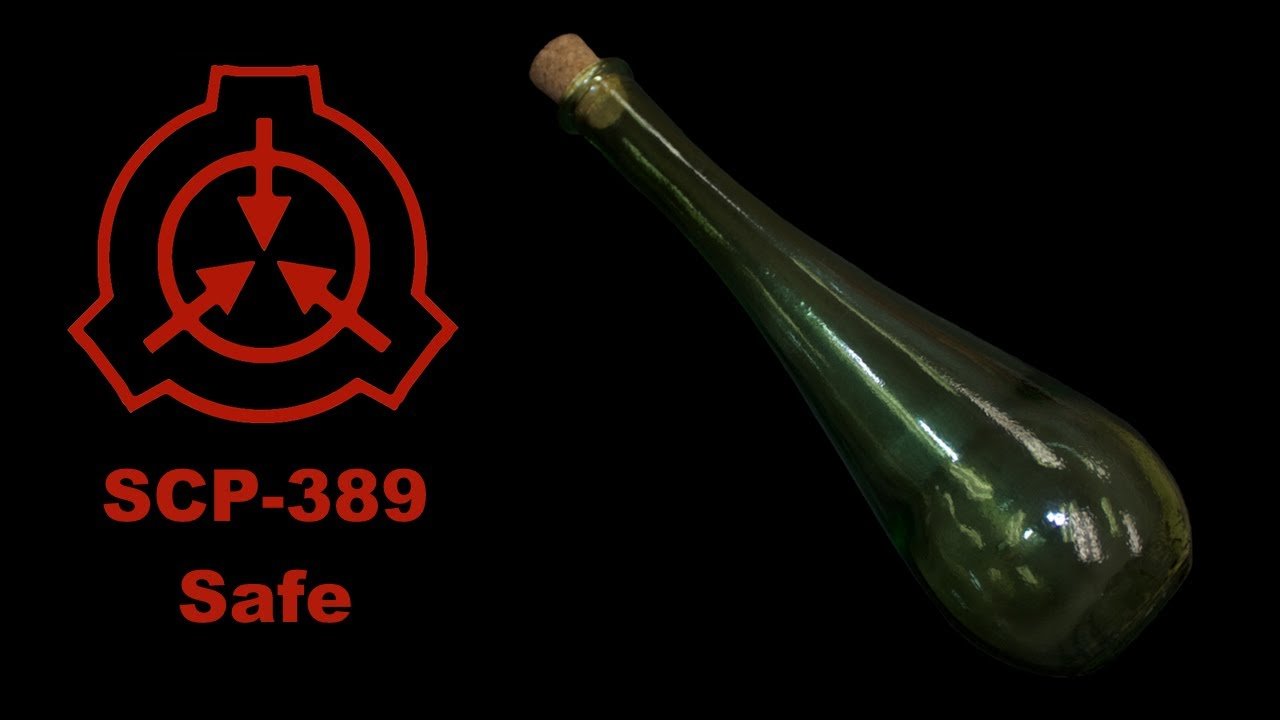
SCP-389 is an indestructible green glass bottle that delivers handwritten notes to an unknown correspondent named Gedril, returning from the ocean within 24 hours with typed replies describing an alien world of migrating trees and liquefying insects. This Safe-class anomaly represents one of the Foundation’s most accessible windows into cross-dimensional communication, yet its mechanics remain frustratingly opaque.
Classification & Containment Breakdown
Object Class: Safe
SCP-389 earns its Safe classification not because it’s harmless, but because it’s predictable. The bottle requires no specialized containment infrastructure—it sits on a shelf in Dr. ███████’s office at a coastal Site. The Foundation’s containment philosophy follows a simple principle: Safe-class objects are those that can be reliably contained with minimal resources, and SCP-389 poses no threat of breach or autonomous action.
The proximity to the sea isn’t arbitrary. SCP-389’s anomalous properties only activate when cast into ocean water, making coastal storage a practical necessity for ongoing research. Unlike reality-bending artifacts that require electromagnetic shielding or temporal stabilizers, this bottle simply needs to be kept away from unauthorized personnel who might initiate correspondence with an unknown entity.
The containment procedures reveal something crucial about Foundation methodology: sometimes the best containment is simply controlled access. SCP-389 won’t escape, won’t multiply, and won’t suddenly turn hostile. It waits.
The Discovery: A Teenage Girl’s Six-Year Correspondence
The origin story of SCP-389 reads like the beginning of a young adult fantasy novel—and that’s precisely what makes it so unsettling. A 15-year-old girl, whose name remains redacted, found the bottle on a beach approximately six years before Foundation acquisition. On impulse, she wrote a note, sealed it inside, and threw it into the waves.
When the bottle returned days later with a reply, she didn’t report it to authorities. She didn’t tell her parents. She simply continued writing.
For six years, this teenager maintained regular correspondence with Gedril, an entity from an unknown location who typed responses on what appears to be a mechanical typewriter. The girl’s willingness to keep this secret suggests the letters contained nothing threatening—no demands, no manipulation, just conversation. This benign interaction pattern is what ultimately led to the Safe classification.
The Foundation only discovered SCP-389 through routine monitoring of anomalous activity reports. The girl cooperated fully during debriefing, sharing the complete history without resistance. This raises an important question: how many other anomalous objects exist in private hands, their effects so subtle that they never trigger Foundation detection protocols?
How SCP-389 Works: The Mechanics of Impossible Mail Delivery
The bottle itself defies conventional physics in subtle ways. Despite being chemically identical to standard glass, SCP-389 has survived multiple drops from shelf height without sustaining chips, cracks, or fractures. This isn’t the dramatic invulnerability of SCP-682; it’s a quiet impossibility that suggests the bottle exists slightly outside normal material constraints.
The operational cycle follows a precise pattern:
- A note is placed inside the bottle
- The bottle is cast into ocean water
- The bottle disappears beyond 100 meters from shore
- The bottle returns at the next high tide (approximately 24 hours later)
- The original note is gone, replaced by a typed response
Testing revealed critical limitations. When researchers sent the bottle without a note, it returned empty. The anomaly requires intentional communication—it’s not a passive transportation device but an active correspondence system. This suggests intelligence on the receiving end, capable of distinguishing between deliberate messages and empty containers.
Every attempt to track SCP-389’s journey has failed spectacularly. GPS devices, radio transmitters, and even Foundation-developed anomalous trackers all cease functioning at the 100-meter threshold. The bottle doesn’t just travel to another location—it appears to transition into a space where conventional tracking methods become meaningless. This failure pattern mirrors other dimensional anomalies, particularly SCP-507’s involuntary shifts, where tracking equipment consistently loses signal during dimensional transitions.
The typewritten responses arrive on standard paper using English language, but the content reveals something far stranger than a simple pen pal across the ocean.
Gedril’s World: An Anthropological Mystery
Gedril’s descriptions paint a picture of an ecosystem that operates on fundamentally different biological principles. She describes trees that physically uproot themselves and migrate—not through slow evolutionary adaptation, but as part of their normal life cycle. These aren’t metaphors or poetic descriptions; Gedril provides specific details about seasonal patterns, migration routes, and the ecological niches these mobile plants occupy.
The insect life cycle she describes challenges everything we understand about metamorphosis. Creatures resembling Earth’s ladybugs (Coccinellidae) undergo a process where multiple larvae gather together, spontaneously liquefy into a single unified mass, then reform as adult individuals. This isn’t the solitary pupation of terrestrial insects—it’s a collective transformation that suggests either radically different biochemistry or an environment where the boundaries between individual organisms are more fluid than on Earth.
What makes Gedril’s correspondence particularly fascinating is her pattern of disclosure. She freely shares detailed information about her environment, culture, food, and customs. She’ll describe the taste of local fruits, the architecture of buildings, the social dynamics of her community. But ask about her specific location, her personal history, or any identifying details, and the questions are simply ignored in the next response.
This selective transparency suggests sophisticated understanding of information security. Gedril knows exactly what she’s revealing and what she’s withholding. She’s not a naive correspondent accidentally leaking details about a hidden civilization—she’s a careful communicator who has established clear boundaries about personal information while remaining genuinely engaged in cultural exchange.
The parallels to other dimensional anomalies are striking. SCP-093’s mirror tests revealed alternate Earths with divergent evolutionary paths. SCP-507 has documented dozens of parallel dimensions, many with familiar-yet-alien ecosystems. Gedril’s world fits this pattern: recognizable enough to describe using English terminology (trees, insects, buildings), but operating on principles that make it definitively not our Earth.
One compelling theory suggests SCP-389 doesn’t transport through space at all, but through dimensional boundaries. The 100-meter tracking failure threshold might represent the point where the bottle transitions between realities. The 24-hour return cycle could reflect temporal differences between dimensions—what feels like a day in our world might be the precise window when dimensional barriers thin enough for the bottle to return.
The Unanswered Questions: What the Foundation Won’t Tell Us
Despite years of testing, fundamental mysteries remain. The bottle’s destination during those 24 hours is completely unknown. It doesn’t appear in any ocean on Earth—deep-sea monitoring networks would have detected it. The tracking failure suggests it leaves our dimensional space entirely, but where it goes and how it navigates back remains unexplained.
Gedril’s nature presents another puzzle. She writes in fluent English, understands cultural references well enough to maintain coherent conversation, and uses a mechanical typewriter—a technology that suggests either a parallel development path or contact with Earth technology at some point. Is she human? A human descendant in an alternate timeline? An entirely different species that learned English specifically for this correspondence?
The ocean requirement is particularly curious. SCP-389 only functions when cast into saltwater. Attempts to activate it in lakes, rivers, or even large swimming pools filled with ocean water have failed. The anomaly requires genuine ocean—suggesting the mechanism isn’t about water chemistry but about connection to a specific geographic or dimensional feature. Perhaps Earth’s oceans serve as natural dimensional weak points, places where the barriers between realities are naturally thinner.
The return pattern—always at high tide—adds another layer of mystery. Tidal forces are gravitational phenomena caused by the Moon’s influence on Earth’s water. Does Gedril’s world have similar tidal patterns? Or does the bottle use our tides as a navigational beacon, a predictable temporal marker that allows it to find its way back to our reality?
Most troubling is what the Foundation hasn’t attempted—or hasn’t documented attempting. Has anyone tried to send a person through with the bottle? Has the Foundation attempted to expand the communication channel, perhaps by sending larger containers or multiple bottles simultaneously? The containment procedures suggest ongoing research, but the available documentation reveals nothing about these obvious experimental directions.
Frequently Asked Questions
Can anyone use SCP-389, or does it only work for specific people?
Testing confirms that SCP-389 responds to any written message, regardless of who places it in the bottle. The original 15-year-old girl had no special properties or anomalous characteristics—she was simply the first person to try using it. This universal functionality is part of why the Foundation maintains strict access control despite the Safe classification.
Has the Foundation tried to meet Gedril in person?
The documentation provides no evidence of successful physical contact attempts. The bottle’s size limits what can be sent, and tracking devices fail beyond 100 meters from shore. Any attempt to follow the bottle or send a person through would require technology that can survive dimensional transition—something the Foundation has not successfully developed for this specific anomaly.
What happens if you don’t put a note in the bottle?
Controlled testing revealed that sending SCP-389 empty results in its return still empty at the next high tide. The anomaly requires intentional communication to activate the response mechanism. This suggests Gedril (or whatever intelligence receives the bottle) can distinguish between deliberate messages and empty containers, choosing not to respond to the latter.
Why does Gedril refuse to share personal information?
Gedril’s selective disclosure pattern suggests deliberate information security practices. She may be following guidelines from her own civilization’s equivalent of the Foundation, or she may simply understand that revealing too much personal information could compromise her safety. Her willingness to share cultural and environmental details while avoiding personal identifiers demonstrates sophisticated understanding of privacy boundaries.
Could SCP-389 be used to establish formal diplomatic contact with Gedril’s world?
Theoretically, yes—the communication channel is stable, reliable, and has functioned for at least six years without degradation. However, the Foundation’s primary mandate is containment, not diplomacy. The limited bandwidth of written correspondence and Gedril’s refusal to share location information make formal contact protocols extremely difficult to establish. SCP-389 remains a window into another world, but not yet a door.