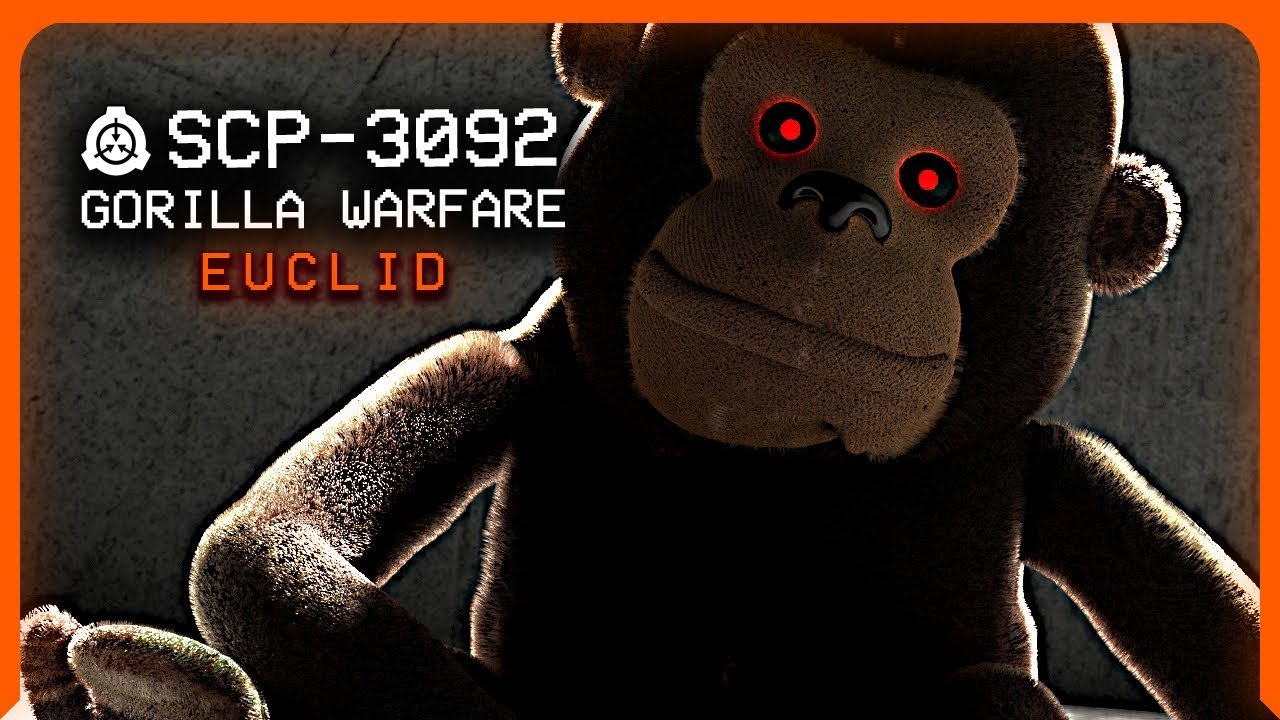
SCP-3092 is a Black Tie Toys arcade claw machine that transforms won plush toys into sapient, 0.3-meter-tall gorilla instances (SCP-3092-A) proficient in guerrilla warfare tactics. These cotton-stuffed combatants stage elaborate escape attempts and pranks using improvised weapons, yet deliberately avoid causing serious harm—treating containment as an ongoing tactical “game” rather than genuine warfare.
The Cheyenne Arcade Incident: How SCP-3092 Was Discovered
On May 3rd, 2020, animal control officers in Cheyenne, Wyoming responded to what they assumed was a routine exotic pet complaint at a family restaurant and arcade. What they encountered instead was 21 small plush gorillas conducting coordinated guerrilla operations throughout the facility—defacing property, setting traps, and engaging in what witnesses described as “organized chaos.”
The initial cover story of an escaped pet chimpanzee quickly fell apart when responders realized these weren’t biological entities at all. Foundation agents arrived to find the restaurant transformed into a miniature war zone, complete with graffiti, improvised catapults, and strategically placed glitter bombs. Several aggressive instances were “killed” with small arms fire before the remaining gorillas—in a move that would define their behavioral profile—formally surrendered to Foundation officials.
The source was traced to an unassuming claw machine that had operated normally for seven years. After civilian amnesticization and evidence cleanup, both SCP-3092 and its 21 plush insurgents entered Foundation custody, marking the beginning of one of the organization’s most peculiar containment challenges.
Object Mechanics: From Arcade Prize to Anomalous Combatant
SCP-3092 functions identically to any commercial claw machine until the critical moment: when an operator successfully retrieves a plush toy through the prize chute. At this instant, the transformation occurs—the ordinary stuffed animal becomes an instance of SCP-3092-A, a sapient cotton-and-felt gorilla measuring roughly 30 centimeters tall and weighing 400 grams.
The machine itself shows no unusual construction. Its steel frame, plastic components, and electronics all display wear consistent with years of arcade use. The anomaly activates only through successful gameplay with valid U.S. currency, suggesting the transformation requires both mechanical completion and some form of transactional element.
What makes SCP-3092 particularly dangerous from a containment perspective is the secondary anomaly: contact-based replication. When any SCP-3092-A instance touches a non-anomalous plush toy, that toy immediately converts into an identical copy of the touching instance—complete with similar personality traits, ideology, and behavioral patterns. This exponential multiplication factor explains why the Cheyenne incident escalated from a single won prize to 21 coordinated combatants.
Instances demonstrate acute awareness of this replication ability. Newly created SCP-3092-A entities frequently attempt to reenter the claw machine to convert remaining prizes, effectively using SCP-3092 as a recruitment center. This tactical understanding of their own anomalous properties suggests sophisticated strategic thinking far beyond what their appearance would indicate.
The Psychology of Plush Guerrillas: Behavioral Analysis of SCP-3092-A
SCP-3092-A instances present a fascinating paradox: they possess genuine expertise in guerrilla warfare tactics while simultaneously engaging in what can only be described as elaborate performance art. Each instance demonstrates proficiency in stealth infiltration, weapon improvisation, trap construction, and small arms maintenance—skills that would require years of training in human combatants.
Their tactical repertoire includes slingshots, miniature catapults, tripwires, strategic graffiti placement, “glitter bombs,” and the classic bucket-above-door trap. They’ve successfully breached containment multiple times using ventilation systems, picked biometric locks, and coordinated multi-instance operations with military precision. Yet every weapon they employ is deliberately non-lethal, every attack calculated to annoy rather than injure.
What makes their behavior particularly intriguing is the ideological diversity. Each instance created by SCP-3092 possesses a distinct personality and crude ideology resembling various real and fictional guerrilla groups. They develop individual identities, form alliances, and pursue separate objectives—all while maintaining their commitment to what appears to be an unspoken rule: this is a game, not actual warfare.
The “pain” and “death” mechanics reveal the performative nature of their existence. When damaged, instances react with melodramatic expressions of agony despite lacking nervous systems. Severe injuries induce a “death” state where they fall dramatically and cease movement—until disturbed, at which point they briefly animate to request that investigators stop bothering them because they’re “out of the game.” Conventional stitching and re-stuffing functions as “medical attention” that restores them to full activity.
This commitment to theatrical rules extends to their response to mock tranquilizers. Testing revealed that any feather-tipped dart—regardless of whether it contains actual sedatives—induces an immediate “sleep” state complete with twitching and exaggerated snoring. They’re not actually tranquilized; they’re playing along with the scenario because that’s what the game demands.
The Helmer Incident: When Pranks Go Wrong
June 9th, 2020 marked a turning point in understanding SCP-3092-A psychology. Two instances escaped containment through ventilation ducts and infiltrated Dr. Martin Helmer’s office, where they constructed an elaborate tripwire trap. The intended outcome was straightforward: Dr. Helmer would trip, fall forward, and land face-first on a pillow emblazoned with a crude insult—a classic slapstick prank consistent with their established behavioral pattern.
The execution went catastrophically wrong. Dr. Helmer tripped as planned, but his trajectory carried him into a bookshelf instead of the pillow. He suffered a fractured collarbone—an injury far more severe than any previous SCP-3092-A containment breach had caused.
The instances’ response was immediate and revealing. Rather than fleeing or continuing their escape attempt, both gorillas expressed genuine remorse, alerted Foundation personnel to the situation, and cooperated fully with recontainment. Investigation of their cells later revealed that they had converted their amenities into handmade gifts and apology cards intended for Dr. Helmer.
More significantly, no subsequent containment breach has employed tripwire traps of any kind. The instances collectively learned from this incident and adjusted their tactical playbook to eliminate hazards that could cause unintended serious harm. This demonstrates not just individual learning but shared knowledge transfer across the SCP-3092-A population—and a moral framework that prioritizes their “game” remaining harmless.
Containment Evolution: From Bullets to Mock Tranquilizers
The Foundation’s approach to SCP-3092-A containment has evolved through trial and error, each iteration revealing more about the instances’ nature. Initial responses employed standard small arms and net launchers—effective but carrying risks of collateral damage and excessive force against what are, ultimately, stuffed toys.
The breakthrough came accidentally on May 18th, 2020, when Agent Megan Cho fired a tranquilizer rifle at an escaping instance. The gorilla immediately “passed out,” falling to the ground in an exaggerated sleep state complete with occasional twitches and theatrical snoring. This response was puzzling until subsequent testing revealed the truth: the tranquilizer itself was irrelevant. Any feather-tipped pneumatic dart produced the same effect, whether loaded with sedatives or completely inert.
This discovery fundamentally changed containment protocols. SCP-3092-A instances weren’t being chemically subdued—they were choosing to play along with the tranquilizer scenario because it fit their internal rules of engagement. A dart hit means you’re “tranquilized,” so you perform being tranquilized. The Foundation now arms response teams with mock tranquilizer rifles, eliminating the risk of accidentally sedating human personnel while maintaining perfect effectiveness against the plush combatants.
Current containment procedures reflect this understanding. Individual kennels with biometric locks prevent escape attempts while amenities are provided as behavioral incentives. The instances receive rewards for compliance but nothing that could serve as escape tools—a balance that acknowledges their intelligence while respecting the game’s boundaries.
Information Gain: The Unanswered Questions
The seven-year dormancy period before SCP-3092’s anomalous activation remains unexplained. The machine operated normally in commercial settings from its manufacture until 2020, dispensing ordinary plush toys to countless customers. What triggered the change? Did the anomaly develop gradually, or was there a specific activation event? Investigation into Black Tie Toys manufacturing has revealed no other anomalous arcade machines, suggesting SCP-3092 may be unique—but the mechanism behind its transformation from mundane to anomalous remains a critical gap in Foundation understanding.
The cross-SCP interaction potential raises fascinating possibilities. Reddit discussions have explored how SCP-3092-A might interact with SCP-2295 (The Patchwork Bear), a benevolent anomaly that performs surgical repairs on damaged individuals. Would SCP-2295 recognize “injured” SCP-3092-A instances as requiring medical attention? Could it repair their theatrical damage, and would the gorillas accept such help? More intriguingly, what would happen if an SCP-3092-A instance touched SCP-2295 itself? Would the replication anomaly convert a helpful medical bear into a guerrilla combatant, or would SCP-2295’s own anomalous properties resist the transformation?
The philosophical question of genuine sapience versus elaborate programming haunts every interaction with SCP-3092-A. They demonstrate learning, emotional responses, individual personalities, and moral reasoning—all hallmarks of true consciousness. Yet their rigid adherence to “game rules,” performative pain responses, and inability to acknowledge that their attacks are non-lethal suggest they may be following an incredibly sophisticated script rather than exercising free will. Are they truly aware, or are they the universe’s most convincing automatons?
The ideological diversity among instances presents another puzzle. Each SCP-3092-A created directly by the claw machine possesses unique guerrilla group inspiration—some resembling historical revolutionary movements, others mimicking fictional resistance organizations. Where does this information come from? The machine contains no database, no connection to external information sources. Yet somehow, each new instance emerges with distinct tactical preferences and ideological frameworks. This suggests the anomaly may be drawing from collective human consciousness or accessing information through unknown means.
Frequently Asked Questions About SCP-3092
Can SCP-3092-A instances actually feel pain?
No. Despite their melodramatic reactions to damage, SCP-3092-A instances lack nervous systems or biological pain receptors. Their exaggerated expressions of agony are performative—part of the “game” they’re playing. Testing has confirmed they’re cotton-stuffed felt with no capacity for genuine physical suffering, though they commit fully to the theatrical experience of being injured.
What happens if you repair a “dead” SCP-3092-A instance?
Conventional stitching, patching, and re-stuffing functions as “medical attention” that revives “dead” instances. They interpret these repairs as healing and return to full activity once restored. Instances that are merely “playing dead” will briefly animate if disturbed, requesting that investigators leave them alone because they’re “out of the game”—unless the damage is repaired, at which point they’re back “in play.”
Why don’t SCP-3092-A instances cause serious damage despite their tactical skills?
All evidence suggests they’re deliberately limiting their attacks to non-lethal pranks and inconveniences. They’ve ignored opportunities for arson or breaching other SCP containments in favor of glitter bombs and graffiti. When questioned, they insist their attacks are devastating with many casualties—suggesting they either genuinely believe this or are committed to maintaining the fiction. The Helmer incident demonstrated that when they accidentally cause real harm, they show immediate remorse and adjust tactics to prevent recurrence.
How many SCP-3092-A instances currently exist in Foundation custody?
As of the most recent documentation, 23 instances are contained. This number includes the original 21 from the Cheyenne incident plus additional instances created during testing. The count remains relatively stable due to strict protocols preventing contact with non-anomalous plush toys and keeping SCP-3092 unplugged except during approved experiments.
What was the most elaborate SCP-3092-A escape attempt?
While specific details of all containment breaches aren’t fully documented, the coordinated June 2020 ventilation system infiltration demonstrates their capabilities. Two instances simultaneously escaped, navigated complex ductwork, reached a specific target’s office, and constructed an elaborate trap—all requiring reconnaissance, planning, and precise execution. Their ability to pick biometric locks and coordinate multi-instance operations suggests even more sophisticated attempts may have occurred during the 21-instance Cheyenne incident before Foundation containment.