Executive Summary
SCP-291 is a Safe-class anomalous machine resembling a steel building that can completely disassemble living organisms into preserved component blocks and later reassemble them with perfect biological function. Discovered at [REDACTED LOCATION], this 10.5m × 30.2m structure performs organ-level deconstruction in 20-30 minutes, storing body parts in transparent preservation blocks that enable unprecedented medical procedures—including cross-species transplants and consciousness transfers—while raising profound ethical questions about the nature of identity and bodily autonomy.
The Discovery and Physical Structure
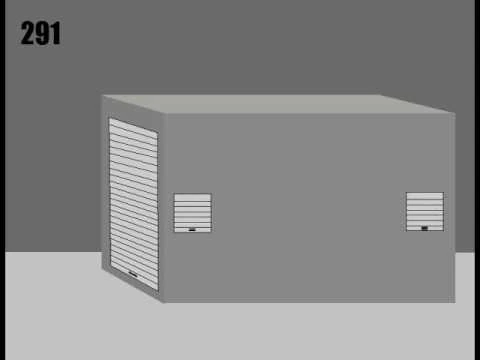
SCP-291’s origins remain one of the Foundation’s most tantalizing mysteries. Found at a location scrubbed from all records, the machine arrived in Foundation custody as a nearly featureless steel box measuring 10.5 meters by 30.2 meters at its base and standing 15 meters tall—roughly the size of a small warehouse. Unlike most anomalous objects that betray their strangeness through impossible geometries or reality-warping effects, SCP-291’s exterior is deceptively mundane.
The structure features two large garage-style doors (5 meters wide) on opposite narrow ends, composed of horizontal metal slats. The front entrance has no external handle and resists all non-destructive opening attempts when unpowered. Only when connected to a suitable electrical source does the door spring open automatically. This fail-safe design earned SCP-291 its Safe classification—when disconnected from power, it becomes an inert steel box incapable of harming anyone.
Two small hatches (1m × 1m) flank each main door, serving as waste disposal chutes for the machine’s byproducts. The interior lock mechanisms can be manually operated from inside, preventing personnel from being trapped during power failures. What makes this containment particularly unusual is that the machine’s own design provides most of its security features, suggesting its creators anticipated the need for safety protocols.
The materials composing SCP-291 test as ordinary steel—no exotic alloys or impossible substances. It can theoretically be cut or damaged with sufficient force, though such testing remains prohibited due to the irreplaceable nature of the technology. This ordinariness raises a disturbing question: if the materials are conventional, what makes the machine anomalous is purely its function.
How the Disassembly Process Works
The disassembly sequence begins when a living organism (minimum mass: 1.6 kilograms) is placed inside a transparent “coffin” lined with blue-green gel cushioning. Dead organisms trigger no response—SCP-291 requires active biological processes to initiate. The coffin rests on a conveyor system in a 4m × 2m control room featuring an unlabeled console and display screen.
Once an organism is detected, the display generates a real-time scanned image with grid overlays. The control interface—devoid of any written language, numbers, or symbols—operates through a binary on/off button system that Dr. Rights painstakingly decoded through trial and error. This absence of linguistic markers suggests either non-human designers or a machine intended for universal operation across language barriers.
Pressing the first large button floods the coffin with an unidentified blue liquid that acts as a contact sedative. Subjects describe the taste as resembling “Kool-Aid” before losing consciousness within seconds. Remarkably, this liquid can be safely inhaled and swallowed without causing drowning or chemical burns—a property that defies conventional pharmacology. As the liquid fills the coffin, it undergoes a phase transition: liquid to syrup to solid gel, encasing the subject completely.
During this gelation process, all detectable vital signs cease. Breathing stops. Heartbeat flatlines. Yet subjects report no memory of death or distress—only “a very restful, dreamless sleep.” This suggests the blue substance doesn’t merely sedate but places biological systems in a state of suspended animation that current medical science cannot replicate.
The conveyor then carries the encased subject through a locking door into SCP-291’s unexplored interior. For 20-30 minutes (depending on organism size), the machine fills with mechanical clanking, whirring, and grinding. Electromagnetic pulses surge through the machinery, making internal exploration impossible without equipment destruction. The display shows only a loading bar—no visual feed of the disassembly process exists.
What emerges at the opposite end is biological deconstruction taken to its logical extreme: the organism divided into 24 distinct blocks of preserved tissue.
The Block System: Biological Architecture Revealed
Each preservation block is composed of an unidentified transparent solid—not glass, not plastic, but something that maintains perfect clarity while protecting its contents from decay indefinitely. The blocks vary in size according to their contents and fit into specific cubbyholes like three-dimensional puzzle pieces. Attempting to force a block into the wrong slot prevents machine reactivation, suggesting a sophisticated recognition system.
The division pattern reveals fascinating insights into how SCP-291 conceptualizes anatomy:
Neural and Sensory Systems are isolated individually—brain, left eye, right eye each receive separate blocks. This granular separation enables the consciousness transfer experiments that would later horrify ethics committees.
Musculoskeletal Components are divided by quadrant and depth: upper/lower, left/right, with the skeletal system split at mid-spine. This allows for limb transplants with unprecedented precision.
Organ Systems are grouped by function and location: heart alone, lungs with diaphragm, complete digestive tract, reproductive organs as a unit. The lymphatic and circulatory systems are preserved in two blocks divided at the waist—a recognition that these networks permeate the entire body.
Skin arrives neatly folded in its own block, like a deflated bodysuit waiting to be worn again.
The preservation technology itself represents perhaps the greatest mystery. The blocks withstand indefinite storage without refrigeration or degradation. Only extreme heat can melt them, and sharp impacts can shatter them—but breaking a block causes the preservation to fail catastrophically. The contents become unusable, and the remaining material dissolves to dust within minutes, as if the solid matrix was actively maintaining tissue viability.
The Reassembly Protocol: Playing God with Biology
Reconstruction reverses the process with surgical precision. Blocks are inserted into corresponding cubbyholes in the entrance room. Empty cubbies are permitted—SCP-291 will simply omit those components—but missing vital organs causes immediate shutdown and requires use of the emergency reset button.
When all desired blocks are loaded and cubby doors closed, pressing the second console button initiates reassembly. The doors lock, blocks are withdrawn through unknown means, and the machinery roars to life for 40-50 minutes. The longer reconstruction time suggests a more complex process than disassembly—perhaps because the machine must not only position tissues but reconnect billions of cellular junctions, nerve pathways, and capillary networks.
The result emerges in a transparent container filled with evaporating blue liquid: a fully functional organism with no memory of the process. Subjects awaken disoriented but unharmed, reporting intense hunger (their digestive systems are emptied during processing) and discovering themselves completely hairless and nude. A waste block containing hair, clothing scraps, digestive contents, and any carried objects is deposited in the external hatches.
The seamless nature of reassembly is medically miraculous. Wounds seal with minimal scarring. Transplanted organs integrate perfectly without rejection. Even when non-vital parts are omitted—an eye, a limb, a kidney—the body compensates as if it had always been absent, with blood vessels and nerves terminating cleanly rather than leaving traumatic amputation damage.
This capability transforms SCP-291 from curiosity to potential medical revolution. Heart transplants without immunosuppression. Limb reattachment with full nerve function. Skin grafts between unrelated individuals. The machine accomplishes in minutes what would require teams of surgeons and months of recovery—if it were possible at all.
Cross-Species Experiments: The Ethics of Biological Mixing
Dr. Rights’ experimental program pushed SCP-291 beyond human medicine into the realm of speculative biology. Of twenty attempted cross-species transfers, only three succeeded—a 15% success rate that suggests biological compatibility barriers even this anomalous technology cannot fully overcome.
Experiment 001 involved swapping a cat’s left eye with a human subject’s eye. The human adapted remarkably well, gaining feline visual capabilities: enhanced night vision, motion detection, but reduced color perception. The subject reported feeling the eye was “theirs” within days. The cat, however, clawed out its human eye within a week—unable to process the incompatible neural signals or perhaps disturbed by the alien sensory input. This asymmetry suggests consciousness and neural architecture play crucial roles in transplant success.
Experiment 007 remains the most philosophically disturbing test on record. A human brain was successfully transferred into an English mastiff’s body—possible only because the dog breed’s large skull could accommodate human brain mass. The human consciousness, now trapped in a quadrupedal form, desperately requested immediate reversal. Meanwhile, the mastiff’s mind in a human body learned bipedal walking within hours and had to be re-disassembled after an incident involving “the humiliation of a female doctor”—suggesting the dog retained its behavioral instincts despite its new form.
This experiment proves SCP-291 transfers consciousness completely. The brain is not merely the seat of memory but of identity itself. Yet it also reveals the profound psychological trauma of species dysphoria—the human subject’s distress at being trapped in a body fundamentally incompatible with their self-image mirrors discussions in transgender medicine and body dysmorphia, but taken to an extreme no human has experienced before.
Experiment 016 crossed ethical lines even by Foundation standards: a female D-class subject had her reproductive organs exchanged with those of a pregnant Labrador retriever. The file provides no follow-up, leaving horrifying questions unanswered. Did the human body reject the canine pregnancy? Did the dog successfully carry human fetuses? The experiment’s inclusion in official records suggests it “succeeded” by SCP-291’s standards, but at what cost to the subjects involved?
The low success rate of cross-species transfers likely stems from biochemical incompatibility. Even when SCP-291 can physically connect tissues, species-specific hormones, immune responses, and cellular signaling may prevent long-term integration. The three successes involved relatively isolated systems—a sensory organ, a brain (which is immunologically privileged), and reproductive organs (which have some immunosuppressive properties during pregnancy).
Unanswered Questions: The Machine’s True Purpose
SCP-291’s design philosophy raises more questions than it answers. The complete absence of written language, numerical displays, or symbolic notation suggests several possibilities:
Non-human origin: The machine may predate human civilization or come from an entirely non-human intelligence that communicates through different modalities. The intuitive button interface could be a universal design meant to be decoded through experimentation.
Post-human technology: Alternatively, SCP-291 might be a artifact from humanity’s future, where language has been superseded by direct neural interfaces or where machines are designed for cross-temporal use.
Deliberate obscurity: The lack of instructions might be intentional—a safety feature ensuring only those willing to experiment carefully can operate it, or a test to see if a civilization is advanced enough to reverse-engineer its function.
The blue liquid’s composition remains unidentified despite extensive analysis. Its properties—sedative on contact, safely inhalable, pleasant-tasting, capable of inducing suspended animation, and able to transition between liquid, gel, and solid states—suggest a programmable smart material far beyond current nanotechnology. The “Kool-Aid” flavor is particularly bizarre: why would an alien or future technology taste like a 20th-century American beverage? Is this a translation effect, where the machine adapts its properties to subject expectations? Or coincidence?
The electromagnetic pulses and unexplored interior machinery hint at technologies the Foundation cannot yet comprehend. Surveillance equipment sent inside emerges twisted and wrecked, deposited in waste chutes. This suggests the machine actively defends its operational secrets, or that the forces involved in biological disassembly are incompatible with electronic observation.
Perhaps most troubling: SCP-291 was found, not created. Someone or something built this machine, deployed it to [REDACTED LOCATION], and either abandoned it or lost it. Was it a medical facility? A processing center for some unknown purpose? A prototype that escaped containment? The building-like structure suggests it was meant for regular use, not as a one-time device.
Thematic FAQ
Can SCP-291 bring dead people back to life?
No. SCP-291 requires living organisms with active biological processes to initiate disassembly. Dead tissue triggers no response from the machine. However, if someone were disassembled while alive and their blocks preserved, they could theoretically remain in suspended animation indefinitely and be reassembled centuries later—a form of immortality through discontinuous existence.
What happens if you put two people in the coffin at once?
The machine does not activate when multiple organisms are placed in the coffin simultaneously. SCP-291 appears designed to process single individuals only, suggesting its purpose involves maintaining individual identity rather than creating biological amalgamations.
Has anyone tried using SCP-291 on other SCPs?
According to the file, “No tests involving using SCP-291 with other SCPs have yet been authorized.” This restriction likely stems from unpredictable interactions between anomalies. Disassembling a regenerating SCP, a reality-bending entity, or a cognitohazardous organism could produce catastrophic results—or reveal whether SCP-291’s technology can affect anomalous biology.
Could SCP-291 solve the organ shortage crisis?
Theoretically, yes. A single donor could provide organs for multiple recipients through careful block management. However, the ethical implications are staggering: who decides which D-class personnel become involuntary organ farms? The technology’s potential for medical good is inseparable from its potential for abuse—a tension that defines much of the Foundation’s work.
Why do subjects wake up hairless?
Hair, along with clothing and digestive contents, is classified as “waste” by SCP-291 and deposited in external chutes. This suggests the machine distinguishes between essential biological components and expendable materials. Interestingly, this means SCP-291 considers hair non-essential to identity, while it preserves every organ system with meticulous care—a philosophical stance on what constitutes the “self.”