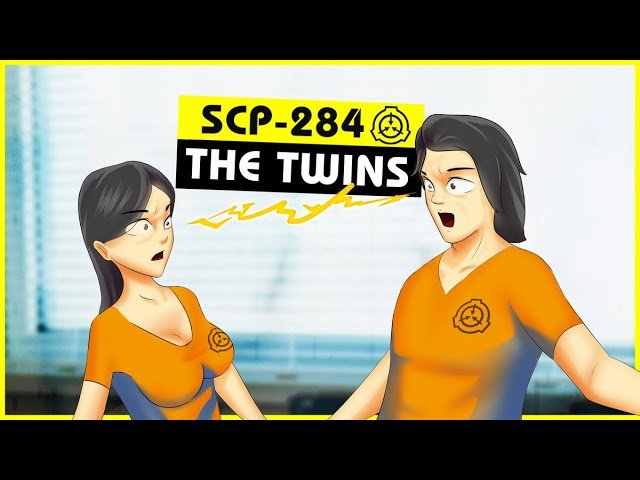
SCP-284 refers to a pair of dizygotic (fraternal) twins—one female (SCP-284-1) and one male (SCP-284-2)—who share a single functional brain distributed across two separate bodies. Despite being physically distinct individuals, they possess shared memories, sensory experiences, and a synchronized consciousness that defies conventional neuroscience. Classified as Safe, they represent one of the Foundation’s most profound studies of human neural connectivity.
The Neurological Paradox: How One Brain Controls Two Bodies
At first glance, SCP-284-1 and SCP-284-2 appear to be ordinary fraternal twins. She stands 1.72 meters tall; he measures 1.79 meters. They were born on an undisclosed date in Illinois and have lived their entire lives as what most would consider two separate people. But beneath the surface lies an impossibility: they are two bodies controlled by one brain.
SCP-284-1 houses the left hemisphere of their shared brain, while SCP-284-2 contains the right hemisphere. In typical human neurology, these hemispheres communicate through the corpus callosum—a thick bundle of neural fibers. In SCP-284, this connection exists across physical space, with no anatomical structure bridging the gap between their skulls.
Each hemisphere has enlarged approximately 50% beyond normal size, presumably to compensate for the extraordinary task of maintaining two separate bodies simultaneously. This expansion suggests their neural tissue has adapted to handle double the sensory input, motor control, and cognitive processing of a standard human brain.
The twins share everything a unified consciousness would experience: memories form identically in both minds, skills learned by one become knowledge for both, and physical sensations cross between bodies. When SCP-284-1 touches a hot surface, SCP-284-2 feels the burn. When SCP-284-2 tastes food, SCP-284-1 experiences the flavor. This complete sensory synchronization occurs regardless of physical distance, though significant separation introduces processing delays.
Remarkably, the twins have developed a voluntary sensory filtering mechanism. They can completely block out each other’s visual and auditory input, while taste, smell, and touch can be dampened but not eliminated. This learned ability suggests their shared consciousness possesses a level of control over information flow that shouldn’t be possible—the receiving twin decides what to filter, not the one experiencing the sensation. It’s as if their distributed brain has developed its own internal firewall.
Classification & Containment Philosophy
SCP-284 carries a Safe classification, which in Foundation terminology doesn’t mean “harmless”—it means “predictable and containable.” The twins require no special security measures beyond standard humanoid containment protocols. Their quarters consist of a single room with two beds, a setup they specifically requested. When offered separate accommodations, their response was telling: “privacy is moot.”
This statement reveals a profound truth about their existence. For individuals who have never experienced a moment of mental solitude, who have shared every thought, sensation, and dream since birth, the concept of privacy holds no meaning. They are, in the most literal sense, never alone.
The Foundation’s approach to SCP-284 reflects its handling of cooperative, sentient anomalies. They’re permitted occasional off-site trips with minimal supervision—one Level 1 researcher and one Level 1 field agent. This lenient treatment acknowledges their humanity and poses an interesting ethical question: Are they prisoners or protected individuals? The Foundation’s containment philosophy here leans toward the latter, treating them more as research participants than threats.
This containment approach also reveals organizational priorities. When an anomaly poses no danger and willingly cooperates, the Foundation can afford to be humane. SCP-284’s case stands in stark contrast to the brutal containment of hostile entities, demonstrating that the organization’s methods scale with threat level and cooperation.
The Split-Brain Experiments: Test Log 284-1 Breakdown
Test Log 284-1 represents one of the most invasive and revealing experiments conducted on SCP-284. Researchers separated the twins to opposite ends of the facility—maximizing physical distance while remaining within the same complex. A surgical team then removed the top of SCP-284-2’s cranium and applied electrodes directly to his exposed brain tissue.
The results were immediate and unambiguous: every stimulation produced identical reactions in both twins.
When researchers triggered motor responses in SCP-284-2’s right hemisphere, SCP-284-1’s left-side muscles contracted in perfect synchronization. When they stimulated sensory regions, both twins reported identical sensations—pressure, tingling, warmth—despite SCP-284-1 being nowhere near the surgical suite. When memory centers were activated, both recalled the same specific experiences simultaneously.
This experiment confirmed what the Foundation suspected: their connection isn’t metaphorical or psychological. It’s a genuine neural link that operates independent of physical proximity. The electrical impulses traveling through SCP-284-2’s neurons somehow instantaneously manifest in SCP-284-1’s corresponding brain tissue.
From a neuroscience perspective, this should be impossible. Neural signals are electrochemical processes bound by the speed of cellular transmission. Yet SCP-284 demonstrates what appears to be instantaneous information transfer across space. The mechanism remains unknown—the portions of their brains responsible for this connection are classified as [DATA REDACTED], suggesting the Foundation has discovered something it considers too dangerous or complex to document in standard files.
Real-world split-brain research, conducted on patients whose corpus callosum has been severed to treat epilepsy, shows that disconnected hemispheres can develop independent awareness. SCP-284 represents the inverse phenomenon: separated hemispheres maintaining perfect unity. Where split-brain patients struggle with conflicting impulses from each hemisphere, SCP-284 functions as a seamlessly integrated consciousness despite the physical separation.
The Piano Phenomenon: Muscle Memory vs. Neural Knowledge
The incident documented in Researcher Note 284-2 occurred during a routine day when SCP-284-1 was playing piano in Dr. ██████’s office. Across the facility, SCP-284-2’s fingers began twitching erratically—seemingly random spasms that concerned nearby staff. When brought to the music room, the mystery resolved itself: his finger movements were perfectly synchronized with SCP-284-1’s piano performance.
This phenomenon illuminates a crucial distinction in how their shared brain operates. Both twins possess identical knowledge of piano technique—the theory, the finger positions, the musical notation. This cognitive information transfers perfectly between them. However, muscle memory and physical conditioning remain body-specific.
SCP-284-1 had spent months developing the finger strength, dexterity, and muscle memory required for piano performance. Her muscles had adapted to the repetitive motions, building the specific neural pathways between her motor cortex and finger muscles. SCP-284-2 possessed all the mental knowledge of how to play, but his hands lacked the physical development.
When SCP-284-1 played, her motor cortex sent signals to her fingers. Simultaneously, those same neural impulses reached SCP-284-2’s motor cortex—after all, they share one brain. His motor cortex attempted to execute the commands, but his underdeveloped finger muscles could only produce weak, uncoordinated twitches.
This reveals something profound about the nature of skill acquisition. Knowledge and execution are separate processes. You can understand intellectually how to perform a backflip, but without training, your body won’t cooperate. SCP-284 demonstrates this principle in its purest form: one mind that knows how to play piano, but only one body capable of doing so.
The phenomenon also raises questions about their subjective experience. Does SCP-284-2 feel phantom sensations of playing piano? Does he experience a disconnect between intention and execution? The involuntary nature of his twitching suggests the motor commands reach his body automatically, bypassing conscious control—a form of mirror movement disorder amplified by their unique neural architecture.
The Sleep Synchronization Mystery
Perhaps the most mysterious aspect of SCP-284’s condition is their sleep synchronization. Neither twin can remain conscious for more than sixteen minutes after the other falls asleep. This isn’t a matter of choice or habit—it’s a biological imperative. Additionally, both twins awaken simultaneously, whether naturally or when artificially roused.
The sixteen-minute threshold is oddly specific. Why not immediate unconsciousness? Why not an hour? This delay suggests their shared consciousness can operate in a “partial” state temporarily, with one hemisphere maintaining wakefulness while the other rests. But beyond that critical window, the entire system shuts down.
This pattern mirrors nothing in conventional sleep research. Typical humans cycle through sleep stages independently—your brain doesn’t require anyone else’s permission to sleep or wake. Yet SCP-284 functions as a unified system with synchronized circadian rhythms.
Several theories might explain this phenomenon:
The Consciousness Threshold Theory: Perhaps consciousness requires a minimum level of neural activity across both hemispheres. When one twin sleeps, their hemisphere enters low-activity mode. The remaining active hemisphere can sustain consciousness briefly, but eventually lacks sufficient processing power to maintain wakefulness alone.
The Safety Mechanism Hypothesis: Their condition might include a built-in failsafe. If one body becomes exhausted or injured to the point of unconsciousness, forcing the other to sleep prevents one hemisphere from overworking while the other rests. This would protect their shared brain from asymmetric strain.
The Distributed Consciousness Model: Their awareness might not reside in either hemisphere individually but in the connection between them. When one hemisphere enters sleep mode, the connection weakens. After sixteen minutes, the link degrades below the threshold required for consciousness, pulling the other hemisphere into sleep as well.
The simultaneous awakening is equally puzzling. It suggests their sleep cycles are perfectly synchronized at a neurological level—REM sleep, deep sleep, and light sleep phases occur in lockstep. This coordination implies their shared consciousness maintains some level of communication even during sleep, ensuring both bodies remain in identical states.
The Philosophy of Shared Identity: Where Does One Person End and Another Begin?
SCP-284 forces us to confront fundamental questions about personal identity and the nature of self. Are they one person or two? The answer depends entirely on how you define personhood.
By biological metrics, they’re clearly two individuals—separate bodies, separate DNA (being dizygotic twins), separate physical experiences of the world. But by neurological and psychological metrics, they’re one person—a single consciousness, unified memories, shared thoughts and emotions. They don’t communicate telepathically; they are the same mind experiencing reality through two sets of sensory organs.
Consider the implications of their statement that “privacy is moot.” Most humans define themselves partly through private thoughts—the internal monologue no one else can access. We have secrets, hidden desires, embarrassing memories we’d never share. SCP-284 has none of this. Every thought SCP-284-1 has, SCP-284-2 experiences simultaneously. Every emotion, every impulse, every fleeting moment of consciousness is mutually accessible.
This raises profound psychological questions. How does personality develop when there’s no internal privacy? The documentation notes they have “separate personalities” despite sharing memories and knowledge. This suggests personality emerges not just from experience and knowledge, but from something more fundamental—perhaps the physical differences in their bodies, their different social interactions, or subtle variations in how each hemisphere processes information.
Their condition also challenges our understanding of autonomy and consent. When SCP-284-1 decides to block out SCP-284-2’s visual input, is she exercising control over her own mind or over his? When they agreed to Foundation containment, was it one decision or two? Legal and ethical frameworks built around individual autonomy struggle to accommodate a consciousness that exists in plural.
Within the broader SCP universe, SCP-284 joins a fascinating category of consciousness-based anomalies. SCP-963 (the amulet that transfers consciousness between bodies) demonstrates consciousness as transferable data. SCP-2140 (retroactive amnestics that erase people from existence) shows consciousness as socially constructed. SCP-1504 (Joe Schmo, the most average human) explores consciousness as statistical normality. SCP-284 reveals consciousness as potentially distributable—capable of spanning multiple physical substrates while maintaining unity.
Real-world parallels exist, though none as extreme. Conjoined twins with shared neural tissue sometimes report sensing each other’s thoughts or emotions. Split-brain patients occasionally describe feeling like two people inhabiting one body. But SCP-284 represents these phenomena taken to their logical extreme: complete neural integration across physically separate bodies.
The twins’ acceptance of their condition—their matter-of-fact statement about privacy, their preference for shared quarters—suggests they’ve never known any other existence. To them, this isn’t an anomaly. It’s simply how consciousness works. They likely find the concept of mental isolation as alien as we find their shared awareness.
Frequently Asked Questions About SCP-284
Can SCP-284-1 and SCP-284-2 be surgically separated?
No. They don’t share a physical connection that can be severed. Each twin possesses only one hemisphere of a functional brain. Separating them would leave each with half a brain, resulting in severe disability or death. Their anomalous connection is what allows them to function normally despite this division.
Do SCP-284-1 and SCP-284-2 have different personalities?
Yes, despite sharing memories and consciousness, they exhibit distinct personalities. This suggests personality emerges from factors beyond just experience and knowledge—possibly including body chemistry, social role, and subtle differences in how each hemisphere processes information. However, they also demonstrate “emotional synergy,” meaning their feelings influence each other more than typical siblings.
What happens if one twin dies?
This scenario isn’t documented in available files, but the implications are grim. Since each twin possesses only one hemisphere, the death of either would leave the survivor with half a functional brain. Given their demonstrated neural dependency—including the inability to remain conscious when separated during sleep—it’s likely the surviving twin would experience severe cognitive impairment or death shortly after.
How far apart can they be before experiencing problems?
The documentation notes that “significant distance” causes delayed responses from the other twin’s lobe. Test Log 284-1 placed them at “opposite ends of the facility,” where the connection still functioned perfectly for sensory transmission. The exact distance threshold where their connection begins to degrade remains unspecified, but it’s clearly measured in hundreds of meters or more, not mere feet.
Why are they classified as Safe if they’re so anomalous?
In Foundation terminology, Safe doesn’t mean harmless—it means predictable and easily contained. SCP-284 poses no threat, requires no special containment infrastructure, and cooperates fully with researchers. They’re Safe because they can be kept in a standard room with minimal security. The classification reflects containment difficulty, not danger level or strangeness.
Can they learn to extend their sensory blocking to include pain?
The documentation states they can only “weaken” physical sensations like touch, not block them completely like vision and hearing. This limitation appears fundamental to their condition. Pain, being a critical survival signal, may be too deeply integrated into their shared nervous system to filter out. The involuntary nature of pain transmission could be a biological safeguard—ensuring both bodies respond to threats even when one isn’t directly experiencing the danger.
SCP-284 stands as one of the Foundation’s most philosophically challenging anomalies. They’re not dangerous, not hostile, not even particularly difficult to contain. Yet they fundamentally challenge our understanding of consciousness, identity, and what it means to be an individual. In a universe filled with reality-bending monsters and world-ending threats, two twins who share a brain remind us that the deepest mysteries often lie not in cosmic horror, but in the question of what makes us us.