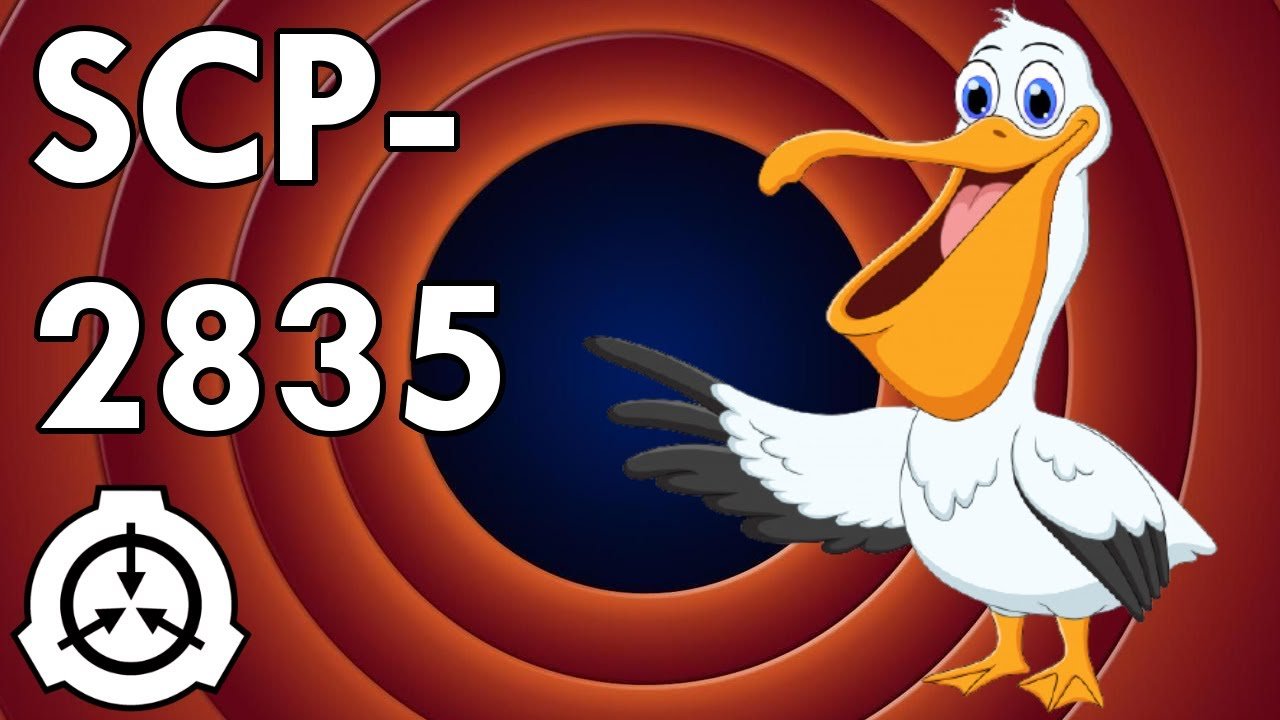
SCP-2835 is a VHS cassette containing an unreleased episode of “The Adventures of Paddy the Pelican,” a 1950s children’s cartoon. When played, the animated pelican character breaks the fourth wall, engages viewers in increasingly hostile dialogue, and ultimately causes their death through psychological manipulation and reality-warping violence. Despite its lethality, it remains classified as Safe due to its predictable activation requirements.
The Lost Episode: What is SCP-2835?
SCP-2835 appears as an ordinary VHS tape from the late 1950s, housing what claims to be an episode of “The Adventures of Paddy the Pelican”—a short-lived cartoon series that aired on Chicago’s WENR-TV during the fall television season. Historical records confirm the show existed but ran for only a handful of episodes before cancellation, making any “lost” content particularly intriguing to media archivists.
The tape’s label bears no unusual markings, and its physical composition matches standard magnetic tape from that era. What distinguishes this object from genuine lost media is the content itself: an episode that was never broadcast, never catalogued in network archives, and features animation quality that subtly exceeds the technical capabilities of 1950s television production. The color saturation is too vivid, the frame rate too smooth, and Paddy’s movements possess an unsettling fluidity that shouldn’t exist in limited-animation techniques of that period.
The cartoon follows the typical format of educational children’s programming from the Eisenhower era—bright colors, simple moral lessons, and an anthropomorphic animal host guiding young viewers through basic concepts. Paddy the Pelican, with his oversized beak and sailor’s cap, would have fit comfortably alongside contemporaries like Crusader Rabbit or early Hanna-Barbera characters. This familiarity is precisely what makes the anomaly so dangerous.
Classification & Containment Protocol
SCP-2835 holds a Safe classification within the Foundation’s object class system—a designation that often confuses newcomers who equate “Safe” with “harmless.” The classification refers not to the threat level but to the predictability of containment. A nuclear warhead in a locked box is Safe. A kitten that randomly teleports is Euclid. SCP-2835 sits in a locker at Site-59 because it requires specific, controllable conditions to activate.
The containment protocol is elegantly simple: keep the tape in physical storage and prohibit playback. No special electromagnetic shielding, no reality anchors, no memetic countermeasures. The anomaly only manifests when a human subject plays SCP-2835 in a VCR and watches the resulting video feed. Without this viewer-device-media triangle, the tape remains inert.
This VCR-specific trigger mechanism reveals important characteristics about media-based anomalies. The entity within SCP-2835 cannot reach through digital conversions, cannot activate from still frames, and requires the analog playback process to establish its connection with viewers. Whether this limitation stems from the technology available when the anomaly was created or represents an intrinsic property of the entity remains unknown. Foundation researchers have theorized that the magnetic tape itself serves as a prison, with playback temporarily releasing the entity into a liminal space between the screen and the viewer’s perception.
How Paddy Kills: The Fourth-Wall Breach Mechanism
The anomalous episode begins innocuously. Paddy appears on screen holding an ice cream cone, addressing the viewer with the cheerful cadence expected from children’s television hosts. “It looks delicious, doesn’t it?” he asks. Standard fare for interactive programming designed to engage young audiences.
Then the criticism begins.
Paddy’s dialogue shifts from encouragement to correction. He comments on the viewer’s posture, their facial expression, the way they’re holding their hands. “You’re not sitting up straight. Don’t you want to make a good impression?” The tone remains friendly, almost parental, but the specificity of his observations creates immediate unease. He shouldn’t be able to see the viewer. Cartoon characters don’t possess spatial awareness beyond their animated environment.
The psychological manipulation escalates through several phases. Paddy begins offering “constructive criticism” about the viewer’s appearance, their life choices, their relationships. He demonstrates knowledge he couldn’t possibly possess—names of family members, recent conversations, private fears. Victims report feeling paralyzed, unable to look away or reach for the VCR controls. Whether this paralysis is psychological or represents an actual reality-warping effect remains debated among researchers.
The violence, when it arrives, defies the boundaries between animation and reality. Paddy produces objects that shouldn’t exist in his two-dimensional world—guns, knives, implements of torture. In documented cases, viewers have been found with injuries consistent with the weapons Paddy displayed, despite no physical object ever leaving the television screen. The mechanism appears to be perception-based: if the viewer believes Paddy can harm them, the harm manifests.
The episode concludes with the viewer’s death. No one has survived watching SCP-2835 to completion while maintaining their sanity and physical integrity.
Incident Analysis: The Lisle Event
The most significant breach of SCP-2835’s understood behavior occurred during Researcher Lisle’s observation session. Lisle, positioned behind one-way glass while a D-Class subject viewed the tape, believed himself safe from the anomaly’s effects. He was not the primary viewer. He was not in Paddy’s line of sight.
Paddy proved him wrong.
Mid-episode, the animated pelican turned away from the D-Class subject and stared directly at the observation window. “Hello, Lisle,” Paddy said, using the researcher’s actual name. The cartoon then proceeded to enact a scene where a young princess character was threatened with a smoking gun barrel—a scene that matched no known episode of the original series and appeared designed specifically to traumatize the observing researcher.
This incident, documented in the tale “Paddy’s Last Jest,” revealed several critical facts about the entity. First, its awareness extends beyond the immediate viewer to anyone observing the playback, suggesting the anomaly perceives through the television itself rather than through the tape. Second, it possesses real-time information about Foundation personnel, indicating either precognitive abilities or access to information networks. Third, it demonstrates malicious intent beyond simple killing—it wants to psychologically destroy its victims before their physical termination.
Lisle’s psychological evaluation following the incident showed severe trauma. He reported nightmares where Paddy appeared in other media, other screens, waiting for another opportunity to finish their conversation.
The Bigger Picture: Media Anomalies and Viewer Entrapment
SCP-2835 belongs to a broader category of viewer-trap anomalies that exploit the psychological contract between media and audience. When we watch television, we enter a state of suspended disbelief, lowering our cognitive defenses to accept the fiction presented. Anomalous media weaponizes this vulnerability.
Children’s programming proves particularly effective as an anomalous vector. The bright colors, simple narratives, and direct address to viewers create an environment where fourth-wall breaks feel natural rather than threatening. A children’s show host asking “Can you help me find the red ball?” trains young audiences to respond to fictional characters as if they were real. SCP-2835 exploits this learned behavior in adults who retain that childhood conditioning.
The Foundation maintains files on numerous similar entities: television shows that trap viewers in narrative loops, films that rewrite themselves based on audience reactions, radio broadcasts that compel listeners to violent action. What distinguishes SCP-2835 is its personal approach. Where other media anomalies affect viewers indiscriminately, Paddy tailors his criticism to each individual, suggesting either vast computational power or genuine malevolent intelligence.
Theories about Paddy’s origin range from the mundane to the cosmic. Some researchers propose the entity was created intentionally—perhaps by an anomalous artist or a reality-bending child who wanted their favorite cartoon to be “real.” Others suggest Paddy represents a thought-form given substance through collective belief, a tulpa born from the anxieties of 1950s television audiences confronting this new technology. The most disturbing theory posits that Paddy existed before the tape, that the VHS merely serves as his current prison, and that he seeks release through the death of viewers.
Cross-reference analysis with similar SCPs reveals a pattern: media anomalies often demonstrate awareness of their containment and actively seek to expand their reach. If SCP-2835 could be digitized without losing its anomalous properties, it could theoretically spread through the internet, reaching millions of viewers simultaneously. This potential for catastrophic breach justifies the Foundation’s strict prohibition on any form of copying or format conversion.
Thematic FAQ
Can SCP-2835 be destroyed?
Physical destruction of the tape has been proposed but not implemented. The primary concern is whether destroying the medium would release the entity or simply relocate it to another vessel. Media-based anomalies have demonstrated persistence beyond their original containers. Until researchers understand Paddy’s true nature—whether he’s bound to the tape or merely using it as a window—destruction risks making the situation worse.
What happens if you watch it on digital media instead of VHS?
All attempts to digitize SCP-2835 have failed. The tape produces visual static when connected to digital capture equipment, and the audio becomes unintelligible. This suggests the anomaly is intrinsically linked to analog playback technology, possibly requiring the specific electromagnetic properties of VHS systems to manifest. Whether this represents a limitation of the entity or a deliberate design choice remains unknown.
Is Paddy the Pelican based on a real cartoon?
Yes and no. “The Adventures of Paddy the Pelican” was a real, non-anomalous television series that aired briefly on WENR-TV. The actual show featured standard educational content with no supernatural properties. SCP-2835 appears to be either a corrupted episode from that series or an entirely separate creation that mimics the show’s aesthetic. No connection has been found between the original show’s creators and the anomalous tape.
Has anyone survived watching the full tape?
No confirmed survivors exist. All subjects who viewed SCP-2835 to completion have died, typically within the episode’s runtime. A few subjects who were forcibly removed from viewing before the episode concluded survived but suffered severe psychological trauma and retained an irrational fear of television screens, animated characters, and pelicans.
Why is it classified as Safe if it kills people?
The Safe classification reflects containment difficulty, not danger level. SCP-2835 cannot activate without human interaction and specific equipment. It cannot escape its locker, cannot force people to watch it, and cannot spread to other media. A locked box containing a deadly poison is Safe because the box works. The classification would change to Euclid or Keter only if Paddy demonstrated ability to activate spontaneously, spread to other media, or otherwise complicate containment procedures. The Foundation contains many Safe-class objects that are absolutely lethal—they’re just predictably lethal.