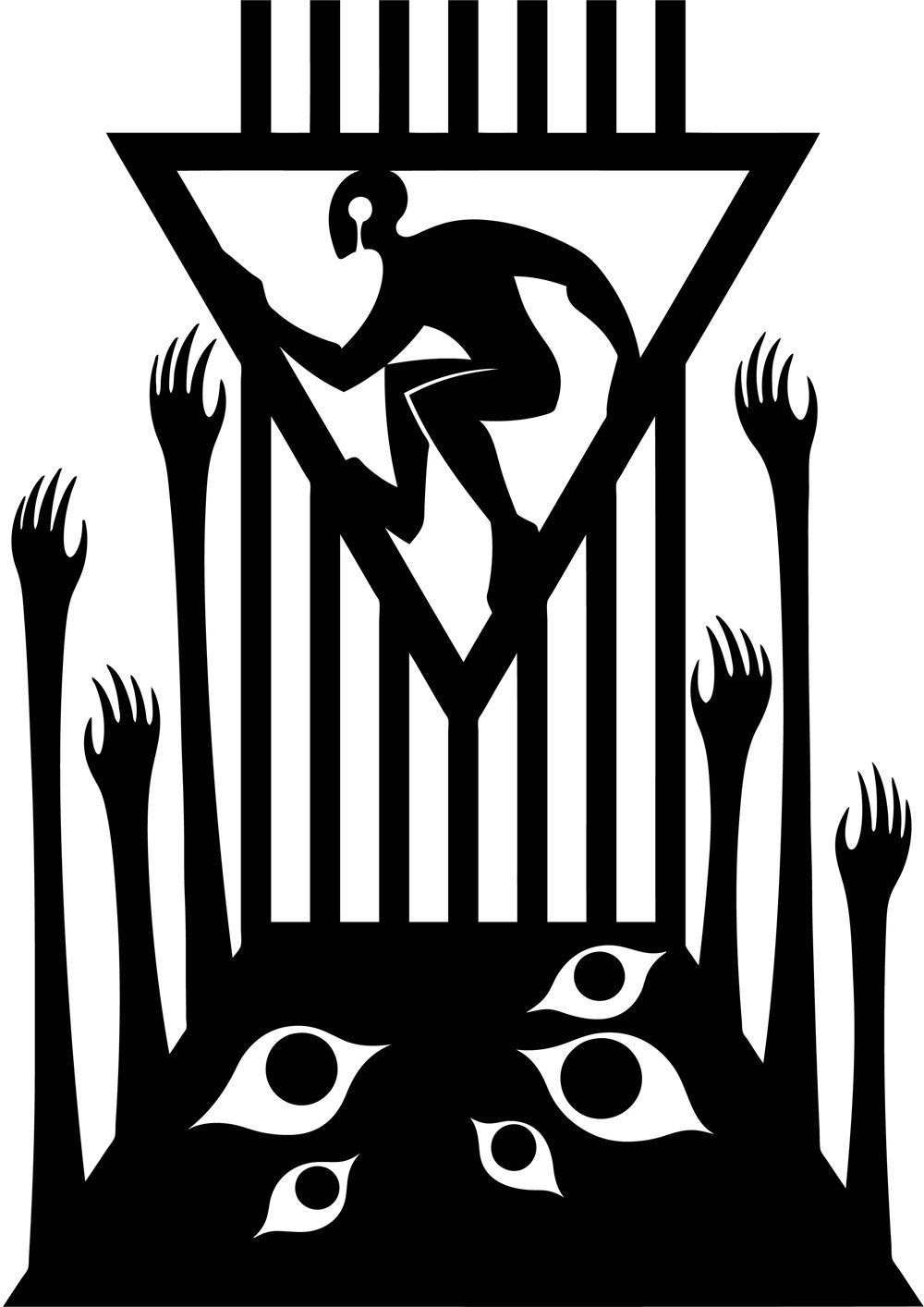
SCP-2701, designated “True Solitary,” is an anomalous prison cell (Cell 667) located in a decommissioned Pennsylvania state penitentiary that transports victims into a timeless pocket dimension of absolute sensory deprivation. When activated through an associated clipboard artifact, subjects experience what feels like eternity in a void devoid of matter, light, or sound—a punishment that systematically destroys human consciousness through infinite isolation.
The Pennsylvania Discovery: Cell 667’s Dark History
The Foundation discovered SCP-2701 during a routine investigation of the abandoned ███████ State Penitentiary in Pennsylvania following reports of missing persons connected to the facility’s closure in the late 1990s. Cell 667 itself appears unremarkable—a deteriorating solitary confinement unit with peeling paint, rusted bars, and structural damage consistent with decades of neglect. However, the cell’s mundane appearance masks one of the most psychologically devastating anomalies in Foundation custody.
The penitentiary’s records revealed that Cell 667 had been unofficially designated “New Solitary” by Warden Samuel Decard, who administered the facility during its final operational years. Decard had developed a reputation among correctional staff for experimental approaches to inmate discipline, though the full extent of his methods remained hidden until Foundation investigators uncovered his personal journals. These documents detailed Decard’s obsession with creating the “perfect punishment”—a form of isolation so complete that it would break even the most hardened criminals without leaving physical evidence of abuse.
What Decard discovered, or possibly created through unknown means, was a dimensional anomaly that transformed Cell 667 into a gateway to absolute nothingness. The warden’s notes suggest he tested the cell on inmates he deemed “irredeemable,” documenting their disappearances as transfers to other facilities. By the time the Foundation intervened, at least seventeen individuals had been subjected to SCP-2701, with Decard himself becoming the anomaly’s final victim under circumstances that remain partially classified.
The Clipboard Mechanism: How SCP-2701 Selects Its Victims
The activation mechanism for SCP-2701 centers on an anomalous clipboard mounted on the wall adjacent to Cell 667. The clipboard contains a single sheet of paper with two column headings: “NAME” and “RELEASE DATE.” This deceptively simple interface functions as a targeting and temporal control system for the dimensional displacement effect.
When a person’s name is written in the NAME column, that individual becomes “marked” by the anomaly regardless of their physical location. The RELEASE DATE column determines the subjective duration of their confinement within the pocket dimension. However, the temporal mechanics operate on a disturbing principle: time within SCP-2701’s void passes at a dramatically accelerated rate relative to baseline reality. A release date set for one week in the future translates to what victims experience as years or potentially centuries of isolation.
The clipboard exhibits several additional anomalous properties. Attempts to destroy it have failed, with the object demonstrating regenerative capabilities. Names written on the clipboard cannot be erased through conventional means, though they disappear automatically once the specified release date arrives and the victim is expelled from the pocket dimension. Most disturbingly, the clipboard appears to possess a form of selective awareness—it will only accept names of individuals who have been physically present within a certain radius of Cell 667, suggesting the anomaly “scans” for potential targets.
Foundation researchers have determined that the activation occurs when the marked individual next falls asleep or loses consciousness. At that moment, they vanish from baseline reality and materialize within SCP-2701’s dimensional space. This delayed activation mechanism made Decard’s experiments particularly insidious, as inmates would be returned to general population only to disappear hours later, creating confusion among staff and preventing immediate investigation.
Inside the Void: The Physics of True Solitary Confinement
Subjects transported into SCP-2701’s pocket dimension describe an environment that violates fundamental principles of human perception and physics. The space contains no matter whatsoever—no air, no surfaces, no light sources. Victims report floating in absolute darkness with no sense of up or down, no temperature sensation, and no sound except their own thoughts. Paradoxically, subjects do not require oxygen, food, or water while inside the dimension, suggesting the anomaly sustains biological functions through unknown means while simultaneously denying all sensory input.
The temporal distortion within SCP-2701 represents its most psychologically destructive feature. Foundation interviews with recovered subjects reveal that time perception becomes severely distorted within minutes of arrival. Without external stimuli to mark the passage of time—no day-night cycles, no hunger pangs, no physical fatigue—the human brain loses its ability to track duration. Subjects report that what they initially perceived as hours stretched into what felt like days, then weeks, then years of unchanging void.
Neurological scans of recovered individuals show patterns consistent with extreme sensory deprivation, including hallucinations, dissociation, and permanent alterations to brain structures responsible for spatial awareness and temporal processing. The human mind, evolved to constantly process environmental information, begins to cannibalize itself when deprived of all input. Subjects develop elaborate internal worlds, false memories, and in some cases, complete personality fragmentation as their consciousness attempts to generate stimulation where none exists.
The dimensional mechanics suggest SCP-2701 operates by creating a localized spacetime bubble isolated from baseline reality. This pocket dimension appears to be finite but unbounded—subjects report no walls or boundaries, yet they cannot escape or encounter anything beyond themselves. Some theoretical physicists within the Foundation have compared it to a zero-dimensional point stretched to accommodate a human consciousness, though this explanation remains speculative.
Warden Decard’s Legacy: The Ethics of Anomalous Punishment
Samuel Decard’s transformation from correctional administrator to anomalous experimenter raises profound questions about the intersection of human cruelty and supernatural phenomena. His journals reveal a man who genuinely believed he was advancing criminal justice reform by developing a punishment that would rehabilitate through absolute reflection. Decard theorized that forcing inmates to confront themselves without distraction would lead to genuine remorse and transformation.
The reality proved far darker. Decard’s early test subjects emerged from brief exposures to SCP-2701 catatonic or psychotic, their minds shattered by experiences they could barely articulate. Rather than abandoning his experiment, Decard interpreted these results as evidence that longer exposure periods were necessary for “complete psychological restructuring.” He began extending confinement durations, documenting the progressive mental deterioration of his subjects with clinical detachment.
Foundation ethics committees have extensively debated whether Decard created SCP-2701 through some form of ritual or anomalous knowledge, or whether he simply discovered a pre-existing dimensional weak point and learned to exploit it. His final journal entries suggest he came to view the void as a sentient entity that communicated with him, though whether this represents genuine anomalous contact or Decard’s own deteriorating mental state remains unclear.
Decard’s fate serves as a grim epilogue to his experiments. According to recovered documentation, he wrote his own name on the clipboard with no release date specified, effectively sentencing himself to eternal confinement. Foundation personnel discovered his body in Cell 667 three days later—physically present but neurologically dead, his brain showing activity patterns consistent with locked-in syndrome. Whether this represented an attempt at atonement, a final experiment, or a punishment imposed by forces he’d awakened remains unknown.
The ethical implications extend beyond Decard’s individual crimes. SCP-2701 represents the weaponization of anomalous phenomena for social control, a concept that deeply concerns Foundation leadership. The ease with which the clipboard can be operated, combined with the devastating effectiveness of the punishment, makes SCP-2701 a potential tool for authoritarian abuse. Current containment protocols emphasize preventing any governmental or organizational entity from learning of the anomaly’s existence.
Cross-Testing Theories: Could SCP-2701 Contain Other SCPs?
The SCP research community has extensively debated whether SCP-2701 could serve as a containment solution for dangerous entities that resist conventional methods. The most frequently cited candidate is SCP-106 (The Old Man), whose ability to phase through solid matter and create pocket dimensions makes traditional containment extremely resource-intensive. Theoretically, SCP-2701’s dimensional displacement might trap even entities with reality-bending capabilities.
However, Foundation policy strictly prohibits using one anomaly to contain another except under the most extreme circumstances, and for good reason. Cross-testing SCP-2701 with hostile entities introduces multiple catastrophic failure modes. First, there’s no guarantee that non-human or extra-dimensional entities would be affected by the clipboard mechanism, which appears calibrated for human consciousness. Second, introducing a powerful anomaly into SCP-2701’s pocket dimension could destabilize the dimensional structure itself, potentially creating a breach point between baseline reality and unknown spaces.
The temporal acceleration effect presents additional concerns. If an intelligent entity were trapped in SCP-2701 for what it experienced as millennia, it might develop capabilities or knowledge that would make it exponentially more dangerous upon release. Some entities might adapt to the void environment, learning to manipulate the dimensional fabric from within. The Foundation learned this lesson through tragic experience with other cross-containment experiments that created more problems than they solved.
Furthermore, SCP-2701’s activation mechanism requires the target to lose consciousness, which many anomalous entities either cannot do or can resist indefinitely. The clipboard’s range limitations and name-based targeting system also suggest it was designed specifically for human subjects, not for entities that lack conventional identities or physical forms.
The most compelling argument against weaponizing SCP-2701 comes from its unpredictable nature. Despite extensive study, Foundation researchers still don’t fully understand the dimensional mechanics at work or what sustains the pocket dimension. Using it as a containment tool could inadvertently feed or strengthen whatever forces maintain the void, potentially expanding its influence or creating additional dimensional weak points.
Frequently Asked Questions
What happens if someone’s release date is never reached?
If no release date is specified or if the date is set impossibly far in the future, the subject remains trapped in SCP-2701’s pocket dimension indefinitely. Warden Decard’s case demonstrates this outcome—his body returned to baseline reality but his consciousness remained functionally destroyed, suggesting that even if physical extraction occurs, the psychological damage from extended exposure becomes irreversible. The Foundation has established strict protocols preventing any personnel from accessing the clipboard without O5-level authorization specifically to prevent indefinite confinement scenarios.
Can multiple people be trapped in SCP-2701 simultaneously?
Yes, the clipboard can accommodate multiple names, and testing has confirmed that each victim experiences the void in complete isolation from others. Even when multiple subjects are confined simultaneously, they report no awareness of each other’s presence. This suggests SCP-2701 either creates separate pocket dimensions for each victim or partitions a single dimension in ways that prevent any form of interaction. This isolation multiplier makes the psychological impact even more severe, as victims cannot even derive comfort from shared suffering.
Has anyone ever escaped SCP-2701 before their release date?
No documented cases of early escape exist in Foundation records. The dimensional barrier appears absolute, with no physical force or anomalous ability tested thus far capable of breaching it from inside. Several reality-bending subjects were experimentally confined (under strict ethical oversight with minimal exposure times), and none demonstrated any ability to manipulate the void environment or create exit points. This impermeability makes SCP-2701 simultaneously one of the most secure containment methods and one of the most dangerous anomalies in Foundation custody.
Why doesn’t the Foundation destroy SCP-2701 entirely?
Beyond the clipboard’s demonstrated resistance to destruction, the Foundation faces a more fundamental problem: they don’t know what would happen to anyone currently trapped in the pocket dimension if the anomaly were neutralized. Destroying the dimensional anchor might permanently strand victims in the void, collapse the dimension and kill them instantly, or potentially release the accumulated temporal energy in catastrophic ways. Additionally, SCP-2701 provides valuable research data on dimensional mechanics and temporal manipulation that could inform containment strategies for other anomalies. The current approach prioritizes preventing new victims while maintaining the status quo for safety reasons.
What psychological support do recovered victims receive?
Foundation medical staff have developed specialized treatment protocols for SCP-2701 survivors, though success rates remain limited. Standard amnestic treatment proves ineffective because the trauma stems not from specific memories but from the fundamental restructuring of consciousness that occurs during extended sensory deprivation. Most recovered subjects require permanent psychiatric care, with many never regaining their pre-exposure personality or cognitive function. The Foundation provides lifetime support in secure medical facilities, though the ethical weight of these cases continues to fuel debates about whether SCP-2701 should be reclassified to a higher threat level despite its passive nature.