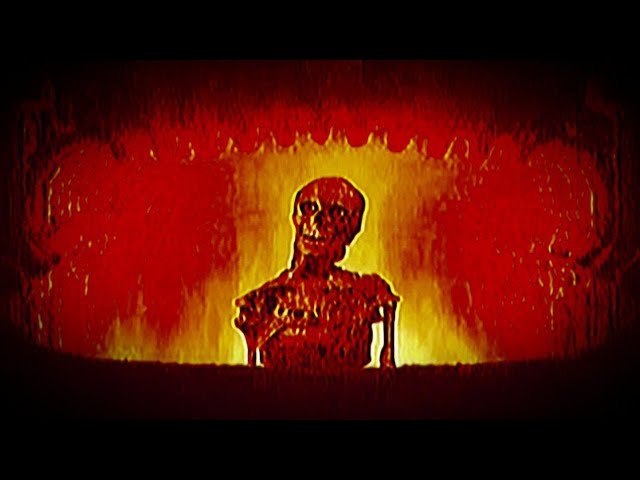
SCP-2419 is a Foundation-operated refinery and waste disposal facility in Colorado that transforms incinerated human remains into immortal, regenerating entities known as “The Laughing Men”—aggressive, unkillable corpses that emit constant laughter and possess an inexplicable hatred for all living things. Built in 1954, this Euclid-class anomaly represents both a containment site and the source of its own breach threat.
The 1954 Facility: What SCP-2419 Really Is
SCP-2419 occupies a remote location 75 kilometers north of Summer Springs, Colorado—a deliberate choice by the Foundation to isolate what was initially conceived as a standard waste processing center. Constructed in 1954 during the Cold War era when the Foundation rapidly expanded its infrastructure, the facility was designed to handle biological waste and remains from containment breaches and terminated personnel.
The site’s dual nature creates a unique classification problem. SCP-2419 refers simultaneously to the physical refinery complex and the anomalous phenomenon that occurs within its incinerators. Unlike typical SCPs where the anomaly exists independently, here the Foundation built the very infrastructure that generates the threat. The facility’s industrial incinerators don’t simply destroy organic matter—they catalyze a transformation that violates every known principle of thermodynamics and biology.
The geographic isolation that once seemed prudent now poses strategic problems. The remote Colorado location means limited response time if containment fails, while the facility’s aging 1950s-era construction wasn’t designed for permanent housing of regenerating hostile entities. What began as a disposal solution became a production line for immortal threats.
The Transformation Process: From D-Class to Laughing Men
When human remains enter SCP-2419’s incinerators, they undergo a metamorphosis that defies biological possibility. Instead of reducing to ash, the organic matter reconstitutes into what the Foundation designates as SCP-2419-A instances. These entities retain a humanoid form but exhibit catastrophic physical damage consistent with incineration—charred skin, exposed bone, and tissue that should render movement impossible.
The signature characteristic is the laughter. Every SCP-2419-A instance produces continuous, involuntary laughter ranging from quiet chuckling to hysterical cackling. Audio analysis reveals no pattern or communication—the laughter appears to be an autonomic response hardwired into their anomalous physiology. This creates a deeply unsettling soundscape within containment areas, where dozens of burning corpses laugh endlessly in the darkness.
Their regeneration operates on a scale that makes termination meaningless. Dismemberment, incineration, acid dissolution—all conventional destruction methods fail because SCP-2419-A instances reconstruct from any remaining tissue fragment within hours. Even complete molecular dispersal results in spontaneous reformation at the original transformation site. The entities don’t heal; they simply refuse to stop existing.
The aggression manifests as an undirected rage toward all living organisms. SCP-2419-A instances attack on sight with surprising coordination despite no observed communication beyond laughter. They demonstrate problem-solving abilities, tool use, and tactical patience—suggesting retained cognitive function despite their destroyed neural tissue. This implies something far worse than mindless undead: these are conscious beings trapped in perpetually burning bodies.
Containment Procedures & The Inevitable Breach
The Euclid classification reflects a grim mathematical reality: SCP-2419 containment will eventually fail. Current protocols involve reinforced holding cells, regular rotation of security personnel to prevent psychological breakdown from constant laughter exposure, and strict prohibition on introducing new organic matter to the incinerators. Yet every terminated D-Class, every containment breach casualty, every biological sample that enters the facility adds another immortal entity to the population.
The Foundation faces an accumulation problem with no solution. SCP-2419-A instances don’t age, don’t tire, and don’t stop. Each year adds more entities to containment while the 70-year-old facility infrastructure degrades. Security protocols assume finite threat duration—but what does “containment” mean for enemies that literally cannot die?
Breach scenarios model catastrophic outcomes. A single escaped SCP-2419-A instance could theoretically reproduce the anomaly by forcing victims into any high-temperature environment, though this remains unconfirmed. The entities’ regeneration means conventional military response would fail. Amnestics can’t erase them. Memetic kill agents require living neural tissue to affect. The Foundation’s standard toolkit becomes useless against an enemy that exists outside biological constraints.
The facility’s remote location, once an asset, now represents a vulnerability. If containment fails during a staffing gap or infrastructure collapse, the nearest response teams are hours away—more than enough time for dozens of laughing, immortal corpses to scatter into the Colorado wilderness.
Case Study: SCP-2419-A-5 and the D-Class Question
John, designated SCP-2419-A-5 after transformation, represents the documented human cost of SCP-2419. Terminated before May 21, 1975, during routine D-Class cycling, John’s remains entered the incinerators as part of standard waste disposal. Hours later, he emerged as a laughing, regenerating entity that retained enough physical characteristics for identification through dental records.
The ethical implications are staggering. The Foundation’s D-Class program operates on the assumption that termination ends suffering. SCP-2419 reveals this as false comfort. Every D-Class processed through the facility doesn’t die—they transform into something that experiences perpetual burning, perpetual rage, and perpetual consciousness locked inside a corpse that won’t stop laughing.
The consciousness question haunts researchers. Do SCP-2419-A instances retain memories of their human existence? The entities don’t speak, but their tactical intelligence suggests preserved cognitive function. If John remembers being human, remembers his termination, remembers transforming into an unkillable burning corpse—the psychological horror exceeds any physical torture. The laughter might not be anomalous compulsion but the only possible response to that realization.
This raises uncomfortable questions about Foundation ethics. Using D-Class personnel for dangerous testing accepts calculated risk of death. But SCP-2419 doesn’t offer death—it offers eternal suffering in a body that regenerates faster than it can be destroyed. The facility transforms the Foundation’s standard operating procedure into a production line for immortal torture victims.
Information Gain: The “Unseen” Lore
SCP-2419’s existence suggests disturbing implications for other Foundation waste disposal sites. If a 1954 Colorado facility spontaneously developed anomalous properties, how many other aging installations might harbor similar transformations? The Foundation’s early Cold War expansion prioritized rapid construction over thorough anomalous screening. SCP-2419 might represent the first discovered case of infrastructure-based anomalies, not the only one.
Cross-referencing with other regeneration-based SCPs reveals no clear pattern. SCP-682’s adaptive regeneration operates on biological principles, however impossible. SCP-2419-A instances regenerate through what appears to be localized reality manipulation—matter spontaneously reorganizing into human form regardless of thermodynamic cost. This suggests potential connection to reality-bending entities or locations, though no direct link has been established.
The historical context raises questions about pre-Foundation incidents. Industrial incinerators existed long before 1954. If SCP-2419’s anomalous properties are inherent to the location rather than the facility, previous structures might have produced similar entities. Local Colorado folklore includes stories of “laughing ghosts” in mining country dating to the 1880s—potentially early SCP-2419-A instances that escaped before Foundation containment. The O5 Council has not authorized investigation into these historical accounts, suggesting either dismissed correlation or classified information above standard researcher clearance.
Fan theories propose SCP-2419 as a “punishment anomaly”—a reality-level response to improper disposal of human remains. This interpretation frames the Laughing Men as cosmic justice for Foundation disregard of D-Class humanity. While unsupported by evidence, the theory resonates because SCP-2419 specifically targets the Foundation’s most ethically questionable practice: treating human beings as disposable resources.
Thematic FAQ
Why can’t the Foundation just stop using SCP-2419’s incinerators?
The facility continues operating because existing SCP-2419-A instances require containment infrastructure. Abandoning the site would release dozens of immortal hostile entities. Additionally, the anomalous properties may extend beyond the incinerators—the entire facility might function as a single anomalous location where human remains transform regardless of disposal method.
Are the Laughing Men actually immortal or just extremely hard to kill?
True immortality. SCP-2419-A instances have survived complete molecular dispersal, vacuum exposure, and submersion in acid for years. They don’t heal damage—they regenerate from conceptual existence. The Foundation has no recorded instance of permanent termination.
What happens if an SCP-2419-A instance escapes containment?
Breach protocols assume worst-case scenarios including reproduction of the anomaly and creation of additional instances from victims. The entities’ intelligence and coordination suggest they could deliberately seek population centers. Current models predict catastrophic casualties before military response could adapt to regenerating enemies.
Could SCP-2419 be connected to other SCPs?
No confirmed connections exist, though researchers note similarities to reality-bending anomalies and locations that impose specific rules on matter. The spontaneous regeneration resembles localized causality violation rather than biological process. Investigation into potential links with other Colorado-based anomalies remains ongoing.
Why is SCP-2419 classified as Euclid instead of Keter?
The classification reflects current containment status, not threat level. While contained, SCP-2419 remains predictable and manageable. The Euclid designation acknowledges that containment will eventually fail due to accumulating entities and aging infrastructure, but hasn’t failed yet. Reclassification to Keter is proposed for when—not if—the first major breach occurs.