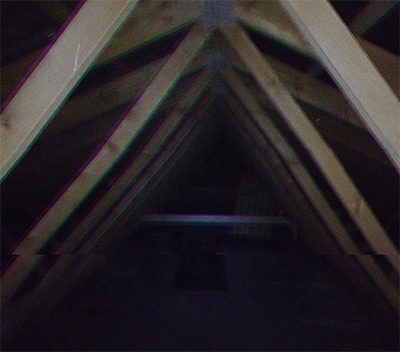
SCP-2740 is a reality-altering cognitohazard believed to possibly exist in the northwest corner of an Indiana attic. The anomaly generates intense existential dread in anyone aware of it, yet its physical existence remains unconfirmed—making it one of the Foundation’s most philosophically disturbing containment challenges.
The Paradox of Non-Existence
SCP-2740 represents a fundamental challenge to our understanding of reality: What happens when something that may not physically exist still produces measurable, dangerous effects on the world? This anomaly occupies the liminal space between perception and reality, where the act of knowing becomes the threat itself.
The Foundation’s documentation deliberately uses uncertain language—”believed to possibly exist”—which is highly unusual for an organization that prides itself on clinical precision. This linguistic hedging isn’t bureaucratic caution; it’s a containment protocol. The moment researchers commit to definitive statements about SCP-2740’s existence, they risk amplifying its reality-altering properties.
This creates a recursive nightmare: To study the anomaly, personnel must acknowledge it. But acknowledgment itself may be what gives SCP-2740 power. The entity exists in a quantum state of observation-dependent reality, similar to Schrödinger’s cat, except the observer doesn’t just collapse the wave function—they become trapped in it.
The philosophical implications extend beyond theoretical physics into epistemology. If awareness alone can manifest threats, then knowledge itself becomes a containment breach vector. The Foundation must balance the need to understand anomalies against the danger that understanding poses. SCP-2740 forces the question: Can ignorance be a valid containment strategy?
Classification & Containment Breakdown
SCP-2740 holds a Euclid classification, reflecting the Foundation’s uncertainty about both its nature and containment requirements. Euclid-class objects are unpredictable or not fully understood—a perfect designation for an anomaly whose very existence is questionable.
The containment procedures focus on information suppression rather than physical barriers. Access to SCP-2740 documentation requires Level 3/2740 clearance, a specialized designation that suggests compartmentalized knowledge protocols. This isn’t standard security theater; it’s recognition that the primary containment mechanism is limiting the number of minds exposed to the cognitohazard.
Personnel who become aware of SCP-2740 report persistent psychological effects even after amnestic treatment, suggesting the anomaly creates permanent alterations in cognitive architecture. The Foundation cannot simply erase knowledge of SCP-2740—the dread it instills appears to bypass normal memory structures and embed itself in deeper neurological patterns.
The containment logic reveals a disturbing truth: The Foundation isn’t containing SCP-2740 itself. They’re containing knowledge of it, operating on the theory that the anomaly’s power scales with the number of observers. This makes every researcher, every D-class subject, and every O5 Council member who reads the file a potential amplifier of the threat.
The Lee Family Home: Ground Zero
The Lee family residence in Indiana serves as the epicenter of SCP-2740’s manifestation. The northwest corner of the attic isn’t just a location—it’s a conceptual anchor point where the anomaly’s influence concentrates. The family has remained in the home for years, not because they’re physically trapped, but because they’ve “never tried” to leave.
This distinction is crucial. Physical imprisonment would be comprehensible, even mundane by Foundation standards. But the Lee family’s situation suggests something far more insidious: a memetic compulsion that operates below conscious awareness. They don’t feel trapped because the idea of leaving has been excised from their cognitive possibility space.
The domestic setting amplifies the horror. Homes represent safety, familiarity, and control over one’s environment. SCP-2740 inverts this, transforming the most mundane space—an attic storage area—into a locus of existential threat. The anomaly proves that danger doesn’t require exotic locations or dramatic manifestations. It can exist in the corner of your ceiling, in the space you walk past every day without noticing.
The family’s psychological imprisonment raises questions about free will and agency. If they cannot conceive of leaving, are they truly making a choice to stay? The anomaly may function as a reality anchor, warping probability fields around itself to ensure witnesses remain proximate. The Lee family becomes part of the containment apparatus, unwitting guardians of something that may not exist.
The Dread Effect: Cognitive Hazard Analysis
The intense dread response triggered by awareness of SCP-2740 operates independently of the anomaly’s physical properties—or lack thereof. Subjects report overwhelming existential terror that persists even when they rationally understand the entity may not be real. This suggests the dread isn’t a reaction to a threat, but rather a direct neurological effect imposed by the cognitohazard.
Compared to other memetic SCPs, SCP-2740’s dread effect is notable for its lack of clear causation. Memetic kill agents typically function through specific visual or linguistic patterns that exploit vulnerabilities in human cognition. SCP-2740 requires only abstract awareness—you don’t need to see it, hear it, or read specific trigger phrases. Simply knowing the concept exists is sufficient.
The neurological mechanism likely involves the amygdala’s threat detection systems being artificially activated without corresponding sensory input. The brain receives a danger signal with no identifiable source, creating profound cognitive dissonance. Humans are pattern-recognition machines; when we experience fear without an object to fear, our minds generate increasingly disturbing explanations to resolve the contradiction.
The Foundation’s inability to determine the dread effect’s source represents a critical knowledge gap. Standard cognitohazard analysis relies on identifying the transmission vector—the specific information pattern that causes harm. SCP-2740 appears to bypass this entirely, suggesting it operates on principles the Foundation doesn’t yet understand. The anomaly may be rewriting the rules of cause and effect, making the dread not a symptom but a fundamental property of the reality distortion itself.
Franklin Lee Interview Breakdown
The post-discovery interview with Franklin Lee provides the closest thing to direct testimony about SCP-2740’s nature. Lee’s statements are characterized by unusual linguistic patterns—frequent pauses, self-corrections, and contradictory descriptions that suggest his perception of events has been compromised.
Key revelations from the interview include Lee’s insistence that the attic corner “changed” without any physical alteration occurring. He describes the space as simultaneously empty and occupied, present and absent. This paradoxical description aligns with quantum superposition theories, where SCP-2740 exists in multiple states until observation forces a collapse—except the collapse never fully resolves.
What Lee doesn’t say proves equally significant. He never directly describes seeing SCP-2740, only feeling its presence. He cannot explain why the family stayed, offering circular reasoning that trails into silence. These gaps in testimony suggest memetic influence actively preventing accurate description. The anomaly may possess self-preservation mechanisms that corrupt witness accounts, ensuring it remains indefinable and therefore uncontainable through conventional means.
The interview’s most disturbing element is Lee’s final statement, redacted in official documentation. Foundation analysts note that personnel who read the unredacted version experience intensified dread effects, suggesting Lee’s words contain concentrated cognitohazardous properties. The anomaly may have used Lee as a transmission vector, encoding itself into his testimony to spread beyond the physical location.
Information Gain: Reality-Altering Implications
SCP-2740 shares conceptual DNA with other perception-based anomalies like SCP-055 (the self-keeping secret) and SCP-3125 (the memetic entity that exists in ideatic space). However, SCP-2740’s unique characteristic is its ambiguous ontological status. While SCP-055 definitely exists but cannot be remembered, and SCP-3125 exists as a thought-form, SCP-2740 occupies the uncertain territory between existence and non-existence.
This positioning has profound implications for theoretical physics, particularly observer-dependent reality models. Quantum mechanics demonstrates that observation affects particle behavior at subatomic scales. SCP-2740 suggests this principle scales to macroscopic reality—that human consciousness can literally create or uncreate entities through the act of observation. If true, this validates certain interpretations of quantum theory while opening terrifying possibilities about reality’s malleability.
The containment philosophy required for SCP-2740 represents a paradigm shift. Traditional containment assumes a concrete threat that can be isolated, neutralized, or destroyed. But how do you contain something that exists only in the space between knowing and not knowing? The Foundation’s approach—limiting information exposure—acknowledges that some anomalies cannot be defeated, only managed through strategic ignorance.
The Level 3/2740 classification mystery deepens these questions. Standard security clearances follow predictable patterns, but the specialized designation suggests SCP-2740 requires unique cognitive preparation or memetic inoculation before exposure. The Foundation may have discovered that certain mental states or knowledge frameworks provide partial immunity to the dread effect. Alternatively, Level 3/2740 clearance might indicate personnel who have already been compromised and are being monitored for reality-altering effects.
Cross-testing with other cognitohazards remains prohibited, but theoretical analysis suggests SCP-2740 could interact catastrophically with antimemetic entities. If an anomaly that resists being known encounters an anomaly whose existence depends on being known, the resulting paradox might create a reality-breaking feedback loop. The Foundation’s conservative approach to SCP-2740 research reflects awareness that some questions are too dangerous to answer.
Thematic FAQ
Does SCP-2740 actually exist physically?
The Foundation cannot definitively confirm SCP-2740’s physical existence. All evidence is circumstantial—psychological effects, witness testimony, and localized reality distortions. The anomaly may exist purely as a cognitohazardous concept that generates real-world effects through observer interaction, making the question of physical existence philosophically meaningless.
Why can’t the Foundation just destroy the Lee family home?
Destroying the location might not eliminate SCP-2740 if the anomaly exists primarily in conceptual space rather than physical reality. Additionally, the Lee family’s continued presence may serve as an unintentional containment mechanism, anchoring the entity to a specific location. Removing them could allow SCP-2740 to spread or manifest elsewhere with unpredictable consequences.
How is SCP-2740 different from other memetic hazards?
Most memetic hazards require specific information patterns—images, sounds, or text—to transmit their effects. SCP-2740 requires only abstract awareness of its potential existence. This makes it nearly impossible to contain through information suppression, as even knowing that “something might be in that attic corner” is sufficient for exposure.
Can amnestics cure the dread effect?
Standard amnestic treatments show limited effectiveness against SCP-2740’s psychological impacts. The dread appears to persist even after memories of the anomaly are suppressed, suggesting it creates permanent neurological changes or operates through mechanisms that bypass conventional memory structures. Some researchers theorize the dread is a side effect of perceiving something that violates causality, leaving a permanent cognitive scar.
What would happen if SCP-2740 became widely known?
Mass exposure represents a potential XK-class end-of-world scenario. If millions of people simultaneously became aware of SCP-2740, the collective observation might force the anomaly into definitive existence, amplifying its reality-altering properties exponentially. Alternatively, widespread knowledge might dilute its power through diffusion. The Foundation cannot risk testing either hypothesis.