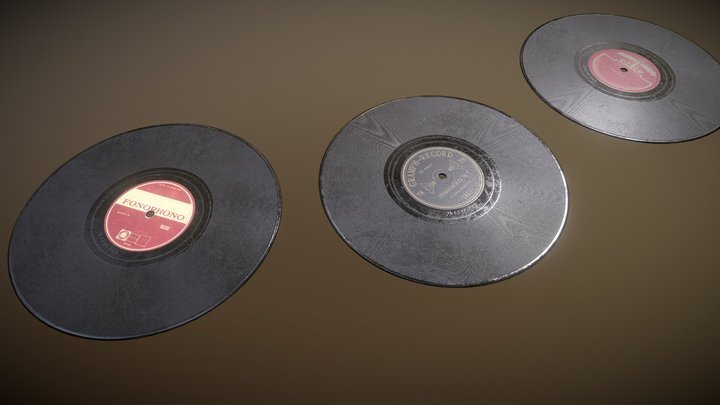
SCP-235 is a collection of anomalous shellac phonograph records from the late 1920s that produce reality-altering effects when played. Each record contains a different song with a white label, and playback causes severe spatial distortions, temporal anomalies, and physical transformations in nearby objects and living beings, making them one of the Foundation’s most dangerous auditory hazards.
The 1920s Artifact: Material Composition & Discovery
SCP-235 consists of multiple shellac phonograph records manufactured using production techniques consistent with late 1920s American recording technology. Shellac, a resin secreted by the lac bug, was the dominant material for audio recording during this era—brittle, heavy, and capable of holding approximately three to four minutes of audio per side when played at 78 RPM.
Each record in the SCP-235 collection features a pristine white label with handwritten song titles in black ink. The penmanship style matches commercial recording practices from 1927-1929, yet no record label, manufacturer mark, or catalog number appears on any instance. This absence of commercial branding is the first indicator of their anomalous origin.
The Foundation acquired the initial set of SCP-235 records during a 1963 raid on a private estate in Providence, Rhode Island. The collection was discovered in a sealed basement vault alongside occult literature and experimental audio equipment dating to the Prohibition era. Historical research suggests the original owner, a sound engineer named [REDACTED], had connections to early electronic music pioneers and fringe acoustic research groups that explored “sonic manipulation of physical space.”
Material analysis reveals the shellac composition matches period-appropriate formulations, but spectroscopic examination detected trace amounts of an unidentified crystalline compound embedded within the grooves—a substance that does not appear in any known phonograph manufacturing process.
Classification & Containment Breakdown
SCP-235 is classified as Euclid due to the unpredictable and escalating nature of its effects. While the records themselves remain inert when not played, the difficulty in predicting the exact manifestation of anomalous phenomena during playback prevents a Safe classification. The objects require active containment protocols rather than simple storage.
Current containment procedures mandate that all SCP-235 instances be stored in individual soundproof containers within a Faraday-shielded vault at Site-77. No playback equipment is permitted within 50 meters of the storage facility. Any testing requires O5-level approval and must occur in a reinforced testing chamber equipped with immediate audio cutoff systems and reality anchor stabilizers.
The reasoning behind these measures stems from Incident 235-07, when unauthorized playback caused a 12-meter radius sphere of space to experience non-linear temporal flow for 96 hours. Objects within the affected zone aged at rates varying from 1:1000 to 1000:1 relative to normal time, and three personnel experienced fatal rapid aging before containment was reestablished.
The Faraday shielding prevents potential electromagnetic anomalies from propagating beyond the containment area, while reality anchors help stabilize local spacetime against the records’ physics-violating effects.
The Acoustic Anomaly: How SCP-235 Defies Physics
When played on any phonograph capable of reading 78 RPM shellac records, SCP-235 produces music consistent with late 1920s jazz, blues, and early swing recordings. The audio quality matches period recordings—surface noise, limited frequency range, and the characteristic warmth of acoustic recording techniques.
The anomaly manifests approximately 30-45 seconds after playback begins. Sound waves from SCP-235 do not behave according to standard acoustic principles. Instead of dissipating energy through air molecule vibration, the audio appears to interact directly with the quantum wavefunction of matter within range.
Normal sound waves transfer kinetic energy through compression and rarefaction of air molecules, losing intensity according to the inverse square law. SCP-235’s audio maintains constant amplitude regardless of distance from the source until reaching a sharp boundary at approximately 15-20 meters, where effects cease entirely. This suggests the anomaly operates through a mechanism unrelated to conventional wave propagation.
Documented effects include:
- Spatial distortion: Solid objects bend, stretch, or compress in rhythm with the music’s tempo and melody. A rising musical phrase causes vertical elongation; descending notes produce compression.
- Temporal desynchronization: Different regions within the effect radius experience time at different rates, creating zones where causality becomes non-linear.
- Material transmutation: Prolonged exposure causes objects to shift between states of matter or transform into entirely different substances. Wood becomes glass, metal liquefies, organic tissue crystallizes.
- Consciousness alteration: Human subjects report perceiving additional spatial dimensions and experiencing memories that never occurred.
Expert analysis suggests SCP-235 may be encoding information in a format that bypasses auditory processing and directly manipulates the Planck-scale structure of spacetime. The music serves as a carrier wave for instructions that rewrite local physical laws.
Cross-Reference Analysis: Similar Audio Anomalies in the Foundation
SCP-235 belongs to a broader category of auditory cognitohazards and reality-altering sound phenomena documented by the Foundation. However, its mechanism differs significantly from other musical anomalies.
SCP-012 (“A Bad Composition”) compels listeners to complete an unfinished musical score using their own blood, operating through memetic compulsion rather than physical reality manipulation. SCP-513 (a cowbell) produces psychological trauma through a sound that implants a hostile entity into the listener’s perception. SCP-407 (“The Song of Genesis”) accelerates biological evolution through audio exposure but remains bound by biological principles.
What distinguishes SCP-235 is its direct manipulation of non-living matter and spacetime itself. The anomaly doesn’t require human perception to function—effects occur even in sealed chambers with no observers present. This suggests SCP-235 operates at a more fundamental level of reality than memetic or cognitohazardous audio.
Theoretical analysis by Foundation physicists proposes that SCP-235 may be an artifact of “acoustic thaumaturgy”—a hypothetical practice that uses sound as a medium for reality-bending rituals. The 1920s timeframe coincides with a documented surge in occult experimentation with emerging technologies. Radio, phonographs, and electrical recording equipment were new tools that esoteric practitioners attempted to weaponize for supernatural purposes.
The crystalline compound found in SCP-235’s grooves may serve as a physical anchor for thaumaturgic programming, with the music acting as an activation sequence. Each song could represent a different “spell” encoded in audio format, explaining why different records produce variations in their reality-altering effects.
Test Log Breakdown: What Happens When You Play the Records
Test 235-A (Initial Assessment)
D-8847 was instructed to play SCP-235-03 (labeled “Midnight Serenade”) in a standard testing chamber. For the first 28 seconds, playback proceeded normally with period-appropriate jazz music. At 0:29, the D-Class subject reported that the walls appeared to be “breathing.” Video footage confirmed rhythmic expansion and contraction of concrete surfaces matching the song’s 4/4 time signature.
At 1:15, the subject’s chair began melting into the floor while simultaneously maintaining structural integrity—occupying an impossible state between solid and liquid. D-8847 attempted to stand but found his legs had fused with the liquefied chair material. Playback was terminated at 1:47. The chair required 6 hours to fully resolidify, with D-8847’s legs embedded in the reformed material. Surgical extraction was necessary.
Test 235-F (Extended Exposure)
To determine long-term effects, SCP-235-07 (“The Wanderer’s Waltz”) was played for a full 3-minute duration in an empty chamber containing only a steel table and a potted plant. Remote observation revealed progressive reality degradation.
At 0:45, the table began phasing between visible and invisible states. At 1:30, the plant experienced rapid growth, flowering, death, and decomposition in a 15-second cycle that repeated continuously. At 2:10, spatial geometry within the chamber became non-Euclidean—parallel walls appeared to intersect, and the floor existed at multiple heights simultaneously.
When personnel entered the chamber 30 minutes after playback ceased, they reported extreme disorientation and nausea. The steel table had transformed into a crystalline structure of unknown composition. The plant had become a hybrid organism displaying characteristics of both flora and fungi, with tissue samples containing DNA sequences not found in any terrestrial species.
Test 235-K (Containment Breach Scenario)
During an unauthorized experiment, Junior Researcher Vance played SCP-235-12 (“Echoes of Tomorrow”) without proper safety protocols. The resulting anomaly expanded beyond predicted parameters, affecting a 40-meter radius and breaching containment.
Personnel in adjacent corridors reported seeing “afterimages” of themselves performing actions they had not yet taken. Security footage showed individuals existing in multiple temporal states simultaneously—past, present, and near-future versions occupying the same space. One guard experienced his own death from a containment breach that wouldn’t occur for another three days, suffering fatal cardiac arrest from the psychological trauma of witnessing his future demise.
The temporal anomaly persisted for 8 hours before collapsing. Amnestics were administered to 47 personnel, and 12 individuals required permanent reassignment due to irreversible temporal perception disorders.
Frequently Asked Questions
What songs are on SCP-235?
Each SCP-235 record contains a unique song with titles written on white labels. Documented titles include “Midnight Serenade,” “The Wanderer’s Waltz,” “Echoes of Tomorrow,” and approximately 30 other compositions. The songs musically resemble authentic 1920s jazz and blues recordings, but no matches have been found in historical music archives. The artists and composers remain unidentified, suggesting the recordings were created specifically for anomalous purposes rather than commercial release.
Can SCP-235 be destroyed?
Destruction attempts have been unsuccessful and dangerous. When researchers attempted to break SCP-235-04, the record regenerated within 72 hours, and the destruction attempt triggered an uncontrolled reality-altering event that aged the testing chamber’s contents by 200 years in 15 minutes. Incineration, acid dissolution, and molecular disintegration have all failed. The crystalline compound embedded in the shellac appears to anchor the records to reality in a way that resists conventional destruction methods. Current protocol focuses on containment rather than neutralization.
Has anyone survived listening to a complete SCP-235 record?
Yes, but with severe consequences. D-Class personnel who have heard full playbacks typically experience permanent alterations to their perception of time and space. Survivors report ongoing hallucinations of “impossible geometries,” inability to perceive linear time, and in some cases, spontaneous teleportation to locations they were thinking about. Most survivors require permanent containment in specialized medical facilities. No Foundation personnel above D-Class designation have been authorized for full-duration exposure.
Are the records connected to a specific time period or location?
Evidence suggests SCP-235 originated in Providence, Rhode Island, during the late 1920s, likely created between 1927-1929. The discovery location, manufacturing techniques, and musical style all point to this timeframe. Historical research indicates the original creator may have been involved with occult groups experimenting with “sonic thaumaturgy”—using sound technology for supernatural purposes. The late 1920s saw a convergence of new audio technology and esoteric experimentation, creating ideal conditions for anomalous artifact creation. However, the true origin remains classified, and some researchers theorize the records may be far older, merely disguised as 1920s artifacts.
Why doesn’t the Foundation just stop researching SCP-235?
Despite the dangers, SCP-235 represents a unique opportunity to understand how sound can be weaponized to manipulate physical reality. The principles behind the anomaly could lead to breakthroughs in reality-anchoring technology, temporal mechanics, and defense against other auditory cognitohazards. Additionally, the existence of SCP-235 suggests other similar artifacts may exist in private collections or undiscovered locations. Understanding these records helps the Foundation identify and contain related anomalies before they cause civilian casualties. Research continues under strictly controlled conditions with extensive safety protocols.