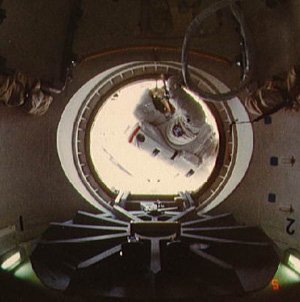
SCP-2222 is an anomalous airlock system located within a classified orbital space station, consisting of two opaque hermetic plug doors and a 3.6-meter diameter cylindrical chamber. This extraterrestrial containment anomaly exhibits spatial properties that violate conventional physics, making it one of the Foundation’s most enigmatic space-based objects requiring continuous orbital monitoring and strict access protocols.
The Orbital Discovery: How the Foundation Found SCP-2222
The Foundation’s acquisition of SCP-2222 remains partially redacted, but available documentation suggests its discovery occurred during routine monitoring of decommissioned Cold War-era space stations. The anomaly exists within a facility designated as “████ ████████-█,” likely a Soviet or early international space station that was officially declared defunct decades ago.
Initial reconnaissance teams noticed discrepancies in the station’s structural blueprints—an airlock chamber that appeared on no original design documents. When Foundation astronauts first approached the structure, they reported unusual electromagnetic interference and temporal distortions in their equipment readings. The opaque nature of the hermetic doors prevented visual inspection, forcing researchers to rely on remote sensing equipment that consistently returned contradictory data about the chamber’s interior dimensions.
What transformed this from a curiosity into a classified SCP was the first accidental breach. A maintenance crew attempting to seal what they believed was a malfunctioning door triggered the airlock sequence, and the individual who entered the chamber did not emerge from the opposite door as physics would dictate. Instead, telemetry suggested they had been displaced to an unknown location—or possibly ceased to exist in conventional spacetime.
Spatial Mechanics & Anomalous Properties
SCP-2222’s cylindrical chamber measures exactly 3.6 meters in diameter according to external measurements, yet internal dimensional analysis reveals significant spatial inconsistencies. Objects entering through one door do not consistently exit through the other, despite the chamber’s apparent finite length.
The anomalous physics manifest in several documented ways. First, the chamber appears to function as a non-Euclidean space where traditional geometric rules collapse. Laser measurements sent through the airlock register distances ranging from 3.6 meters to several kilometers, with readings fluctuating without pattern. Second, the opaque hermetic doors prevent all electromagnetic radiation from penetrating, including radio waves, making communication with anyone inside impossible.
Most disturbing is the temporal component. Chronometers sent through the airlock return with time discrepancies—some showing mere seconds have passed while external observers measure hours, others displaying impossible negative time values. This suggests SCP-2222 doesn’t simply transport matter through space, but potentially through time or into parallel dimensional frameworks.
The hermetic sealing serves a critical containment function. When both doors remain closed, the anomaly appears dormant. However, opening either door while the chamber contains matter triggers what researchers term “spatial cascade events”—reality distortions that can propagate beyond the immediate chamber if not immediately contained.
Containment Protocol Analysis
SCP-2222 is classified as Euclid, reflecting both its unpredictable nature and the Foundation’s incomplete understanding of its mechanisms. The Euclid designation acknowledges that while the anomaly can be contained, its behavior patterns remain insufficiently documented to guarantee Safe classification.
Containment procedures mandate that both hermetic doors remain sealed at all times except during authorized testing. The entire space station segment housing SCP-2222 has been isolated from other orbital facilities, with a minimum exclusion zone of 500 meters enforced through automated guidance systems that redirect any approaching spacecraft.
Orbital containment presents unique challenges absent in terrestrial facilities. The Foundation cannot simply build concrete walls or establish armed perimeters in space. Instead, containment relies on maintaining the station’s orbit through periodic thruster adjustments, preventing atmospheric decay that would cause uncontrolled reentry. The station’s position is continuously monitored by Foundation satellites, and cover stories attribute it to classified military research to deter civilian space agencies.
Personnel access requires specialized training in zero-gravity containment protocols and emergency evacuation procedures. All testing must be approved by Site Command and conducted remotely when possible, with human subjects entering only when absolutely necessary for data collection that automated systems cannot provide.
The D-Class Experiments: What Happens Inside
Foundation testing logs reveal a disturbing pattern of outcomes for D-Class personnel sent through SCP-2222. Test subjects are equipped with full telemetry suits, cameras, and communication equipment before entering the first door. Once inside the chamber, all electronic signals cease immediately—a complete communications blackout that persists until the subject either exits or is declared lost.
In Test Log 2222-A, D-9841 entered the chamber and successfully emerged from the opposite door after what external observers measured as 47 minutes. However, the subject’s chronometer indicated only 3 minutes had elapsed, and they reported seeing “nothing but white” during the entire transit. Psychological evaluation revealed severe dissociation and an inability to recall specific details beyond the overwhelming whiteness.
Test Log 2222-C produced more alarming results. D-7623 entered the chamber, and the exit door opened 12 seconds later—but no one emerged. Video footage from inside the chamber (recovered later through specialized equipment) showed the subject walking forward, then suddenly fragmenting into what appeared to be multiple overlapping versions of themselves before vanishing entirely. The subject’s biosigns ceased simultaneously across all monitoring equipment.
Perhaps most unsettling was Test Log 2222-G, where D-4455 emerged from the exit door before entering the entrance door. External cameras confirmed the subject exited 8 seconds before their scheduled entry time, creating a causality violation that required immediate temporal containment protocols. The subject possessed memories of entering the chamber and experiencing “infinite repetition” but could not articulate what that meant in coherent terms.
These experiments led to a moratorium on human testing, with current protocols limiting chamber access to remote probes and expendable equipment.
Theories on Origin & Purpose
The Foundation’s research division has proposed several competing theories about SCP-2222’s origins, none conclusively proven.
The Weapons Platform Hypothesis suggests SCP-2222 was intentionally created during the Cold War as an experimental disposal system for nuclear waste or biological weapons. The spatial anomalies could represent a failed attempt to create a “pocket dimension” for permanent storage, with the project abandoned when researchers lost control of the dimensional parameters.
The Extraterrestrial Artifact Theory posits that SCP-2222 predates human space exploration entirely. Proponents note that the airlock’s dimensions don’t match standard specifications for any known space program, and the materials composing the hermetic doors contain isotopic ratios inconsistent with Earth-origin manufacturing. This theory suggests humans simply built a space station around an existing anomalous object found in orbit.
The Dimensional Breach Model proposes that SCP-2222 isn’t a constructed object at all, but rather a naturally occurring tear in spacetime that happens to be contained within an artificial structure. The “airlock” might be humanity’s attempt to seal and control a phenomenon that spontaneously manifested in orbit, possibly triggered by high-energy particle interactions in the upper atmosphere.
Fan communities have connected SCP-2222 to other space-based anomalies, particularly those involving dimensional instability. Some theorists link it to SCP-120 (a teleportation pool) or SCP-093 (the Red Sea Object), suggesting a network of interconnected dimensional gateways scattered across Earth and near-Earth space.
Cross-Reference: SCP-2222 in the Larger Foundation Universe
SCP-2222 exists within a broader category of space-based anomalies that challenge the Foundation’s primarily terrestrial containment infrastructure. It shares characteristics with several documented objects that manipulate spatial dimensions or create pocket realities.
The anomaly’s temporal distortion effects parallel those observed in SCP-004 (the 12 Rusty Keys and Door), where subjects experience time differently inside versus outside the anomalous space. However, SCP-2222’s orbital location adds complexity—relativistic effects from orbital velocity already create minor time dilation, making it difficult to distinguish anomalous temporal shifts from natural physics.
Foundation astronomers have noted that SCP-2222’s orbital position occasionally aligns with other classified space anomalies, leading to speculation about whether these objects influence each other. During one such alignment, monitoring equipment detected unusual gravitational waves emanating from the chamber, suggesting possible interaction with distant massive objects or dimensional boundaries.
The O5 Council has classified SCP-2222 as a potential component of Project Heimdall, the Foundation’s contingency plan for extraterrestrial containment breaches. If hostile entities ever threaten Earth from space, SCP-2222’s dimensional displacement properties could theoretically be weaponized as a last-resort defense mechanism—though the unpredictable nature of where displaced matter actually goes makes this option extremely risky.
Frequently Asked Questions
What happens if someone gets stuck inside SCP-2222?
Based on documented test logs, individuals trapped inside SCP-2222’s chamber experience severe temporal and spatial distortion. Some subjects report experiencing “infinite repetition” or existing in multiple states simultaneously. The Foundation has no reliable method for extracting trapped personnel, as opening the doors while someone remains inside risks catastrophic spatial cascade events. Current protocols treat anyone who fails to exit within 60 minutes as permanently lost.
Why can’t the Foundation just destroy SCP-2222?
Destroying the anomaly poses unacceptable risks. The chamber’s dimensional properties mean that physical destruction could rupture the spatial boundaries containing whatever exists inside, potentially releasing the accumulated displaced matter and energy back into normal space. Additionally, the anomaly’s location in orbit means any explosive containment failure would create debris that threatens other satellites and space stations. The Foundation’s policy is to maintain stable containment rather than risk catastrophic breach through destruction attempts.
Is SCP-2222 connected to other dimensional SCPs?
While no direct connection has been proven, researchers note striking similarities between SCP-2222 and other dimension-manipulating anomalies. The temporal distortions mirror effects seen in SCP-004, while the spatial displacement resembles SCP-120’s teleportation properties. Some theorists propose these anomalies represent different manifestations of the same underlying dimensional instability, possibly created by a single unknown entity or civilization. However, the Foundation maintains these as separate objects until conclusive evidence of connection emerges.
Has anyone ever successfully mapped what’s inside the chamber?
No complete mapping exists. Remote probes equipped with LIDAR and spatial measurement tools return contradictory data—some suggesting the chamber is exactly 3.6 meters as external measurements indicate, others recording distances of several kilometers or even infinite regression. The most successful probe transmitted data for 6 hours while external observers measured only 30 seconds of transit time, capturing images of what appeared to be endless white void with occasional geometric structures that defied Euclidean geometry. The probe never exited either door and is presumed lost in whatever space exists within SCP-2222.
Could SCP-2222 be used for space travel or exploration?
While the theoretical potential exists, practical application is impossible with current understanding. The unpredictable nature of where and when subjects emerge makes SCP-2222 useless for controlled transportation. Additionally, the high casualty rate among test subjects and the complete communications blackout inside the chamber mean any exploratory mission would be effectively suicide. The Foundation has explicitly prohibited any attempts to “navigate” or “control” the anomaly’s dimensional properties until a complete theoretical framework for its operation can be established—something that may never occur given the object’s apparent violation of known physics.