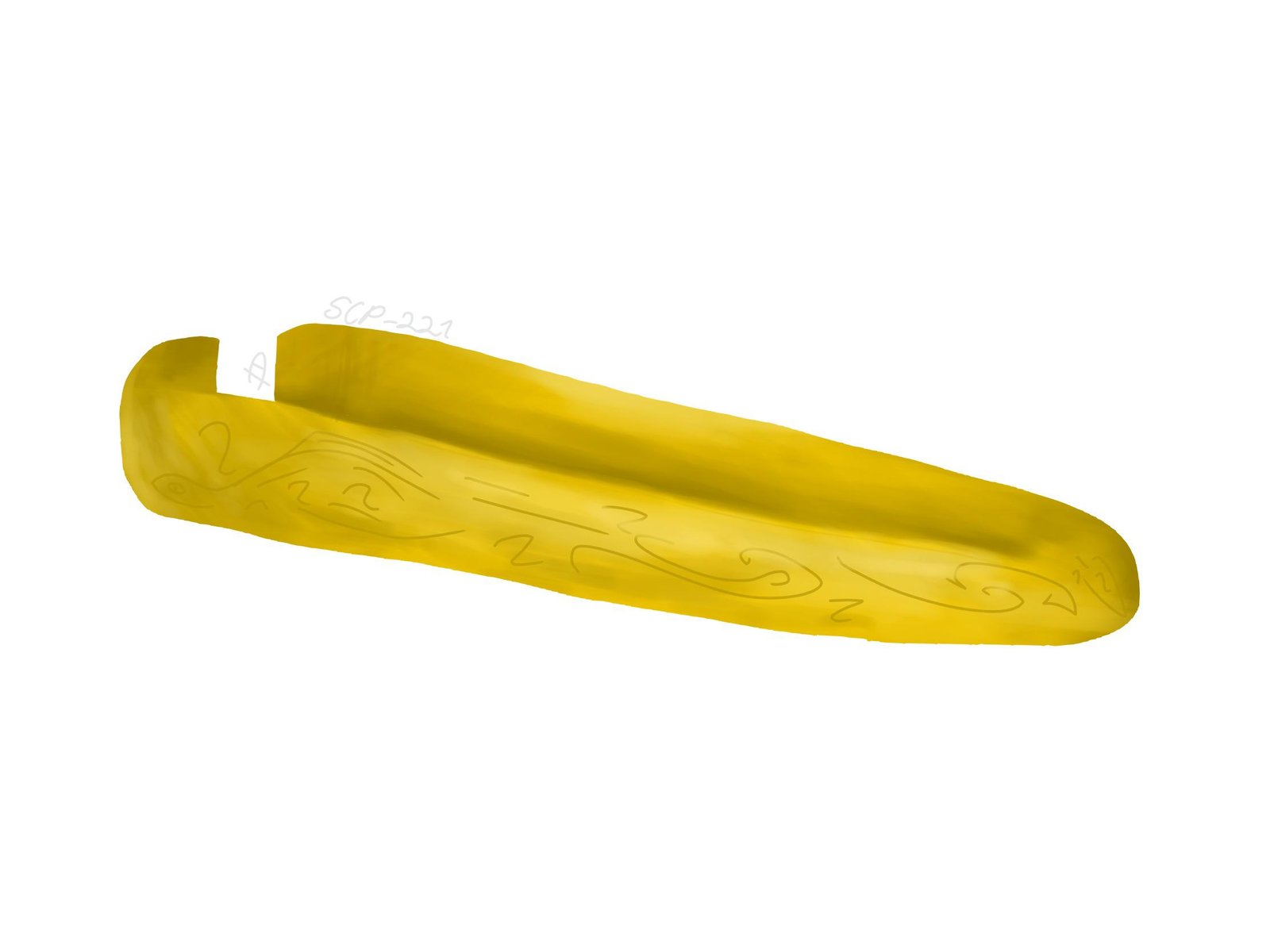
SCP-221 is a pair of 16th or 17th-century gold tweezers that induces severe, localized obsessive-compulsive disorder in anyone who uses them on their own body. What begins as routine hair removal rapidly escalates into uncontrollable, destructive grooming behavior that continues until physical intervention occurs. Despite its devastating psychological effects, SCP-221 remains classified as Safe due to its predictable nature and ease of containment when not in active use.
The Renaissance Artifact: Origins and Physical Properties
SCP-221 appears to be a product of European goldsmithing from the late Renaissance period, an era when personal grooming implements were status symbols among the wealthy. The tweezers measure approximately 8 centimeters in length and display craftsmanship consistent with 16th or 17th-century techniques. The gold construction suggests these were luxury items, possibly commissioned by nobility or wealthy merchants who could afford such extravagance for everyday grooming.
During this historical period, tweezers served multiple purposes beyond cosmetic hair removal. Physicians used similar instruments for extracting splinters, removing sutures, and performing delicate medical procedures. The quality of SCP-221’s construction indicates it was likely intended for personal use rather than medical application, though its original owner remains unknown.
The object shows signs of age-appropriate wear, with slight discoloration and microscopic scratches consistent with centuries of existence. No engravings, maker’s marks, or identifying symbols have been found on the surface, making it impossible to trace the item to a specific goldsmith or workshop. This anonymity raises questions about whether the anomalous properties were intentional or emerged through unknown circumstances after creation.
What transforms this historical curiosity into an anomalous threat is not its appearance but its psychological payload—a compulsion mechanism that activates upon skin contact and refuses to release its victim until external forces intervene.
The Compulsion Mechanism: How SCP-221 Hijacks the Mind
The anomalous effect of SCP-221 manifests exclusively when an individual uses the tweezers on their own body. The moment of contact triggers an immediate neuropsychological cascade that resembles obsessive-compulsive disorder but operates at supernatural intensity and speed.
Initial use appears normal. The subject plucks a hair, examines the result, and experiences what they describe as “satisfaction” or a sense that the area “needs more work.” This seemingly innocuous beginning masks the cognitive trap being set. Within minutes, the compulsion intensifies. The subject becomes fixated on perceived imperfections—stray hairs, skin irregularities, or blemishes that may not actually exist.
Unlike clinical OCD, which develops over time and responds to cognitive behavioral therapy or medication, SCP-221’s compulsion is immediate, absolute, and resistant to rational intervention. Subjects report full awareness that their behavior is harmful, yet they describe an overwhelming inability to stop. The tweezers become an extension of an irresistible urge that overrides self-preservation instincts.
The progression follows a predictable pattern: hair removal escalates to skin picking, which advances to tissue damage, and ultimately results in severe self-mutilation if the object is not forcibly removed. The affected individual will continue using SCP-221 until physically restrained or until the tweezers are taken away. Even after separation, subjects report lingering urges and phantom sensations for hours or days, though these gradually diminish without the object’s presence.
Neurologically, SCP-221 appears to hijack the brain’s reward pathways while simultaneously disabling executive function and impulse control. The result is a closed loop where each action with the tweezers provides momentary relief that immediately demands repetition, creating an accelerating cycle of compulsive behavior.
Classification & Containment Protocol
SCP-221 holds a Safe classification within the Foundation’s object class system. This designation often confuses newcomers to SCP lore, as “Safe” does not mean harmless—it means predictable and easily contained. SCP-221 poses no threat when stored properly and only becomes dangerous through direct misuse. Unlike Euclid or Keter-class anomalies that require complex containment or pose existential risks, SCP-221 can be neutralized simply by keeping it away from potential users.
Current containment procedures require SCP-221 to be stored in a standard secure locker at Site-19. The object must be kept in a sealed container, and any personnel handling it must wear protective gloves to prevent skin contact. These measures are sufficient because SCP-221 exhibits no autonomous behavior, does not attempt to breach containment, and cannot activate its effects without human interaction.
The simplicity of containment underscores an important principle in Foundation operations: the most dangerous anomalies are not always the hardest to contain. SCP-221’s true threat lies in human curiosity and the mundane appearance of the object. A casual observer might mistake it for a museum piece or antique curiosity, making accidental exposure a persistent risk during transport or cataloging.
Handling protocols explicitly forbid any testing on human subjects without O5-level approval, though historical test logs remain in the database for research purposes. The psychological damage inflicted by SCP-221 is considered severe enough that further experimentation offers diminishing returns compared to the harm caused.
Test Log 221-A: The Progression of Obsession
Early Foundation testing of SCP-221 documented the anomaly’s effects with clinical precision, though the results proved disturbing enough to halt further human trials. Test subjects, all D-class personnel who volunteered under standard protocols, demonstrated remarkably consistent behavioral patterns.
Subject D-8432, a 34-year-old male, began by removing a single eyebrow hair. He reported the action felt “normal” and “satisfying.” Within three minutes, he had removed his entire left eyebrow. At the five-minute mark, he began working on the right eyebrow despite visible distress and verbal acknowledgment that he wanted to stop. By minute eight, he had moved to his scalp, creating a small bald patch. Researchers intervened at minute twelve when the subject began causing visible skin damage.
Post-test interviews revealed that D-8432 experienced full cognitive awareness throughout the ordeal. He described the sensation as “knowing I should stop but feeling like I would die if I didn’t keep going.” The compulsion did not cloud his judgment or create delusions—it simply overrode his ability to act on rational thought.
Subject D-9217, a 28-year-old female, exhibited even faster escalation. She began with leg hair removal and progressed to dermis-level tissue damage within seven minutes. Her case demonstrated that the compulsion’s intensity does not correlate with the user’s baseline mental health or pre-existing conditions. D-9217 had no history of OCD, anxiety disorders, or self-harm behavior, yet SCP-221 induced identical effects.
The most disturbing aspect of these tests was the subjects’ post-exposure testimony. All reported that during use, each action with the tweezers felt simultaneously horrifying and necessary. The psychological conflict created by this dual awareness—the knowledge of harm combined with the inability to stop—resulted in lasting trauma that required amnestic treatment in several cases.
The Unanswered Questions: Theories on Anomalous Origin
The Foundation has yet to determine how SCP-221 acquired its anomalous properties. Several theories exist within the research community, though none have been conclusively proven.
The Intentional Creation Hypothesis suggests SCP-221 was deliberately crafted as a cursed object, possibly by an alchemist or occultist during the Renaissance. This era saw widespread belief in sympathetic magic and the creation of enchanted items. The choice of gold—a metal associated with purity and incorruptibility in alchemical tradition—might have been intentional, serving as a conduit for the compulsion effect. If true, this raises questions about the creator’s purpose. Was SCP-221 designed as a torture device, a tool of assassination through psychological destruction, or an experiment in mind control?
The Accidental Anomaly Theory proposes that SCP-221’s properties emerged through unknown circumstances unrelated to its creation. Perhaps the object was exposed to a memetic hazard, came into contact with another anomalous item, or absorbed psychic residue from a traumatic event. Historical records from the 16th and 17th centuries contain numerous accounts of “cursed objects” that brought misfortune to their owners, though separating folklore from genuine anomalies remains challenging.
Researchers have noted potential connections to other compulsion-based SCPs in the Foundation database. SCP-221 shares behavioral similarities with objects that induce repetitive actions or override free will, suggesting it might belong to a broader category of anomalies that weaponize human psychology through physical contact. Some theorists speculate about involvement from Groups of Interest such as the Serpent’s Hand or remnants of occult societies that operated during the Renaissance.
The gold composition itself warrants investigation. Certain anomalous materials demonstrate enhanced conductivity for supernatural effects, and gold’s historical association with divine power and transformation might be more than symbolic. Could the metal itself be anomalous, or does it simply serve as an ideal medium for the compulsion effect?
Without access to the object’s complete history or the ability to trace its provenance, these questions remain speculative. The Foundation continues to monitor for similar artifacts that might provide comparative data or reveal patterns in anomalous object creation.
Frequently Asked Questions
What happens if someone uses SCP-221 on another person instead of themselves?
The anomalous compulsion effect only activates when an individual uses SCP-221 on their own body. Testing has confirmed that using the tweezers on another person produces no anomalous results—it functions as an ordinary pair of tweezers. This specificity suggests the compulsion mechanism requires a psychological feedback loop between the user’s actions and their perception of their own body. The self-directed nature of the effect makes SCP-221 particularly insidious, as it transforms self-care into self-destruction.
Can the effects of SCP-221 be reversed or treated?
Once SCP-221 is removed from the subject, the acute compulsion gradually fades over several hours to days. However, the psychological trauma from the experience often requires therapeutic intervention. Subjects report intrusive thoughts, phantom urges to continue grooming, and anxiety around similar objects. In severe cases where significant self-mutilation occurred, the Foundation administers Class-B amnestics to reduce trauma-related memories while preserving the subject’s general awareness of the incident for safety purposes. Physical injuries heal normally and do not exhibit anomalous properties after exposure ends.
Why is SCP-221 classified as Safe if it causes such severe harm?
The Safe classification reflects containment difficulty, not danger level. SCP-221 poses no threat when properly stored and only becomes dangerous through direct misuse. It cannot breach containment, does not exhibit autonomous behavior, and its effects are entirely predictable. Many Safe-class objects are lethal or psychologically devastating—the classification simply means the Foundation can reliably prevent incidents through basic security measures. By contrast, Euclid-class objects require more complex containment due to unpredictable behavior, and Keter-class anomalies pose existential threats that are difficult or impossible to fully contain.
Has anyone ever died from using SCP-221?
Foundation records indicate that without intervention, subjects using SCP-221 will continue self-mutilation until they cause fatal injuries or die from blood loss and shock. Early containment incidents before proper protocols were established resulted in at least two fatalities among recovery personnel who handled the object without protection. Current containment procedures have prevented deaths since implementation, though the potential for lethal outcomes remains if the object were to fall into civilian hands or be used in an uncontrolled environment.
Are there other SCP objects similar to SCP-221?
The Foundation database contains numerous anomalies that induce compulsive behavior or override free will through physical contact. While each exhibits unique characteristics, SCP-221 belongs to a broader category of objects that weaponize everyday items by corrupting their normal function. Researchers continue to study patterns among these anomalies to better understand the mechanisms behind compulsion-based effects and develop more effective containment strategies. The specific combination of historical artifact, touch-activation, and self-directed compulsion makes SCP-221 particularly noteworthy within this category.