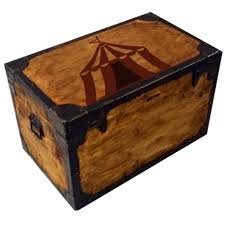
SCP-190 is a carved wooden box measuring 50 cm × 70 cm × 35 cm, created by Herman Fuller’s Circus of the Disquieting. When opened by individuals aged 10 or older, the box generates a spatial anomaly that traps victims in an extradimensional space resembling a circus tent interior, making it one of the Foundation’s most insidious child-targeting anomalies.
The Prize Toybox: Physical Description & Craftsmanship
SCP-190 presents as a meticulously crafted wooden box bound with iron bands, displaying exceptional 19th-century carnival artisan work. The lid features an intricate carving depicting a large circus tent with its entrance flaps open—an invitation that doubles as a warning for those familiar with Herman Fuller’s signature aesthetic.
The craftsmanship reveals deliberate psychological manipulation through design. The wood shows signs of hand-carving with period-appropriate tools, suggesting construction between 1890-1920, coinciding with Herman Fuller’s Circus peak activity period. The iron banding isn’t merely decorative; metallurgical analysis indicates the bands contain trace amounts of materials not naturally occurring on Earth, suggesting the box was either constructed in an alternate dimension or modified with anomalous materials.
The circus tent carving employs forced perspective techniques that create an optical illusion—the tent appears to “breathe” or shift when viewed peripherally. This subtle movement serves as a lure mechanism, particularly effective on children whose pattern-recognition systems are still developing. The open tent flaps carved into the lid mirror the actual opening mechanism, creating a symbolic resonance between the physical act of opening the box and entering the depicted tent.
Classification & Containment Protocol
Object Class: Safe
SCP-190 receives Safe classification not because it’s harmless, but because its anomalous properties activate only under specific, predictable conditions. The object remains inert unless deliberately opened by someone meeting the age threshold, making containment straightforward through simple physical security.
Current containment procedures mandate storage in a standard secure locker at Site-19. Access requires Level 2 authorization, and all personnel interacting with SCP-190 must be under 10 years of age or utilize remote handling equipment. The Foundation prohibits direct handling by individuals aged 10 or older, as even accidental activation results in immediate spatial displacement with no known reversal method.
The simplicity of containment belies the object’s danger. Unlike Euclid or Keter-class anomalies requiring elaborate containment systems, SCP-190’s threat comes from its deceptive appearance as a harmless antique. The real containment challenge involves preventing unauthorized access by curious personnel who underestimate a “Safe” classification.
The Anomalous Mechanism: How SCP-190 Works
SCP-190’s activation sequence demonstrates sophisticated anomalous engineering. When an individual aged 10 years or older opens the lid, a spatial rift instantaneously forms, displacing the victim into a pocket dimension. External observers report the victim simply “vanishing” the moment the lid reaches approximately 15 degrees of opening—no flash of light, no sound, just immediate absence.
From the victim’s perspective, the experience is radically different. Survivors (recovered through unrelated dimensional breaches) describe a sensation of falling upward, followed by materialization inside a massive circus tent. The interior space violates known physics—the tent appears to extend infinitely in all directions while simultaneously feeling claustrophobic. Lighting comes from an unknown source, creating the perpetual twilight common to carnival midways.
The dimensional space exhibits non-Euclidean geometry. Victims report walking in straight lines only to return to their starting position, or seeing themselves in the distance as if viewing their own past. Time dilation effects occur inconsistently; some victims experience hours while external time shows only minutes, while others report the reverse.
The age threshold of 10 years suggests the anomaly targets developed spatial reasoning capabilities. Children under 10 lack the cognitive framework the anomaly requires to establish a stable dimensional lock. This selectivity indicates intentional design rather than random anomalous behavior—Herman Fuller’s Circus specifically engineered SCP-190 to capture children old enough to experience terror but young enough to be vulnerable.
Herman Fuller’s Circus: The Dark Carnival Connection
Herman Fuller’s Circus of the Disquieting represents one of the Foundation’s most persistent Groups of Interest. Operating since at least the 1880s, the Circus travels through dimensional boundaries, leaving anomalous artifacts and traumatized witnesses across multiple realities. SCP-190 exemplifies the Circus’s modus operandi: objects disguised as prizes or entertainment that inflict psychological harm.
The Circus’s business model revolves around collecting “performers”—individuals trapped in anomalous states who provide entertainment through their suffering. SCP-190 likely served as a recruitment tool, capturing children who would either become performers or audience members trapped in perpetual viewership. The box’s design as a “prize” suggests it was given to children as a reward, making the betrayal more psychologically devastating.
Other Herman Fuller artifacts in Foundation custody share similar characteristics: SCP-1884 (Madame Rezarta’s Psychic Sideshow), SCP-3717 (The Epicurean Occultist), and SCP-2902 (The Human Skeleton Closet) all demonstrate the Circus’s preference for transformation and entrapment over simple destruction. The organization views anomalies as art installations, with human suffering as the medium.
Historical records indicate Herman Fuller himself may have been an anomalous entity or reality bender who established the Circus as a mobile nexus point between dimensions. The Circus’s ability to appear and disappear without conventional travel suggests it exists partially outside normal spacetime, explaining how artifacts like SCP-190 contain pocket dimensions—they’re fragments of the Circus’s own dimensional structure.
Acquisition History & Discovery Logs
The Foundation acquired SCP-190 in 1967 following a series of child disappearances in rural Pennsylvania. Local law enforcement investigating the vanishings discovered the box in an abandoned farmhouse previously owned by a family claiming to have won it at a traveling carnival in 1952. The family’s 12-year-old daughter had disappeared after opening the box, with parents reporting she “stepped into thin air.”
Initial containment proved challenging because Foundation personnel didn’t understand the age-based activation requirement. Three researchers vanished during preliminary examination before Dr. Sarah Chen hypothesized the age correlation after reviewing victim demographics. Subsequent testing with D-class personnel confirmed individuals under 10 could safely open the box without triggering the anomaly.
Interviews with the surviving family members revealed the carnival matching descriptions of Herman Fuller’s Circus—striped tents with impossible colors, performers who seemed “wrong,” and a ringmaster who never blinked. The box was presented as a prize for winning a rigged game, a common Circus tactic for distributing anomalous objects to unsuspecting victims.
Foundation historians traced similar disappearances back to 1893, suggesting SCP-190 has been active for over a century. The box appears periodically in different locations, always associated with carnival or circus events, then vanishes for years before resurfacing. This pattern indicates either multiple instances of SCP-190 exist, or the object possesses limited autonomous mobility, returning to the Circus between appearances.
Cross-References & The Bigger Picture
SCP-190 connects to a broader network of anomalies within the Foundation’s database. SCP-1695 (The Ghastly Grocer) shares the “prize” deception mechanism, while SCP-2902 demonstrates similar dimensional entrapment properties. Understanding SCP-190’s mechanics provides insight into how Herman Fuller’s Circus constructs pocket dimensions—likely through reality-bending performances that “carve out” spaces from baseline reality.
The box’s relationship to SCP-3717 is particularly significant. Both objects serve as gateways to Circus-controlled dimensions, suggesting the organization maintains an entire network of interconnected pocket realities. Victims trapped in SCP-190’s dimension may actually be imprisoned in the same extradimensional space as other Circus captives, separated only by perceptual barriers.
Research into SCP-190 has influenced Foundation understanding of spatial anomalies generally. The object demonstrates that pocket dimensions can be “packaged” into physical containers, a principle now applied to containment of other reality-bending entities. The age-based activation threshold has prompted investigation into whether other anomalies exhibit similar cognitive-dependent triggers that remain undetected.
The Circus’s continued operation despite Foundation efforts suggests Herman Fuller possesses either powerful reality-bending capabilities or protection from a higher-dimensional entity. Some researchers theorize the Circus exists as a parasite on the concept of entertainment itself, drawing power from humanity’s collective desire for spectacle and wonder.
Frequently Asked Questions
Can victims trapped in SCP-190 be rescued?
No reliable rescue method currently exists. The Foundation has attempted dimensional breaching, reality anchors, and negotiation with Herman Fuller’s Circus representatives, all without success. The few survivors recovered emerged through unrelated dimensional anomalies, suggesting escape requires external dimensional instability rather than internal effort. Victims should be considered permanently lost upon activation.
Why does SCP-190 only affect people aged 10 and older?
The age threshold correlates with cognitive development milestones, specifically the maturation of spatial reasoning and abstract thinking capabilities. The anomaly requires a developed mental framework to establish a stable dimensional lock. Children under 10 lack sufficient cognitive complexity for the entrapment mechanism to function, making them immune to the effect. This selectivity indicates intentional design rather than limitation.
How many people has SCP-190 captured?
Foundation records document at least 47 confirmed disappearances directly attributable to SCP-190 since 1893. However, the actual number likely exceeds several hundred when accounting for unrecorded historical cases and the object’s periodic disappearances from Foundation custody. Each activation represents a permanent loss, as no victim has ever returned through the box itself.
Is Herman Fuller’s Circus still active?
Yes. The Circus continues operating across multiple dimensions, with sightings reported as recently as 2023. The organization demonstrates remarkable persistence despite Foundation containment efforts. Mobile Task Force Sigma-3 (“Bibliographers”) specializes in tracking Circus appearances, but the group’s dimensional mobility makes interception nearly impossible. The Circus appears to view Foundation interference as part of the performance.
What happens if someone under 10 opens the box?
Individuals under the age threshold can open SCP-190 without triggering the spatial anomaly. The box opens normally, revealing an empty interior lined with faded red velvet. No dimensional displacement occurs, and the individual can close the box safely. This immunity makes children under 10 ideal for handling procedures, though ethical concerns limit such use to remote manipulation systems in practice.