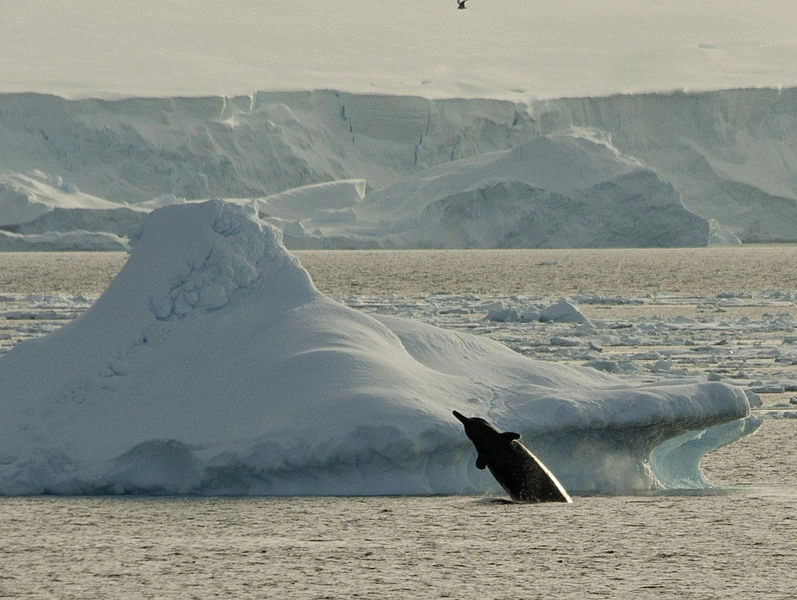
SCP-1836 is a mobile, 90-meter-tall green iceberg controlled by a sentient entity named Sanna, who systematically destroys whaling vessels using a swarm of extinct cetacean specimens (SCP-1836-1). This Euclid-class anomaly represents both an environmental avenger and a living graveyard of marine extinction events spanning millions of years.
The Green Iceberg: Physical Properties and Discovery
SCP-1836 defies conventional glaciology from the moment of visual contact. Unlike the white or blue-tinted icebergs that calve from polar ice sheets, this anomaly presents a distinct green coloration throughout its crystalline structure. The pinnacle-style formation rises 90 meters above sea level, with an estimated total length of 123 meters and a submerged depth extending approximately 450 meters below the waterline.
Mass estimates place SCP-1836 between 150,000 and 170,000 metric tons—within normal parameters for an iceberg of its visible dimensions. What separates this formation from natural ice structures is its complete immunity to thermal degradation. The anomaly has maintained structural integrity across multiple climate zones and seasonal cycles without measurable melting or calving events.
The iceberg’s mobility patterns violate known oceanographic principles. Rather than drifting with prevailing currents, SCP-1836 demonstrates purposeful navigation, maintaining speeds of up to 8 knots against wind and tide. Satellite tracking reveals deliberate course corrections and what appears to be patrol behavior along historical whaling routes in the North Atlantic and Southern Ocean.
Initial Foundation detection occurred following a cluster of unexplained maritime disasters in waters where iceberg presence was meteorologically impossible. The green coloration, visible from reconnaissance aircraft, triggered immediate anomalous classification protocols.
Sanna: The Consciousness Within
The entity identifying herself as Sanna represents the cognitive core of SCP-1836. Through limited communication attempts with Foundation personnel—primarily via manipulation of ice formations to create written messages and through dreams experienced by nearby individuals—researchers have constructed a partial psychological profile of this ancient consciousness.
Sanna demonstrates advanced linguistic capabilities, communicating in multiple languages including archaic dialects that predate modern whaling industries. Her knowledge base suggests either extreme longevity or access to collective memories spanning centuries. The entity displays emotional responses consistent with grief, rage, and protective instincts specifically oriented toward cetacean life.
The mechanism binding Sanna’s consciousness to the iceberg structure remains theoretical. Leading hypotheses suggest either a voluntary merging with glacial ice through unknown thaumaturgic means, or an involuntary transformation resulting from a catastrophic event. Sanna’s own communications reference “becoming the tomb” and “carrying the lost ones,” implying a deliberate choice to serve as guardian and memorial.
Psychological assessments indicate Sanna operates under a rigid moral framework: humans who harm whales and dolphins warrant destruction, while other maritime traffic receives warnings but not attacks. This selective aggression demonstrates both intelligence and restraint—qualities that complicate containment ethics and threat assessment protocols.
The Cetacean Graveyard: SCP-1836-1 Instances
Surrounding SCP-1836 at all times is a mobile swarm designated SCP-1836-1: perfectly preserved specimens of extinct whale and dolphin species. These entities number between 40 and 60 individuals at any given observation, though the total population may fluctuate as specimens submerge to depths beyond sonar detection.
The evolutionary timeline represented within SCP-1836-1 spans approximately 50 million years of cetacean development. The oldest identified specimen belongs to Protocetidae, the transitional “walking whales” that first adapted to aquatic life during the Eocene epoch. Progressive specimens include Basilosaurus, various extinct families of baleen whales, and the most recent additions—river dolphin species that vanished within the last two centuries due to habitat destruction and hunting.
Each SCP-1836-1 instance exhibits mobility despite lacking visible means of propulsion and showing no signs of decomposition. Specimens move through water with the grace and speed characteristic of their living counterparts, responding to apparent commands from Sanna. During attacks on whaling vessels, SCP-1836-1 instances coordinate tactical maneuvers including hull breaching, net entanglement, and crew intimidation through surfacing behaviors.
Tissue samples obtained from SCP-1836-1 specimens (collected from fragments left at attack sites) reveal cellular structures in a state of suspended animation. DNA analysis confirms species identification and has provided paleontologists with genetic data previously unavailable from fossil records. The preservation method appears related to the same anomalous properties maintaining SCP-1836’s structural integrity.
The symbolic significance of this cetacean collection cannot be overstated. Sanna has assembled a living museum of extinction—each specimen representing a failure of ecological stewardship. The proto-whale serves as reminder of evolutionary potential, while the recently extinct river dolphins indict modern industrial civilization directly.
Vengeance Against Whalers: Behavioral Analysis
SCP-1836’s operational pattern demonstrates sophisticated target discrimination and tactical planning. The anomaly exclusively attacks vessels engaged in commercial whaling operations, with a 100% destruction rate across 23 documented incidents since Foundation monitoring began.
Attack methodology follows a consistent sequence. SCP-1836 approaches target vessels at high speed, typically during low-visibility conditions. SCP-1836-1 instances initiate the assault by damaging propulsion systems and communication equipment, effectively isolating the ship. The iceberg itself then delivers the killing blow—ramming the vessel at structural weak points with precision that suggests either sonar-equivalent sensory capabilities or intimate knowledge of ship architecture.
Survivor testimonies (from crew members who abandoned ship before final impact) describe hearing vocalizations resembling whale songs during attacks, and several report visual hallucinations of drowning in ice-cold water while surrounded by “ghosts of whales.” These memetic effects may represent Sanna’s attempt to impart experiential understanding of cetacean suffering to human witnesses.
Notably, SCP-1836 has never attacked research vessels, naval ships, or commercial fishing operations targeting non-cetacean species. On three documented occasions, the anomaly has positioned itself between whaling vessels and whale pods, effectively serving as a physical barrier. This protective behavior extends to all cetacean species, not exclusively those represented in SCP-1836-1.
The ethical dimension of SCP-1836’s activities creates unprecedented challenges for Foundation doctrine. The anomaly functions as an autonomous enforcement mechanism for environmental protection—a role that aligns with certain human values while violating the fundamental principle of normalcy preservation. Each destroyed whaling ship generates media coverage, survivor accounts, and public speculation that threatens the Veil.
Containment Paradox: Why You Can’t Cage an Ocean
SCP-1836 carries an Euclid classification, reflecting both its predictable behavioral patterns and the practical impossibility of physical containment. Mobile oceanic anomalies present unique logistical challenges that strain Foundation resources and methodology.
Current containment protocols focus on monitoring rather than restriction. A network of satellite tracking systems, oceanographic sensors, and embedded agents within maritime industries provides real-time location data. When SCP-1836 approaches commercial shipping lanes, Foundation naval assets deploy to redirect civilian traffic under cover of “iceberg warnings”—technically accurate if incomplete.
The primary containment objective involves preventing public documentation of attacks. Mobile Task Force Gamma-6 (“Deep Sea Divers”) maintains rapid response capabilities to reach attack sites, administer amnestics to survivors, and recover evidence before conventional rescue operations arrive. Cover stories attribute ship losses to equipment failure, rogue waves, or conventional iceberg collisions.
Proposals for aggressive containment—including military destruction of SCP-1836—have been repeatedly rejected by the O5 Council. Practical concerns include the unknown consequences of destroying Sanna’s physical form (potential release of a more dangerous non-corporeal entity) and the risk of liberating SCP-1836-1 instances as independent anomalies. Additionally, ethical arguments note that SCP-1836 exclusively targets an industry of questionable moral standing, raising questions about whether containment serves normalcy or simply protects commercial interests.
Alternative containment strategies under consideration include diplomatic engagement with Sanna to establish attack-free zones, or supporting international whaling bans to eliminate the anomaly’s target set entirely. The latter approach represents a controversial expansion of Foundation influence into global policy—a precedent with far-reaching implications.
Frequently Asked Questions
What makes SCP-1836’s iceberg green?
The green coloration results from anomalous crystalline structures within the ice that refract light differently than normal frozen water. Analysis suggests the color may be intrinsically linked to Sanna’s consciousness—a visual manifestation of the entity’s presence within the physical structure.
Can SCP-1836 be destroyed?
Theoretically yes, but practical and ethical concerns prevent attempts. The anomaly has demonstrated resistance to conventional explosives during one unauthorized military engagement. More importantly, destroying Sanna’s physical form might release her consciousness in a less predictable format, or free the SCP-1836-1 specimens as independent threats.
Has anyone successfully communicated with Sanna?
Limited communication has occurred through ice-carved messages and induced dream states in nearby personnel. Sanna responds to questions about her motivations but refuses to discuss her origins in detail. She has expressed willingness to cease attacks if humanity abandons whaling entirely—a condition the Foundation cannot enforce globally.
Are the extinct whales in SCP-1836-1 actually alive?
The specimens exist in a state between life and death. They demonstrate mobility, apparent awareness, and coordinated behavior, but lack metabolic processes associated with living organisms. They function more as animated remains under Sanna’s control than as resurrected creatures.
Why doesn’t the Foundation just support whaling bans to neutralize SCP-1836?
The Foundation’s mandate focuses on containing anomalies, not reshaping human civilization to accommodate them. Actively lobbying for international policy changes would represent mission creep and potentially expose the organization’s existence. However, internal debates continue regarding whether passive support for conservation efforts falls within acceptable parameters.