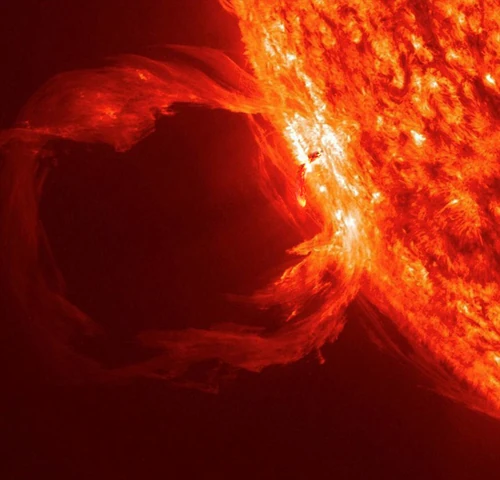
SCP-1682 is a massive, segmented worm-like entity residing within the sun’s core, measuring thousands of kilometers in length. This parasitic organism survives in plasma exceeding 15 million degrees Celsius, feeding on stellar material while posing an existential threat through its potential reproductive cycle that could fundamentally alter solar radiation and trigger apocalyptic scenarios.
The Biological Impossibility: Anatomy of a Stellar Parasite
SCP-1682 represents a complete violation of known thermodynamics and biology. This segmented organism, structurally analogous to terrestrial cestodes (tapeworms) or annelids, exists within an environment that should instantly vaporize any known organic matter. Foundation xenobiologists estimate the entity stretches between 8,000 and 12,000 kilometers in length, with each segment potentially functioning as an independent biological unit.
The creature’s morphology suggests a radial symmetry adapted for navigating convective plasma currents. Unlike Earth-based parasites that absorb nutrients through tegumental surfaces, SCP-1682 appears to directly metabolize ionized hydrogen and helium through mechanisms that defy conventional biochemistry. The entity’s outer membrane must possess properties beyond any known material—withstanding not only extreme temperatures but also the crushing pressure of 265 billion atmospheres found in the solar core.
Terrestrial parasites like Taenia solium achieve lengths of several meters by living in nutrient-rich intestinal environments. SCP-1682 scales this parasitic strategy to cosmic proportions, treating our sun as a host organism. The segmented body plan allows for redundancy; damage to individual segments likely doesn’t compromise the entity’s survival, similar to how planarian flatworms regenerate from fragments.
The most disturbing aspect is the organism’s apparent consciousness or directive behavior. Spectroscopic analysis reveals movement patterns inconsistent with passive drift through convection zones. SCP-1682 actively navigates the sun’s interior, suggesting sensory organs capable of functioning in an environment where electromagnetic radiation would overwhelm any known photoreceptor.
Discovery and Observational Challenges
The Foundation detected SCP-1682 in 19██ through anomalous neutrino flux patterns that couldn’t be explained by standard solar models. Traditional helioseismology—which uses sound waves to map the sun’s interior—revealed density irregularities moving through the radiative zone. These anomalies exhibited biological rhythms: periodic contractions, directional movement, and what appeared to be feeding behavior.
Observing an organism inside the sun presents unprecedented challenges. The Foundation deployed a network of modified neutrino detectors and gravitational wave sensors to track SCP-1682’s movements. Direct visual observation is impossible; instead, researchers construct three-dimensional models from indirect data, similar to how medical CT scans build images from X-ray absorption patterns.
The epistemological problem is profound: How do we verify the existence of something we can only detect through its gravitational and particle emissions? Foundation scientists developed the Helios Protocol, combining data from solar observatories worldwide with classified satellite arrays. Even with this infrastructure, researchers can only update SCP-1682’s position every 6-8 hours, leaving vast gaps in behavioral understanding.
Traditional containment is meaningless for an entity embedded in 1.989 × 10³⁰ kilograms of plasma. The Foundation cannot extract, relocate, or physically restrain SCP-1682. Instead, containment focuses on information suppression and monitoring for behavioral changes that might indicate reproductive activity or migration toward the sun’s surface.
Classification & Containment Philosophy
SCP-1682 holds a Keter classification, not because of immediate danger, but due to the catastrophic potential of its reproductive cycle and the Foundation’s complete inability to neutralize the threat. The entity cannot be destroyed without destroying the sun itself—an obviously unacceptable solution.
Containment procedures prioritize early warning systems. The Foundation maintains constant surveillance through the Helios Array, a global network of specialized observatories disguised as legitimate solar research facilities. Any deviation from SCP-1682’s established behavioral patterns triggers immediate O5 Council notification.
The containment philosophy represents a paradigm shift from traditional Foundation doctrine. Rather than securing and containing, personnel must accept that SCP-1682 exists beyond human control. The strategy focuses on understanding the entity’s lifecycle well enough to predict and potentially prevent reproductive events. This approach acknowledges a humbling reality: some anomalies are simply too large, too remote, or too fundamental to cosmic structure to be “contained” in any conventional sense.
Secondary containment involves suppressing public awareness of solar interior anomalies. Cover stories attribute unusual neutrino readings to experimental error or novel fusion processes. The Foundation has embedded agents in major space agencies to intercept data that might reveal SCP-1682’s existence.
The Reproductive Nightmare: Eggs, Larvae, and Apocalypse Scenarios
The true horror of SCP-1682 lies not in its current state but in its potential lifecycle. Parasitological models suggest the entity is an adult specimen, implying the existence of eggs, larvae, or other developmental stages. Foundation xenobiologists theorize that SCP-1682 may reproduce through broadcast spawning—releasing millions of microscopic eggs into the solar wind.
If these eggs reach other stars and mature, humanity faces an existential threat beyond comprehension. A galaxy infested with stellar parasites could see fundamental changes to stellar behavior across multiple systems. More immediately, if SCP-1682 reproduces within our sun, the larvae could alter solar output in catastrophic ways.
The most disturbing scenario involves eggs hatching within the sun itself. Larval solar parasites might feed more aggressively than the adult, accelerating fusion reactions and increasing solar luminosity. Alternatively, a swarm of juveniles could disrupt convection patterns, causing unpredictable fluctuations in solar radiation reaching Earth.
Foundation biologists studying extremophile reproduction note that many parasites produce thousands of offspring to ensure species survival. If SCP-1682 follows this pattern, a single reproductive event could release enough larvae to fundamentally transform the sun’s internal dynamics within decades.
The entity’s segmented structure suggests another possibility: asexual reproduction through fragmentation. Each segment might be capable of growing into a complete organism if separated from the main body. Solar flares or coronal mass ejections could theoretically eject segments into space, seeding other stars with parasitic organisms.
Cross-SCP Connections: Solar Anomalies and the When Day Breaks Timeline
SCP-1682 has become central to one of the Foundation’s most debated theories: its connection to SCP-001 “When Day Breaks,” an apocalyptic scenario where sunlight transforms humans into grotesque, melted amalgamations of flesh.
The theory proposes that in an alternate timeline, SCP-1682’s eggs hatched prematurely. The larval parasites, feeding voraciously on stellar material, altered the sun’s radiation spectrum. Instead of life-giving light, the sun began emitting a memetic or biological agent that rewrites human cellular structure on contact. This would explain why “When Day Breaks” sunlight behaves unlike normal electromagnetic radiation—it’s contaminated with the metabolic byproducts of juvenile stellar parasites.
Supporting evidence includes spectroscopic anomalies detected during periods of increased SCP-1682 activity. Foundation researchers have documented brief spikes in unusual wavelengths that don’t correspond to known fusion processes. These emissions, lasting only minutes, could represent test releases of reproductive material or metabolic waste products.
Other solar anomalies in Foundation records may relate to SCP-1682’s presence. SCP-1548 (“The Hateful Star”) demonstrates that stellar objects can possess hostile intelligence. If stars can be malevolent, they can also be infected. SCP-1682 might represent a cosmic parasite that targets stars specifically, with Earth’s sun being merely one host among billions.
The “When Day Breaks” connection raises a terrifying question: Is our timeline simply one where SCP-1682’s reproduction has been delayed? Foundation temporal mechanics specialists cannot rule out the possibility that the apocalyptic scenario is inevitable, merely postponed. Every day the entity remains dormant might be borrowed time.
Frequently Asked Questions
How big is SCP-1682 compared to Earth?
SCP-1682 measures approximately 8,000-12,000 kilometers in length, making it roughly equivalent to Earth’s diameter (12,742 km). However, its segmented body is relatively thin compared to its length, giving it a worm-like profile rather than a spherical mass. The entity’s total volume is significantly smaller than Earth’s, but its presence within the sun’s core means it occupies a region where pressure and temperature exceed anything found on our planet.
Can SCP-1682 leave the sun?
Current behavioral analysis suggests SCP-1682 is adapted specifically for the solar interior environment and likely cannot survive outside the sun’s plasma. The entity appears to require the extreme pressure and temperature of the stellar core for metabolic processes. However, Foundation xenobiologists cannot rule out the possibility of a lifecycle stage adapted for space travel, particularly if reproduction involves dispersing offspring to other stars.
Why doesn’t SCP-1682 affect the sun’s visible behavior?
Despite its massive size, SCP-1682 represents a tiny fraction of the sun’s total mass (approximately 0.0000000006%). The sun’s fusion processes are so energetic that the entity’s presence causes only minor perturbations detectable through specialized equipment. Think of it as a tapeworm in a whale—the parasite is enormous by human standards, but the host is so much larger that external symptoms remain subtle.
Is SCP-1682 intelligent?
The entity demonstrates purposeful movement and apparent feeding behavior, suggesting at least instinctive intelligence comparable to terrestrial parasites. Whether it possesses consciousness, self-awareness, or higher cognitive functions remains unknown. The Foundation has attempted communication through modulated neutrino beams and gravitational wave pulses, but SCP-1682 has shown no response to these signals.
What would happen if SCP-1682 died?
The death of SCP-1682 could potentially destabilize the sun’s internal dynamics, depending on how its biomass decomposes. Foundation models suggest that rapid decomposition might release energy equivalent to thousands of solar flares simultaneously, while gradual breakdown might go unnoticed. More concerning is the possibility that the entity’s death could trigger a final reproductive event—a parasitic “last gasp” releasing all stored eggs into the solar system.