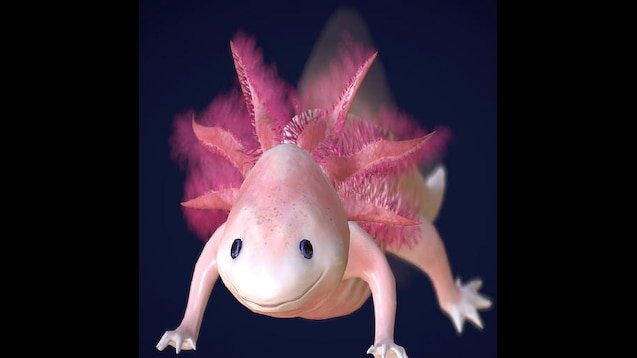
SCP-1371 represents one of the Foundation’s most charming yet scientifically perplexing anomalies—a leucistic axolotl that refuses to sink. Classified as Safe and housed at Site-18, this juvenile amphibian exhibits buoyancy properties that fundamentally contradict our understanding of aquatic biology and physics.
Physical Description and Biological Characteristics
SCP-1371 appears as a leucistic axolotl (Ambystoma mexicanum), displaying the characteristic pale coloration and external gills of this neotenic salamander species. Unlike albinism, leucism results in reduced pigmentation while retaining normal eye color, giving SCP-1371 its distinctive appearance.
The entity ages at a rate consistent with non-anomalous axolotls, suggesting its temporal biology remains unaffected by its anomalous properties. Remarkably, SCP-1371 demonstrates exceptional durability, withstanding moderate atmospheric changes and environmental variations that would typically stress or harm standard axolotls.
The Anomalous Buoyancy Effect
The defining characteristic of SCP-1371 is its extreme positive buoyancy. When any external force attempts to move the creature downward, it generates what researchers describe as “massive excess buoyancy.” This phenomenon violates conventional hydrostatics—the entity doesn’t simply float, it actively resists downward displacement with disproportionate force.
In normal aquatic animals, buoyancy is regulated through swim bladders (in fish) or lung capacity (in amphibians). Axolotls, being fully aquatic salamanders, typically maintain neutral buoyancy through a combination of body density and gill function. SCP-1371’s mechanism appears entirely different, suggesting an unknown biological or paraphysical process.
Containment and Behavioral Observations
Housed in a standard glass aquarium within a Level 1 security cell at Site-18, SCP-1371 requires minimal containment protocols—a testament to its Safe classification. The creature exhibits normal axolotl behaviors including feeding responses, gill movement, and basic locomotion, with the notable exception of its inability to descend naturally through water.
Observers note that SCP-1371 “floats, sometimes a bit too much,” creating challenges for normal amphibian activities like bottom-feeding or seeking shelter in substrate. This raises fascinating questions about how the entity adapts to its perpetual surface-dwelling existence.
Scientific Implications and Theories
The buoyancy generation mechanism remains unexplained. Several hypotheses exist:
Density Manipulation Theory: SCP-1371 may alter its tissue density in response to downward pressure, though no physical mechanism for this has been identified.
Localized Gravity Negation: The entity might generate a localized field that counteracts gravitational force, though this would require exotic physics.
Biological Antigravity: Some researchers propose an unknown organ or cellular structure that produces genuine antigravitational effects through biological processes.
Comparative Analysis with Related SCPs
SCP-1371 shares thematic elements with other buoyancy-related anomalies in the Foundation database, though its biological nature makes it unique among gravity-defying entities. Its Safe classification and benign nature contrast sharply with more dangerous physics-violating anomalies.
Research Value and Ongoing Studies
The entity’s durability and consistent anomalous properties make it an ideal subject for studying the intersection of biology and paraphysics. Understanding SCP-1371’s buoyancy mechanism could provide insights into gravitational manipulation, density control, and the limits of biological adaptation to anomalous properties.
Conclusion
SCP-1371 stands as a testament to the Foundation’s mission of containing and studying the impossible. This curiously buoyant amphibian challenges our understanding of aquatic biology while remaining one of the more approachable anomalies in containment. Its continued study may one day unlock secrets about the fundamental forces governing our reality—all contained within the body of a small, perpetually floating salamander.