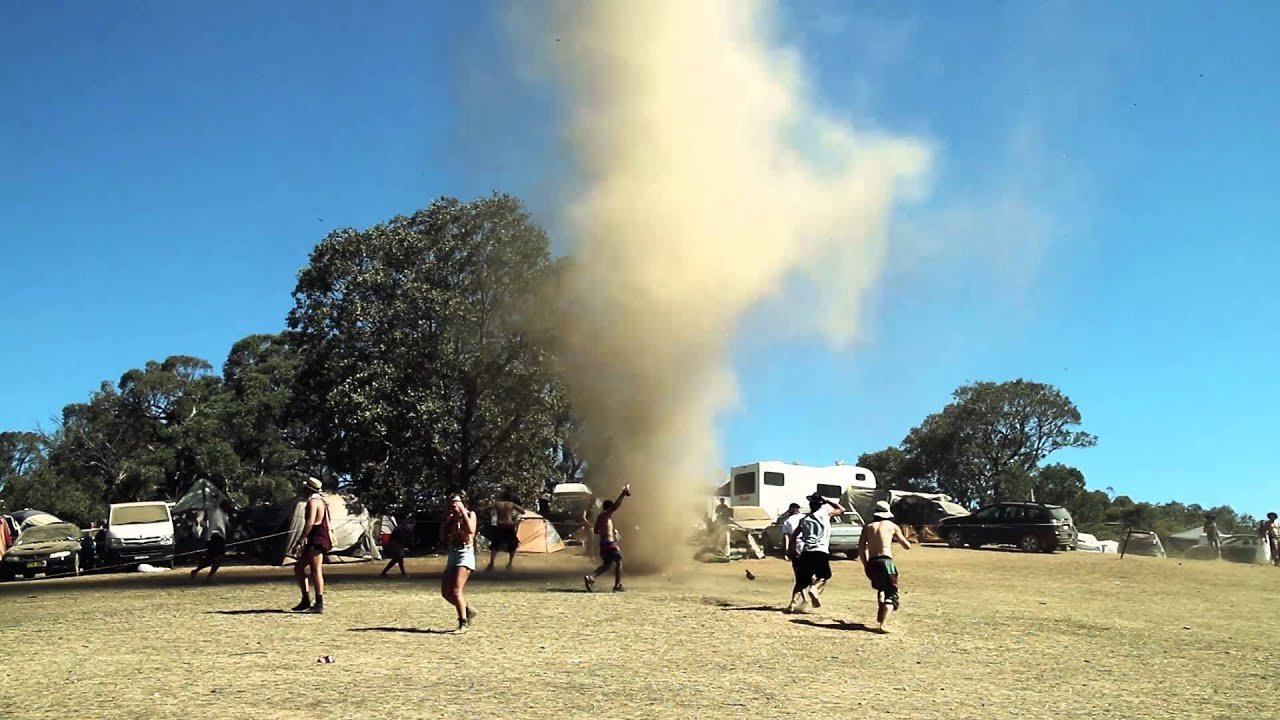
SCP-1352 is a sentient dust devil exhibiting domesticated pet-like behavior, capable of sustained wind speeds exceeding 60 km/h. Unlike natural atmospheric vortices, this anomaly demonstrates conscious decision-making, emotional attachment to humans, and protective instincts—making it one of the Foundation’s most benign yet scientifically perplexing atmospheric entities.
The Atmospheric Anomaly: What Makes a Dust Devil Sentient?
SCP-1352 defies conventional meteorological understanding by maintaining continuous existence as a self-aware atmospheric vortex. Standard dust devils form when hot air near the ground rises rapidly through cooler air above, creating a rotating column that dissipates within minutes. SCP-1352, however, persists indefinitely without requiring specific thermal conditions or geographic features.
Anemometer readings consistently measure wind velocities of at least 60 kilometers per hour within its vortex structure—sufficient to lift and carry small objects weighing up to several kilograms. The entity maintains a compact form approximately 2-3 meters in height and 1 meter in diameter, significantly smaller than most naturally occurring dust devils which can reach 100 meters in height.
What distinguishes SCP-1352 from non-anomalous phenomena is its deliberate manipulation of debris patterns. Rather than random particle distribution typical of natural vortices, the entity selectively collects and arranges small objects—sticks, pebbles, leaves—in patterns that suggest intentional communication. These objects orbit within its structure at consistent velocities, never expelled unless the entity chooses to release them, violating expected centrifugal force behaviors.
The entity demonstrates environmental awareness extending beyond its immediate physical boundaries. It responds to human presence from distances exceeding 50 meters, adjusting trajectory and approach speed based on perceived threat levels or familiarity with individuals. This sensory capability operates through unknown mechanisms, as dust devils possess no biological structures for sight, hearing, or other conventional perception methods.
Behavioral Profile: The Psychology of a Playful Whirlwind
SCP-1352 exhibits behavioral patterns remarkably consistent with domesticated canines, particularly in social bonding and play-seeking activities. The entity actively initiates interaction with humans through approach behaviors, circling movements, and presentation of carried objects—actions analogous to a dog bringing a toy to its owner.
The anomaly’s comprehension of fetch mechanics demonstrates sophisticated cognitive processing. When personnel throw objects, SCP-1352 tracks projectile trajectories, intercepts items mid-flight or upon landing, and returns them to the thrower’s approximate location. This requires predictive modeling, spatial reasoning, and understanding of human intent—cognitive functions typically associated with vertebrate brains possessing dedicated neural structures.
Emotional responses appear genuine rather than programmed. SCP-1352 displays excitement through increased rotation speed and tighter spiral patterns when familiar personnel approach. Conversely, it exhibits what researchers interpret as disappointment or sadness through decreased activity and slower movements when ignored or when preferred interaction partners depart. These emotional states persist across multiple encounters, suggesting memory formation and emotional continuity.
The entity shows clear preference hierarchies among personnel, spending more time with individuals who engage in play activities and demonstrating recognition of specific people across weeks or months of separation. This attachment formation mirrors the bonding processes observed in social animals, raising questions about whether consciousness necessarily requires biological substrates or if information processing patterns alone can generate subjective experience.
Most remarkably, SCP-1352 demonstrates moral reasoning and protective instincts toward humans it perceives as vulnerable or threatened, behaviors that suggest not merely intelligence but something approaching empathy.
Classification & Containment Philosophy
SCP-1352 holds a Safe classification—not because it lacks anomalous properties, but because it poses minimal threat and requires no active containment measures. The Safe designation reflects the entity’s cooperative nature and predictable behavior rather than any limitation of its capabilities.
Containment procedures focus on environmental management rather than restriction. The entity resides in a designated outdoor enclosure within a Foundation facility located in an arid region, mimicking its natural desert habitat. The 50-meter diameter containment area features sand substrate, scattered rocks, and minimal vegetation—conditions that allow SCP-1352 to maintain its form comfortably while providing adequate space for movement and play activities.
Personnel interaction is not merely permitted but encouraged as part of ongoing behavioral research. Regular engagement sessions serve dual purposes: maintaining the entity’s psychological well-being and gathering data on its cognitive capabilities. Staff members are instructed to bring appropriate play objects—lightweight items that won’t cause injury if caught in 60+ km/h winds—and to document any novel behaviors or communication attempts.
The containment philosophy represents a significant departure from traditional Foundation protocols. Rather than viewing SCP-1352 as a threat requiring suppression, researchers treat it as a unique opportunity to study consciousness emerging from non-biological systems. This approach has yielded unprecedented insights into anomalous cognition while maintaining a cooperative relationship with an entity that could theoretically escape standard physical barriers.
The Desert Rescue Incident: When SCP-1352 Became a Hero
The most compelling evidence of SCP-1352’s complex consciousness emerged from an incident predating its Foundation custody. A female hiker traversing remote desert terrain encountered a mountain lion exhibiting predatory stalking behavior. As the animal prepared to attack, SCP-1352—previously unnoticed in the area—rapidly positioned itself between the hiker and the threat.
Witness testimony describes the entity expanding its vortex diameter and intensifying rotation speed, creating a barrier of high-velocity sand and debris. The mountain lion, unable to penetrate this defensive screen and disoriented by the sudden atmospheric disturbance, retreated from the area. SCP-1352 maintained its protective position until the predator disappeared from sight, demonstrating sustained tactical awareness and commitment to the hiker’s safety.
The incident’s aftermath proved equally remarkable. The hiker had dropped her backpack during the initial encounter, and the pack had tumbled approximately 30 meters down a rocky slope. After ensuring the threat had passed, SCP-1352 descended the incline, carefully enveloped the backpack within its vortex, and transported it back to the hiker’s location—a task requiring precise object manipulation and understanding that the item held value to the human.
This event reveals several sophisticated cognitive capabilities. SCP-1352 assessed threat levels, distinguishing between a dangerous predator and a vulnerable human. It prioritized another being’s safety over its own preservation, as confronting a large predator posed potential risks to its structural integrity. The entity demonstrated understanding of object ownership and the concept of returning lost property. Most significantly, it exhibited what can only be described as altruistic behavior—acting to benefit another with no apparent expectation of reward.
Foundation personnel located and contained SCP-1352 three weeks after this incident, following reports of an unusually persistent dust devil in the region. The hiker’s testimony, corroborated by physical evidence and subsequent behavioral observations, established the entity’s protective instincts as genuine rather than anomalous.
Theoretical Implications: Consciousness Without Biology
SCP-1352 challenges fundamental assumptions about the nature of consciousness and the requirements for sentient life. Traditional neuroscience posits that subjective experience emerges from specific biological structures—neurons, synapses, neurotransmitters—organized in particular configurations. Yet SCP-1352 possesses none of these components, existing purely as organized atmospheric movement and suspended particulate matter.
Several theoretical frameworks attempt to explain this phenomenon. The Information Integration Theory suggests consciousness arises from any system capable of integrating information in specific ways, regardless of substrate. By this model, SCP-1352’s ability to process environmental data, form memories, and generate coordinated responses indicates sufficient information integration to produce subjective experience.
Alternative hypotheses propose that SCP-1352 represents a form of emergent consciousness—complexity arising spontaneously when atmospheric conditions reach critical thresholds of organization. This theory draws parallels to how neural networks develop unexpected capabilities when scaled beyond certain parameters, suggesting consciousness might emerge from any sufficiently complex dynamic system.
Cross-references to other atmospheric SCPs provide limited insight, as most weather-related anomalies lack SCP-1352’s clear sentience. SCP-2935 involves atmospheric phenomena, but operates on entirely different principles. The closest parallel exists with certain elemental entities that demonstrate awareness without biological form, suggesting a broader category of consciousness-capable non-organic anomalies.
Fan theories within the SCP research community speculate about external creation—that SCP-1352 might be an artificial construct created by an unknown entity or civilization with advanced understanding of consciousness engineering. However, no evidence supports intentional design, and the entity’s behavior suggests natural development rather than programmed responses.
The entity’s existence forces reconsideration of where consciousness boundaries lie. If atmospheric patterns can achieve self-awareness, what other non-biological systems might harbor hidden sentience? SCP-1352 serves as a reminder that the Foundation’s understanding of life, consciousness, and anomalous phenomena remains incomplete, with each discovery raising more questions than it answers.
Frequently Asked Questions
Is SCP-1352 dangerous to humans?
SCP-1352 poses minimal danger to humans and has demonstrated protective rather than aggressive behavior. While its 60+ km/h wind speeds could theoretically cause minor injuries through debris impact, the entity exercises careful control around people. The only documented incident of SCP-1352 displaying aggressive behavior occurred when defending a hiker from a mountain lion, and even then, the entity directed its force exclusively toward the predatory animal.
Can SCP-1352 communicate with humans?
SCP-1352 communicates primarily through behavioral patterns rather than language. It arranges debris in patterns that researchers interpret as attempts at symbolic communication, though no consistent translation system has been established. The entity responds to verbal commands and gestures, suggesting comprehension of human communication even if it cannot produce speech. Ongoing research explores whether more sophisticated communication methods might be developed.
How did SCP-1352 become sentient?
The origin of SCP-1352’s sentience remains unknown. No evidence indicates artificial creation or external intervention. The most plausible theory suggests spontaneous emergence—that specific atmospheric conditions in its native desert environment created a self-sustaining vortex that gradually developed information-processing capabilities complex enough to generate consciousness. This process likely occurred over extended periods, though the exact timeline cannot be determined.
What happens if SCP-1352 dissipates?
SCP-1352 has shown no signs of dissipation since Foundation containment began. Unlike natural dust devils that collapse when thermal conditions change, the entity maintains structural integrity regardless of temperature, humidity, or other meteorological factors. Whether SCP-1352 is truly immortal or simply possesses an extremely long lifespan remains uncertain. Researchers theorize that the entity’s consciousness might be the organizing principle that prevents dissipation, suggesting its awareness actively maintains its physical form.
Are there other sentient weather phenomena?
SCP-1352 represents the only confirmed case of a sentient dust devil in Foundation records. However, the SCP database contains numerous atmospheric anomalies with varying degrees of apparent awareness. Most lack SCP-1352’s clear pet-like behavior and consistent interaction patterns, making their sentience difficult to verify. The existence of SCP-1352 has prompted renewed investigation of other weather-related anomalies to determine whether consciousness in atmospheric phenomena might be more common than previously recognized.