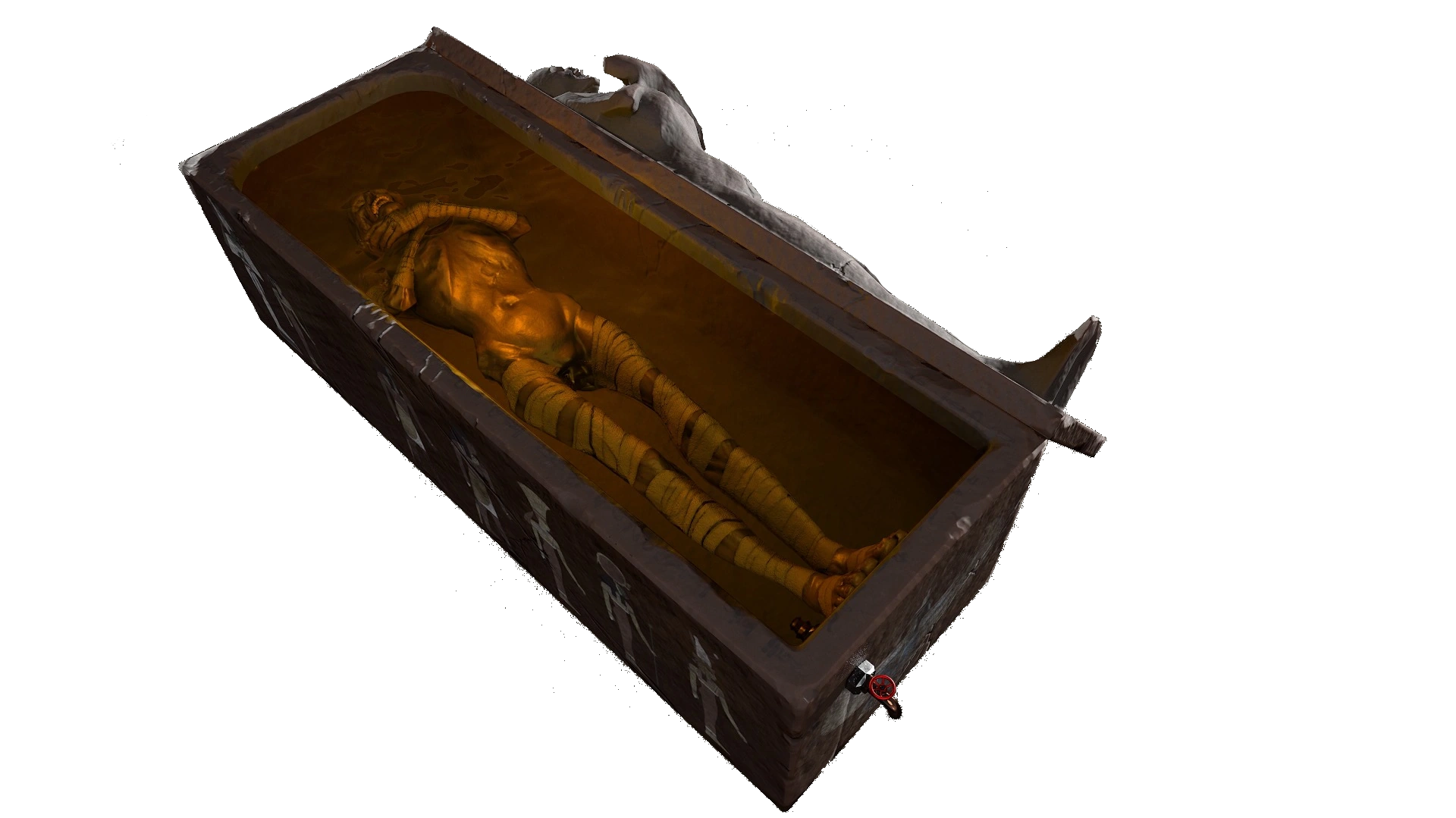
SCP-1176 is the mummified corpse of a 35-year-old human male that continuously produces anomalous honey-like secretions despite being deceased. Acquired by the Foundation in 1985 from a Manna Charitable Foundation facility in Eritrea, this object represents an impossible intersection of ancient mellification practices and biochemical anomalies that violate fundamental laws of thermodynamics.
The 1985 Asmara Raid: How the Foundation Acquired the Mellified Man
The Foundation’s acquisition of SCP-1176 occurred during a covert operation in Asmara, Eritrea—then part of Ethiopia—targeting a facility operated by the Manna Charitable Foundation. In 1985, the region was embroiled in the Eritrean War of Independence, providing cover for Foundation intelligence operations. The Manna Charitable Foundation, a Group of Interest known for distributing anomalous food items under the guise of humanitarian aid, had been using the political instability to operate with minimal oversight.
Foundation intelligence had tracked unusual procurement patterns: industrial quantities of preservation materials, climate-controlled storage units, and reports of “miraculous healing substances” being distributed to local populations. The raid revealed SCP-1176 housed in a temperature-controlled chamber, surrounded by collection apparatus designed to harvest its secretions. Documents recovered from the site indicated the Manna Charitable Foundation believed they possessed a genuine mellified man—a legendary medicinal substance from ancient traditions—and were preparing to distribute its secretions as a panacea.
The geopolitical chaos of mid-1980s Ethiopia allowed the Foundation to extract the object without significant international incident. The Manna Charitable Foundation’s operatives were administered Class-B amnestics, and the facility was sanitized. Cover story protocols attributed the raid to Ethiopian government forces targeting rebel supply lines.
The Ancient Art of Mellification: Historical Context
Mellification—the practice of preserving human corpses in honey—appears in historical texts from medieval China and the Middle East, though its actual practice remains disputed by mainstream historians. According to 16th-century Chinese medical texts, elderly volunteers would consume only honey for months before death, effectively preserving their bodies from within. After death, the corpse would be immersed in honey for decades or even a century, creating a confection called “mellified man” believed to possess extraordinary healing properties.
The practice connects to broader human fascination with preservation and the medicinal use of human remains. Ancient Egyptian mummification, Tibetan self-mummification practices by Buddhist monks, and European pharmaceutical use of “mummy powder” all reflect similar cultural beliefs: that preserved human tissue could transfer vitality or cure disease.
SCP-1176 represents either an authentic example of this practice or an anomalous object deliberately created to mimic the legendary substance. The corpse’s estimated age at death (35 years) and physical condition suggest Middle Eastern or North African origin, consistent with historical accounts placing mellification practices in these regions. However, the continuous production of secretions elevates this beyond any documented historical practice into the realm of the genuinely anomalous.
Anatomical Analysis: The Corpse and Its Properties
SCP-1176 presents as a remarkably well-preserved mummified corpse measuring approximately 170 centimeters in length. The preservation quality exceeds natural mummification or even modern embalming techniques. Tissue samples reveal cellular structures that, while desiccated, maintain unusual integrity. The skin has taken on an amber translucency, similar to organisms preserved in tree resin, with visible subcutaneous structures.
The corpse’s internal organs, examined via non-invasive imaging, show complete preservation despite the absence of traditional mummification procedures like evisceration. Most anomalously, certain glandular tissues—particularly those associated with the endocrine system—display activity signatures impossible in deceased tissue. Thermal imaging reveals localized temperature variations suggesting ongoing biochemical processes.
The secretion emerges from pores across the entire body surface, accumulating at a rate of approximately 50-75 milliliters per day. This fluid possesses a viscosity and appearance nearly identical to natural honey, with a distinctive amber coloration and sweet, floral aroma. Chemical analysis reveals a complex mixture of sugars, proteins, and unidentified organic compounds that resist standard spectrographic analysis.
What makes SCP-1176 truly anomalous is the thermodynamic impossibility of its function. The corpse produces matter and energy without any apparent input. It consumes no nutrients, requires no oxygen, yet continuously generates a complex organic substance. This violates conservation of mass-energy, placing SCP-1176 in a category of objects that fundamentally challenge our understanding of physics.
The Secretion Phenomenon: Biochemistry of the Impossible
The fluid produced by SCP-1176 defies conventional biochemical analysis. Standard tests identify glucose, fructose, and various enzymes consistent with natural honey, but approximately 15-20% of the substance’s composition remains unidentifiable using current analytical methods. This unknown fraction appears to be responsible for the secretion’s anomalous properties.
When consumed by human subjects, the secretion produces mild euphoric effects and temporary enhancement of immune response. Test subjects report improved well-being, accelerated healing of minor wounds, and increased energy levels lasting 24-48 hours. However, these effects show diminishing returns with repeated exposure, and no permanent health benefits have been documented. This contradicts the legendary properties attributed to mellified man in historical texts, which claimed miraculous curative powers.
The production mechanism represents the core anomaly. Deceased tissue cannot perform metabolic functions. The absence of cellular respiration, ATP synthesis, or any conventional energy source makes the continuous production of complex organic molecules impossible under known biological principles. Researchers theorize several possibilities:
The corpse may function as a conduit for extra-dimensional matter transfer, with the secretion originating from an unknown source and merely passing through SCP-1176’s physical form. Alternatively, the object may operate on principles of thaumaturgic biology, where ritual preparation before death created a self-sustaining anomalous system. Some researchers propose the corpse exists in a state of “biological stasis”—neither truly alive nor completely dead—maintained by unknown forces.
Comparative analysis with other regenerative SCPs reveals interesting parallels. Like SCP-500 (the panacea pills) or SCP-006 (the fountain of youth), SCP-1176 produces substances with beneficial biological effects. However, unlike those objects, SCP-1176’s output is continuous and seemingly inexhaustible, suggesting a different underlying mechanism.
Containment Philosophy: Why These Specific Procedures?
SCP-1176 is classified as Safe, reflecting the Foundation’s object classification system: Safe objects are anomalies that can be reliably contained with minimal resources and pose little threat if left alone. The mellified man requires only environmental controls and basic security, meeting these criteria despite its reality-defying properties.
Containment procedures mandate climate-controlled storage at 15-20°C with 40-50% humidity. These parameters prevent degradation of the corpse while maintaining secretion production at measurable rates. Temperature extremes could potentially damage the object or alter its anomalous properties in unpredictable ways. The humidity range prevents both desiccation and mold growth, preserving the corpse’s current state indefinitely.
The requirement for weekly collection of secretions serves multiple purposes. First, it prevents accumulation that could attract pests or create sanitation issues. Second, it provides ongoing samples for research into the secretion’s properties and potential applications. Third, regular monitoring ensures any changes in production rate or composition are immediately detected, potentially indicating containment failure or evolution of the anomaly.
Access restrictions limiting experimentation to Level 3 personnel with approval reflect the object’s value and the ethical considerations surrounding human remains. While SCP-1176 poses minimal direct threat, its nature as a preserved human corpse requires respectful handling consistent with Foundation ethics guidelines. The approval requirement prevents frivolous testing while allowing legitimate research.
Containment breach scenarios for SCP-1176 are low-risk but not negligible. If exposed to the public, the object could trigger widespread interest in mellification practices, potentially leading to copycat attempts or black market trade in supposed “mellified men.” The Manna Charitable Foundation’s previous possession demonstrates that Groups of Interest recognize the object’s value. Reacquisition protocols focus on rapid response and information suppression rather than combat containment.
Cross-Reference: SCP-1176 and the Foundation’s Collection of Preserved Humans
SCP-1176 belongs to a broader category of anomalous human remains within Foundation custody. These objects share common themes: preservation beyond natural limits, post-mortem anomalous activity, and connections to historical or cultural practices.
SCP-2852 involves a phenomenon affecting human corpses during specific circumstances, creating animated remains with altered properties. While SCP-2852 focuses on reanimation, both it and SCP-1176 demonstrate that death does not necessarily terminate anomalous processes in human tissue.
Objects involving mummification practices appear throughout Foundation records. Several SCPs reference ancient Egyptian preservation techniques that successfully captured or created anomalous properties. SCP-1176’s connection to mellification represents a parallel tradition—different cultural context, similar goal of transcending death through preservation.
The Foundation’s collection also includes numerous objects that produce substances from impossible sources. SCP-294 (the coffee machine) generates any requested liquid, while SCP-261 (the vending machine) produces food items that shouldn’t exist. SCP-1176 differs in being biological rather than mechanical, suggesting organic matter can serve as a conduit for anomalous production just as effectively as manufactured devices.
Thematically, SCP-1176 raises questions about the boundary between life and death. Is the mellified man truly deceased, or does it exist in some intermediate state? Does consciousness persist in any form, or is the body merely an anomalous object that happens to be human-shaped? These philosophical questions connect SCP-1176 to broader Foundation research into consciousness, death, and the nature of human existence.
Frequently Asked Questions
What happens if you consume SCP-1176’s secretions?
Consumption produces mild euphoric effects, temporary immune system enhancement, and improved healing of minor injuries lasting 24-48 hours. However, the effects diminish with repeated exposure, and no permanent health benefits occur. The secretion is not addictive but shows reduced efficacy over time, making it unsuitable as a long-term medical treatment.
Is SCP-1176 actually a historical mellified man or an anomalous creation?
The Foundation has not definitively determined SCP-1176’s origin. The corpse’s physical characteristics and preservation method align with historical descriptions of mellification, suggesting it may be an authentic example of the practice. However, the continuous production of secretions represents an anomalous property not described in historical texts, indicating either the legends were incomplete or the object was deliberately created with enhanced properties.
Why doesn’t the Foundation use SCP-1176’s secretions for medical purposes?
While the secretions show beneficial effects, they are not sufficiently powerful or reliable to justify widespread use. The temporary nature of benefits, diminishing returns with repeated exposure, and limited production rate (50-75ml daily) make SCP-1176 impractical as a medical resource. Additionally, Foundation ethics protocols restrict the exploitation of human remains, even anomalous ones, except for critical research purposes.
Could SCP-1176’s preservation method be replicated?
Foundation researchers have attempted to understand and replicate the mellification process without success. The anomalous properties appear intrinsic to this specific object rather than reproducible through technique alone. Whether this reflects unique circumstances of SCP-1176’s creation, individual biological factors, or unknown ritual components remains unclear. Any attempt to create additional mellified men would require extensive research and likely involve thaumaturgic or reality-bending procedures beyond current Foundation capabilities.
What was the Manna Charitable Foundation planning to do with SCP-1176?
Recovered documents indicate the Manna Charitable Foundation intended to harvest and distribute SCP-1176’s secretions as a healing substance to populations in need. While superficially altruistic, this plan ignored the secretion’s limited efficacy and the ethical implications of exploiting human remains. The Foundation’s intervention prevented potential exposure of anomalous materials to civilian populations and the humanitarian crisis that could result from distributing a substance with diminishing medical benefits marketed as a miracle cure.