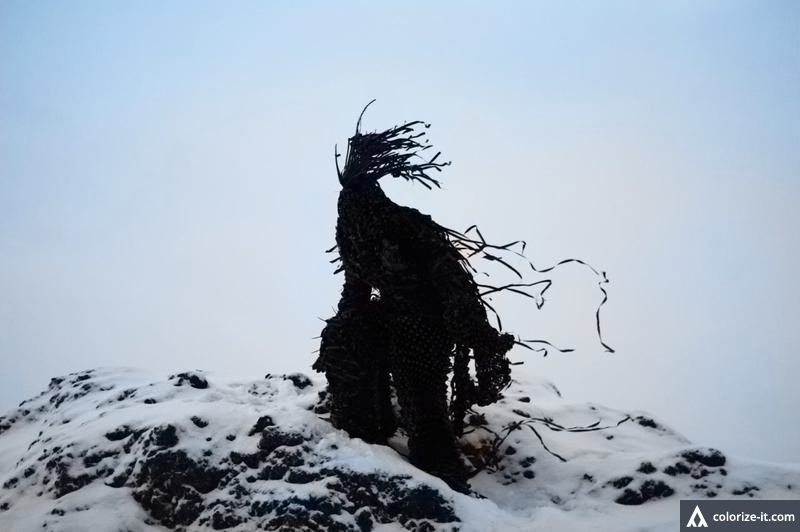
SCP-2521 is a Keter-class anomaly that abducts anyone or anything containing information about it expressed in words or speech. Standing roughly twice human height and composed entirely of black ribbon-like tendrils, this entity represents a unique cognitive threat: it cannot be safely documented through traditional text or verbal communication, forcing the Foundation to describe it entirely through pictograms and symbols.
The Pictogram Paradox: Why This File Breaks Protocol
The SCP-2521 documentation stands as one of the Foundation’s most unusual files—it contains no written words. Every detail about the entity’s appearance, behavior, and containment procedures exists only as simple drawings, symbols, and visual diagrams. This isn’t an artistic choice or security theater. It’s a survival necessity.
The entity demonstrates an immediate attraction response to information about itself when that information takes linguistic form. Write its designation on paper, and the document vanishes. Speak about it aloud, and you disappear. The pictographic documentation represents the Foundation’s solution to an impossible problem: how do you contain something that hunts its own description?
This creates a recursive containment challenge. Personnel must understand the threat without being able to discuss it normally. Training requires visual aids and careful demonstration. Even internal memos must avoid direct reference. The entity has effectively weaponized information itself, turning documentation—the Foundation’s primary tool—into a liability.
The Entity Itself: Anatomy of a Living Infohazard
Based on pictographic evidence and survivor accounts (communicated through drawings), SCP-2521 appears as a humanoid figure approximately 3-4 meters tall. Its body consists entirely of black, ribbon-like appendages that flow and writhe constantly, creating an appearance similar to animated shadows or living ink. These tendrils don’t reflect light normally, giving the entity an almost two-dimensional quality despite its physical presence.
The creature exhibits behavior patterns suggesting intelligence and purpose. It doesn’t wander randomly or attack indiscriminately. Instead, it manifests specifically in response to linguistic information about itself. The more detailed the description, the faster the response. A casual mention might take minutes to trigger manifestation. A detailed written report can summon it almost instantaneously.
Witnesses describe the entity as moving with unsettling fluidity, its ribbon-body allowing it to navigate spaces in ways solid creatures cannot. It doesn’t communicate through sound or gesture. Its only observable motivation appears to be collecting—or perhaps protecting—information about its own nature.
Containment Through Silence: The Impossible Protocol
Traditional SCP containment relies on documentation, communication, and institutional knowledge. SCP-2521 makes all three dangerous. The containment protocol exists as a series of pictograms showing what personnel must not do: no writing, no speaking, no digital text. The entity has created its own containment through its nature—it cannot be safely contained because containment requires the very thing that summons it.
Foundation personnel assigned to SCP-2521 undergo specialized training using only visual materials. They learn to recognize the entity through drawings. They practice emergency procedures through pantomime. They communicate about it using improvised sign language and sketches. This creates operational inefficiencies that would be unacceptable for any other anomaly, but the alternative is losing personnel and documentation.
The containment site itself requires minimal physical security because the entity doesn’t breach containment in traditional ways. It doesn’t need to. It exists in a state of quantum containment—simultaneously contained and uncontainable. Any attempt to improve containment through written procedures summons the very thing being contained.
The Information Abduction Phenomenon
When SCP-2521 manifests in response to linguistic information, it doesn’t attack or destroy. It takes. Documents containing written information about the entity vanish completely, often along with the surfaces they were written on. Digital files disappear from servers. Individuals who speak about it are physically removed from the location, taken by the entity to an unknown destination.
The fate of abducted individuals remains unclear. They don’t return. They leave no trace. The entity appears to collect them along with the information they possessed. Some researchers theorize it maintains a repository of stolen knowledge, perhaps existing in a pocket dimension where it hoards everything related to its nature. Others suggest the abducted become part of the entity itself, absorbed into its ribbon-body.
Objects taken by SCP-2521 show a pattern: the entity prioritizes information density. A single word written on paper might only result in the paper’s disappearance. A detailed file causes the entire filing cabinet to vanish. A person speaking extensively about the entity gets taken immediately, while someone who mentions it briefly might have seconds to stop talking before manifestation occurs.
This selective response suggests the entity doesn’t simply react to its designation being invoked. It responds proportionally to the amount of linguistic information being created about it. The mechanism remains unknown, but the effect is consistent: more words equal faster, more aggressive response.
Meta-Narrative Analysis: The SCP That Knows It’s Fiction
SCP-2521 occupies a unique position in Foundation lore as an anomaly that directly challenges the format of SCP documentation itself. Most SCPs exist within the fiction as objects to be documented. SCP-2521 exists as a critique of documentation. It’s an entity that cannot exist in the medium through which we learn about it.
This creates a fascinating paradox for readers. We know about SCP-2521 because we can read its pictographic file. But within the fiction, that file represents a failure of the Foundation’s primary methodology. The entity has won by forcing the Foundation to abandon its own protocols. It cannot be studied, cannot be fully understood, cannot be safely discussed by the people tasked with containing it.
The meta-textual implications extend further. SCP-2521 represents information that resists being information. It’s a concept that destroys attempts to conceptualize it. In a database built on detailed clinical documentation, it exists as a void—a space where words should be but cannot exist. This makes it one of the most philosophically interesting anomalies in the Foundation’s catalog.
Some fans interpret SCP-2521 as a commentary on the limits of knowledge and the danger of obsessive documentation. Others see it as a playful subversion of SCP format conventions. Both readings work because the entity operates on multiple levels simultaneously: as a fictional monster, as a narrative device, and as a thought experiment about information theory.
Thematic FAQ
What happens if you write about SCP-2521?
The entity manifests and takes the written material, often along with the medium it was written on. If the information is extensive or detailed, it may also take the person who wrote it. Digital text triggers the same response, causing files to vanish from computer systems.
Can you survive an encounter with SCP-2521?
Survival depends on immediately stopping all linguistic communication about the entity. If you realize you’re speaking or writing about it and stop before providing detailed information, manifestation may be delayed or prevented. Once the entity fully manifests and approaches, no successful escape has been documented.
Why doesn’t the pictogram file summon SCP-2521?
The entity responds specifically to linguistic information—words, speech, and text. Visual representations like drawings and symbols don’t trigger the attraction response. This suggests the anomaly targets semantic content rather than information in general, though the exact mechanism remains unknown.
Is SCP-2521 evil or malicious?
The entity shows no signs of malice or aggression beyond its collection behavior. It doesn’t harm people before taking them. It doesn’t destroy for destruction’s sake. Its actions appear motivated by an imperative to gather or protect information about itself rather than by hostility toward humans.
Where do people taken by SCP-2521 go?
Unknown. No one taken by the entity has returned or been recovered. The destination could be a separate dimension, a physical location unknown to the Foundation, or something more abstract. Some theories suggest the taken individuals become part of the entity’s information collection, preserved in some form within its ribbon-body.